
Modern vehicles expose silicone components to aggressive fluids, including fuels, oils, coolants and cleaning agents, that can degrade standard elastomers. Automotive applications therefore require silicone formulations engineered for chemical resistance in demanding environments.
What Automotive Fluid Exposure Challenges Do Silicone Components Face?
Under-Hood Conditions Combine Heat, Vibration and Multiple Fluids
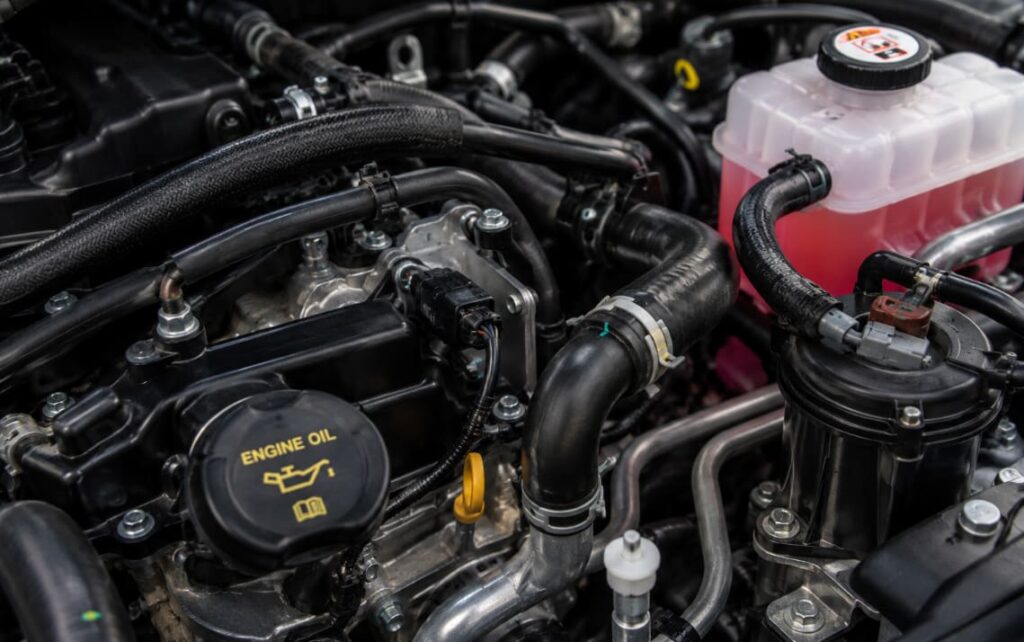
Engine compartments present harsh operating conditions:
- Temperature extremes: Components near engines may experience temperatures from -40°C during cold starts to +150°C during operation. Thermal cycling can accelerate fluid absorption and extraction.
- Vibration and stress: Engine mounts, seals and gaskets experience continual movement, so materials must retain seal force after fluid exposure.
- Fluid variety: Coolants, engine oils, transmission fluids and power-steering fluids each have different chemical compositions that affect silicone differently.
Fuel-System Exposure Creates Additional Risks
Modern fuels present particular material-selection challenges:
- Ethanol blends: E10, E15 and higher-ethanol fuels can cause standard silicone to swell. Ethanol can penetrate polymer networks, extract plasticisers and contribute to hardening over time.
- Biodiesel blends: B20 and higher biodiesel blends can accelerate degradation because fatty acid methyl esters penetrate silicone more readily than petroleum diesel.
- Alternative fuels: Electric-vehicle coolant fluids, hydrogen fuel-cell sealing environments and compressed natural gas (CNG) create different challenges from conventional fuels.1
How Does Silicone Resist Automotive Chemicals?
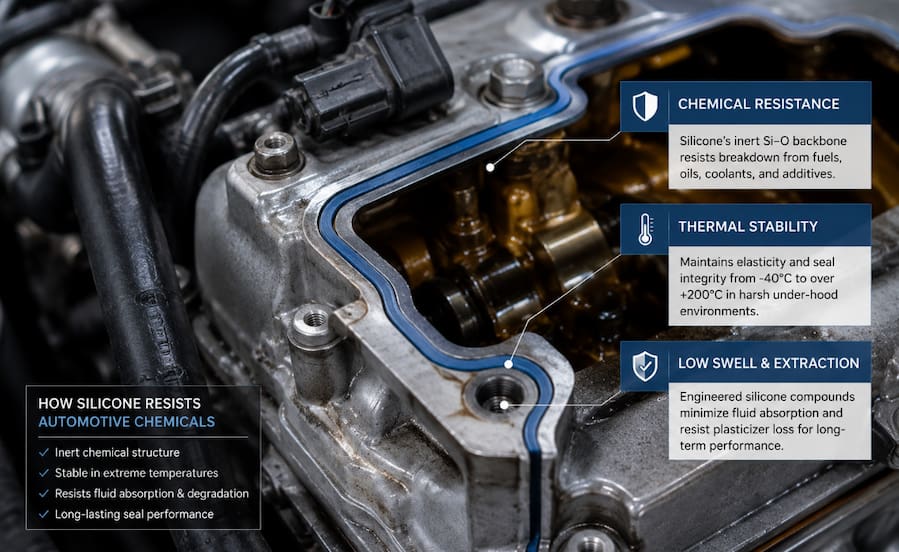
Fluid Absorption and Extraction Drive Property Changes
When silicone contacts automotive fluids, two processes can occur simultaneously:
- Absorption: Fluid molecules penetrate the polymer network and cause swelling. The degree of swelling depends on fluid polarity, temperature and silicone formulation.
- Extraction: Plasticisers, unreacted compounds and low-molecular-weight polymer fractions dissolve into the fluid, potentially causing hardening and weight loss.
The balance between absorption and extraction determines the overall property change. Some fluids mainly cause swelling, while others mainly cause extraction. Many cause both.
Material Selection Determines Chemical Resistance
- Fluorosilicone (FVMQ): A leading option for hydrocarbon resistance. Fluorinated side groups improve resistance to fuels and oils, reducing swelling compared with standard silicone.
- Fluorocarbon (FKM): Offers strong resistance to petroleum oils and fuels, although poorer low-temperature flexibility can limit its suitability in some automotive applications.
- Specialty silicones: Custom formulations can improve fluid resistance through modified polymer structures, cross-link density and additive packages.
For components exposed to fuels, oils and solvents, the silicone cross-linking system also affects long-term fluid resistance, mechanical properties and seal performance.
How Do Silicone Types Perform in Specific Automotive Fluids?
The following figures are indicative results from GoFlexion internal automotive fluid compatibility studies. Actual performance should always be verified against the specified fluid blend, temperature and exposure duration.
Engine Oils
| Silicone Type | SAE 30 Oil @ 150°C | Synthetic 5W-30 @ 150°C |
| Standard VMQ | +8% volume swell | +6% volume swell |
| FVMQ | +3% volume swell | +2% volume swell |
| High-fluorine FVMQ | +1.5% volume swell | +1% volume swell |
Standard silicone can handle mineral and synthetic engine oils at temperatures up to 150°C. Above this range, specialised compounds may be required.
Coolants
| Silicone Type | Ethylene Glycol @ 120°C | Propylene Glycol @ 120°C |
| Standard VMQ | +5% volume swell | +4% volume swell |
| FVMQ | +2% volume swell | +1.5% volume swell |
Coolant resistance is generally good for standard silicone and fluorosilicone. Propylene glycol-based coolants, often used in food-grade applications, may cause less swelling than ethylene glycol formulations.
Fuels
| Silicone Type | Gasoline (E0) | Gasoline (E15) | Diesel (B20) |
| Standard VMQ | +25% swell | +35% swell | +20% swell |
| FVMQ | +8% swell | +12% swell | +6% swell |
| High-fluorine FVMQ | +4% swell | +6% swell | +3% swell |
Standard silicone is not recommended for fuel contact. FVMQ performs more reliably in gasoline and diesel applications, while high-fluorine FVMQ is better suited to continuous fuel immersion.
Brake Fluids
| Silicone Type | DOT 3 @ 120°C | DOT 4 @ 150°C | DOT 5.1 @ 180°C |
| Standard VMQ | +15% swell | +25% swell | Fail (degradation) |
| FVMQ | +5% swell | +8% swell | +15% swell |
| Special brake-grade | +3% swell | +5% swell | +10% swell |
Brake-fluid compatibility becomes especially important at elevated temperatures. Standard silicone can degrade rapidly above 150°C during brake-fluid exposure, making FVMQ or specialist compounds necessary for brake-system seals.
Which Silicone Formulation Is Best for Each Automotive Application?
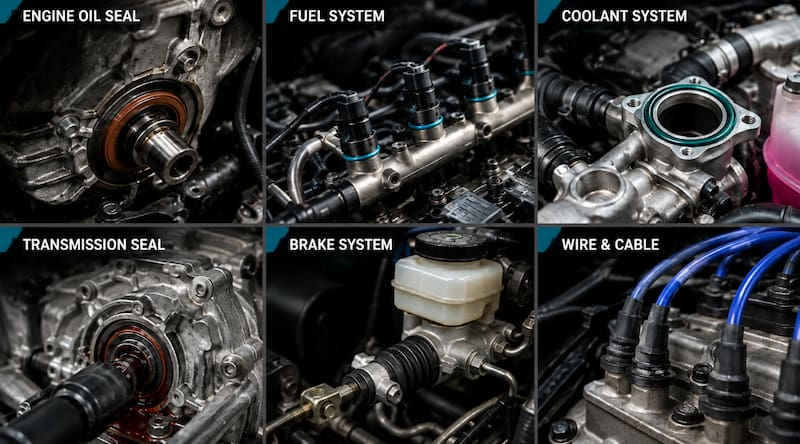
Engine Oil Seals
Recommended: Standard VMQ for conventional oils and FVMQ for synthetic oils at elevated temperatures.
Typical compounds: 50–70 Shore A hardness, using oil-resistant grades with proven field performance.
Design considerations: Maintain adequate gland compression of 15–25% to retain seal force after fluid absorption, while accounting for thermal expansion.
Fuel-System Components
Recommended: FVMQ for fuel contact. High-fluorine grades are preferable for continuous-immersion applications, including fuel sender and pump seals.
Not recommended: Standard VMQ for fuel contact because swelling can lead to seal failure and leakage.
Testing: Fuel-system components should undergo fluid-immersion testing at the maximum operating temperature to confirm dimensional stability.
Coolant-System Seals
Recommended: Standard VMQ is suitable for many coolant applications. FVMQ may be preferable for hybrid-vehicle coolant systems with greater chemical complexity.
Temperature consideration: Coolant-system temperatures can range from -40°C to +130°C, so low-temperature flexibility remains important for cold-start reliability.
Transmission Seals
Recommended: FVMQ for automatic transmission fluid contact. ATF contains additive packages that can challenge standard silicone.
Testing: Extended fluid-immersion testing of 1,000 hours or more can help simulate transmission service-life requirements.
Brake-System Seals
Critical requirement: Use specialist brake-grade silicone formulations designed for the relevant DOT specification.
Temperature: Brake systems can reach +180°C during hard braking. Standard silicone may fail, while specialist compounds are designed to retain their properties.
Performance: Compression-set resistance is essential because seals must maintain force after prolonged high-temperature exposure.
How Can Silicone Formulations Achieve Better Chemical Resistance?
Filler Optimisation Reduces Fluid Penetration
Reinforcing fillers: Treated fumed silica can improve fluid resistance by reducing polymer free volume. Surface-treatment chemistry also affects barrier performance.
Fill loading: Higher filler content reduces polymer exposure to fluids and can decrease absorption. However, excessive filler raises viscosity and may affect processing.
Polymer Modification Improves Resistance to Hydrocarbons
Fluorine content: Higher fluorine content in FVMQ improves hydrocarbon resistance, although it can increase cost and alter processing behaviour.
Vinyl content: Modified vinyl-functional siloxanes can improve cross-link density and reduce fluid penetration rates.
Additive Packages Support Long-Term Stability
Antioxidants: Heat stabilisers help protect against oxidative degradation during fluid exposure.
Plasticiser stabilisation: Lower plasticiser content can reduce extraction concerns.
Surface treatments: Some additives migrate to the surface and create a fluid-resistant barrier.
How Should Automotive Silicone Be Tested for Fluid Resistance?

Automotive Fluid-Immersion Testing
Standard protocols: ASTM D471 measures the effect of liquids on rubber properties, including volume and physical-property changes.2
Test conditions: Typical protocols involve 70 hours at the maximum operating temperature, with measurements taken before and after exposure.
Acceptance criteria: Common targets include volume swell below 15%, hardness change below 10 Shore A and tensile retention above 70%, although final requirements should match the application and customer specification.
Development Testing Protocol
| Test | Duration | Temperature | Measurement |
| Initial properties | – | – | Hardness, tensile, elongation |
| Fluid immersion | 70 hr | Maximum operating temperature | Volume change, hardness |
| Extended immersion | 500 hr | Maximum operating temperature | Property retention |
| Thermal cycling | 100 cycles | -40°C to maximum operating temperature | Seal function |
| Age simulation | 1,000 hr | Elevated temperature | Long-term stability |
Customer Specifications Often Require Additional Validation
Many automotive OEMs use fluid-resistance specifications that extend beyond standard testing. Typical additional requirements include:
- Specific OEM fluid blends
- Extended exposure durations
- Performance after environmental exposure
- Particle-contamination resistance
Conclusion
Selecting silicone for automotive chemical exposure requires more than matching a material to a temperature range. Fluids, exposure time, thermal cycling, seal design and mechanical loading can all affect long-term performance. Standard VMQ may be suitable for coolant and engine-oil applications, while Fluorosilicone is typically the stronger choice for fuel, transmission-fluid and more chemically demanding environments.
At Flexion, we help automotive manufacturers develop silicone compounds that match real operating conditions, from fluid compatibility and compression-set requirements to testing and production documentation. By selecting and validating the right formulation early, engineers can reduce seal failures and support reliable performance throughout the life of the vehicle.
Frequently Asked Questions
What Silicone Type Resists Automotive Fuels?
Fluorosilicone (FVMQ) provides strong resistance to automotive fuels, including gasoline, diesel and ethanol blends. Standard silicone can swell excessively during fuel exposure and is generally unsuitable for fuel-contact applications.
How Do Ethanol Blends Affect Silicone?
Ethanol can penetrate silicone more readily than petroleum hydrocarbons, causing increased swelling and possible extraction of plasticisers. Standard silicone may experience 30–40% volume swell in E15 fuel, while FVMQ can reduce this to approximately 10–15%.
Can Silicone Handle Biodiesel Exposure?
Standard silicone is not recommended for biodiesel exposure at B20 or higher. FVMQ can provide better performance, while higher-fluorine grades may offer additional resistance. Testing with the actual fuel blend remains important.
What Testing Verifies Automotive Fluid Resistance?
ASTM D471 testing measures volume change after 70 hours at the maximum operating temperature. Extended testing of 500 hours or more can help assess long-term stability, while customer-specific protocols may require further validation.
Why Do Brake-System Seals Require Special Silicone?
DOT 3, DOT 4 and DOT 5.1 brake fluids can degrade standard silicone at elevated temperatures above +150°C. Specialist brake-grade formulations are designed to limit fluid swelling and maintain compression-set performance through thermal cycling.