
Every smartphone chip, solar panel and silicone seal traces part of its supply chain back to silica. Before silicon can be used in electronics, aluminium alloys or silicone chemistry, it must be extracted from quartz-rich raw materials through an energy-intensive smelting process.
The industrial route from silica sand to silicon metal relies on carbothermic reduction in a submerged-arc furnace. This process uses carbon, electricity and carefully selected quartzite to convert silicon dioxide, SiO₂, into metallurgical-grade silicon.
For silicone manufacturers, silicon extraction is the first upstream stage in a longer material chain. Silicon metal is later converted into organosilicon intermediates, silicone polymers and finished elastomer compounds. However, the extraction process itself remains fundamentally about producing high-quality silicon metal.
Why Must Silicon Be Extracted From Silica Sand?
Silicon is the second most abundant element in the Earth’s crust, but it is rarely found as pure elemental silicon. It is usually chemically bonded to oxygen as silica, SiO₂, or contained within silicate minerals.
That strong chemical bond is why silicon must be extracted through high-temperature reduction rather than simply separated from ordinary sand.
Silicon Occurs Naturally as Silica and Silicates
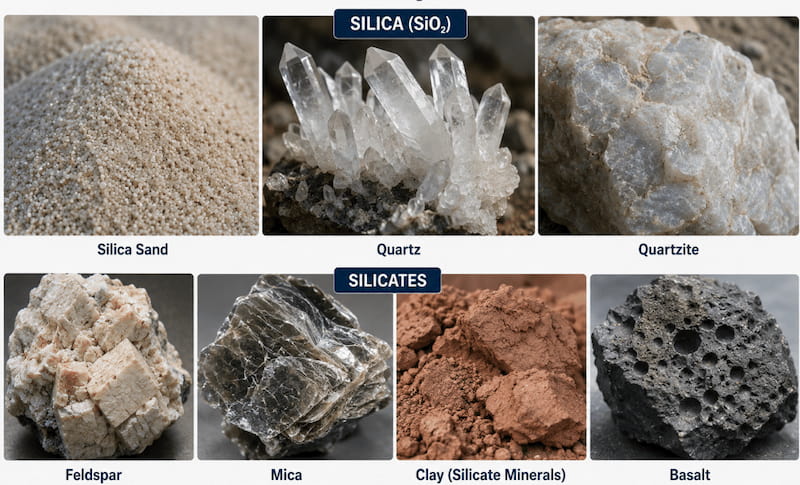
Silicon has a strong affinity for oxygen. As a result, it is commonly found in quartz, sandstone, quartzite, feldspar and other silicate minerals.
Quartz is crystalline silicon dioxide, SiO₂. Quartzite, vein quartz and selected high-purity silica materials are commonly used for silicon production because they offer a more consistent composition than ordinary river or beach sand.
Industrial Quartzite Must Meet Strict Purity Requirements
Not all silica-rich material is suitable for industrial silicon extraction. Beach sand often contains moisture, iron oxides, feldspar, mica, clay and other minerals that can disrupt furnace performance or introduce impurities into the silicon.
Industrial feedstock is selected for:
- High SiO₂ content
- Low levels of iron, aluminium, boron and phosphorus
- Consistent particle size
- Controlled moisture content
- Stable behaviour under high furnace temperatures
The quartzite is typically crushed, washed and screened before entering the furnace. Some applications may require additional treatment before smelting, especially where downstream purity requirements are stricter.
What Is the Core Reaction Used to Extract Silicon?
The main industrial method for producing silicon metal is carbothermic reduction. This process reduces silica using carbon at high temperatures inside a submerged-arc furnace.
The simplified overall reaction is:
SiO₂ + 2C → Si + 2CO
This equation shows silicon dioxide reacting with carbon to form silicon metal and carbon monoxide. In practice, the furnace reactions are more complex and involve several intermediate compounds.
Silicon Carbide Forms During Reduction
At high temperatures, silica reacts with carbon to form silicon carbide, SiC:
SiO₂ + 3C → SiC + 2CO
Silicon carbide is an important intermediate in the furnace. It helps drive further reactions that convert silica into silicon-bearing gases and eventually molten silicon.
Silicon Monoxide Supports Further Silicon Formation
Another important intermediate is silicon monoxide, SiO. A simplified reaction route is:
SiC + 2SiO₂ → 3SiO + CO
The silicon monoxide gas moves through the furnace charge and can react further with carbon:
SiO + C → Si + CO
These reactions occur simultaneously across different furnace zones. The actual reaction pathway depends on temperature, charge permeability, carbon quality, furnace design and operating stability.
Why Does Silicon Extraction Require So Much Energy?
Breaking the silicon-oxygen bond requires extreme heat. The carbothermic reaction is strongly endothermic, meaning it needs substantial electrical energy to proceed at industrial scale.
Technical reviews of commercial silicon production commonly place electricity use at roughly 10–13 MWh per tonne of silicon, although actual consumption varies by feedstock quality, furnace design, electricity source and operating conditions.1
This energy intensity makes electricity availability one of the most important factors in silicon production. It also affects the wider supply chain for products that use silicon metal, including aluminium alloys, photovoltaic materials and silicone intermediates.
How Does a Submerged-Arc Furnace Extract Silicon?
The submerged-arc furnace is the main piece of equipment used to produce metallurgical-grade silicon. It combines electrical resistance heating, electric arcs and a controlled charge mix to maintain the high temperatures needed for reduction.

The Furnace Shell, Electrodes and Charge Mix Work Together
A modern silicon furnace includes:
- A steel shell lined with carbon or graphite refractory material
- Three large electrodes arranged around the furnace centre
- A charge mix of quartzite, carbon reductants and permeability aids
- A molten silicon pool at the base of the furnace
- A tapping system for removing liquid silicon
- An off-gas system for handling carbon monoxide and silica fume
The charge mix usually includes quartzite with carbon sources such as coal, petroleum coke, charcoal or wood chips. The exact blend depends on raw-material quality, furnace design and the required silicon grade.
Three-Phase AC Supports Stable Furnace Operation
Silicon furnaces commonly operate using three-phase alternating current. The three electrodes help distribute electrical load and heat through the furnace.
The electrical current passes through the furnace charge and molten material, creating the resistance and arc heating needed for carbothermic reduction. Modern facilities use controlled electrode positioning to help maintain stable electrical resistance and consistent furnace operation.
Furnace Temperature Changes by Zone
The temperature inside a silicon furnace varies significantly from top to bottom.
| Furnace Zone | Typical Temperature | Main Activity |
| Top charge | 200–800 °C | Drying and preheating |
| Upper reaction zone | 800–1,500 °C | Gas movement and partial reduction |
| Arc zone | 1,800–2,500 °C | Silicon carbide formation and intensive reduction |
| Molten silicon pool | 1,500–1,800 °C | Silicon collection and settling |
| Tap-hole zone | 1,400–1,600 °C | Silicon flow during tapping |
| Off-gas zone | 300–1,200 °C | Gas cooling and silica fume formation |
The hottest area is usually beneath the electrodes, where local temperatures can exceed 2,000 °C. The molten silicon pool remains above silicon’s melting point of approximately 1,414 °C.
What Are the Steps in Industrial Silicon Extraction?
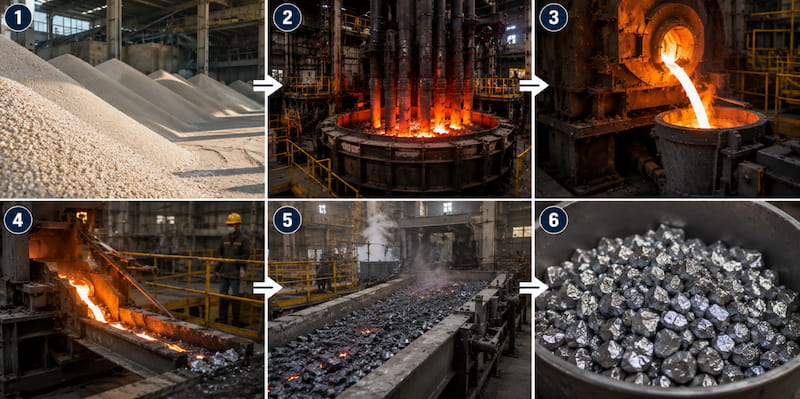
Step 1: Prepare the Quartzite and Carbon Sources
Quartzite is mined, crushed, washed and screened into a consistent furnace feed. Carbon sources are dried and sized before blending with the silica material.
The charge mix must balance silica content, fixed carbon, ash levels, gas permeability and furnace operating requirements.
Step 2: Heat the Furnace to Operating Temperature
A cold furnace is brought up to temperature gradually. Electrode current is increased in a controlled manner while starter materials are introduced.
Once the furnace reaches a stable operating condition, the normal quartzite and carbon charge can be fed continuously.
Step 3: Smelt the Charge Continuously
The charge enters from the top of the furnace and descends through progressively hotter zones. Rising gases preheat the incoming material, while the lower furnace zones provide the heat required for reduction.
Molten silicon collects at the bottom of the furnace. Operators monitor electrode position, furnace resistance, charge movement and gas flow to maintain stable production.
Step 4: Tap and Cast the Molten Silicon
Molten silicon is removed through a tap hole at regular intervals. The liquid metal is collected in ladles or moulds before being cast into ingots, granulated or refined further.
Typical options include:
- Casting silicon into large ingots
- Producing smaller granules for chemical or alloy applications
- Refining the molten silicon before casting
Step 5: Control Impurities Through Refining
Silicon tapped from the furnace can contain iron, aluminium, calcium, titanium, carbon and trace elements. Controlled slag treatment and other refining methods can reduce selected impurities before casting.
Boron and phosphorus are particularly important because they are difficult to remove later. This is why feedstock quality remains critical from the beginning of the process.
Step 6: Crush, Size and Package the Silicon
After cooling, solid silicon is crushed and screened into standard size ranges. Large lumps may be used for alloying, while smaller fractions may be used in chemical processing or prepared for further purification.
According to the U.S. Geological Survey, silicon metal is used in aluminium alloying and chemical applications, particularly silicone production.2
For more detail on what happens after this stage, see Flexion’s guide to the quartz-to-silicone value chain.
What Inputs and Outputs Are Involved in Silicon Extraction?
The exact material balance varies by furnace, feedstock and operating conditions. However, a typical tonne of metallurgical-grade silicon requires significant quantities of quartzite, carbon reductants and electrical energy.
| Material or Output | Typical Amount per Tonne of Silicon |
| Quartzite | 2,500–2,800 kg |
| Carbon reductants | 600–800 kg |
| Electrode paste | 25–40 kg |
| Wood chips or permeability aids | 200–400 kg |
| Electrical energy | 10,000–14,000 kWh |
| Metallurgical-grade silicon | 1,000 kg |
| Slag | 50–150 kg |
| Collected silica fume | 100–300 kg |
The furnace also produces off-gas containing carbon monoxide and fine silica particles. Facilities capture silica fume through gas-cleaning systems, where it can become a valuable by-product for high-performance concrete and cement applications.
Why Are Submerged-Arc Furnaces Used for Silicon Production?
Submerged-arc furnaces remain the standard route for bulk silicon production because they can process quartz and carbon reductants directly at industrial scale.
Ferrosilicon Uses a Related Furnace Process
Silicon metal and ferrosilicon are both commonly produced in submerged-arc electric furnaces. The difference is in the charge composition and final product.
Silicon metal is produced with low iron content and is used in aluminium, chemical and silicone applications. Ferrosilicon contains a much higher percentage of iron and is mainly used as an alloying and deoxidising material in steel and cast iron production.
Gas-Phase Processes Are Used for Higher-Purity Silicon
Fluidised-bed and gas-phase processes are used later in the value chain to produce high-purity polysilicon for photovoltaic and semiconductor applications.
These technologies process silicon-containing gases rather than directly reducing quartzite. They do not replace the submerged-arc furnace for bulk metallurgical-grade silicon production.
Induction Furnaces Are Better Suited to Melting and Refining
Induction furnaces can melt silicon and support selected refining operations. However, they are not generally used for primary carbothermic reduction because they do not heat the porous silica-carbon charge in the same way as a submerged-arc furnace.
What Determines the Purity of Silicon Metal?
The purity of extracted silicon depends on several connected factors.
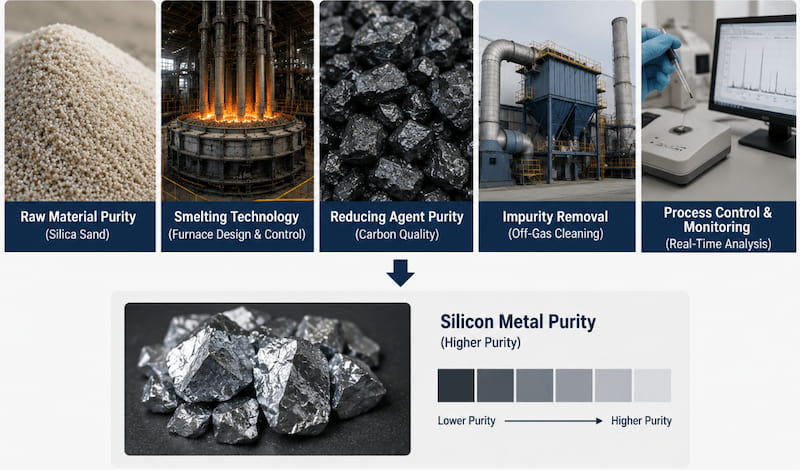
1. Quartzite Feedstock Quality
Iron, aluminium, boron and phosphorus in the quartzite can transfer into the silicon. Low-boron and low-phosphorus feedstock is particularly important for higher-purity downstream applications.
2. Carbon Reductant Selection
Coal, charcoal and petroleum coke have different ash and impurity profiles. Lower-ash reductants can reduce slag formation and help control contamination.
3. Furnace Stability
Stable electrode positioning, consistent charge movement and controlled tapping help produce more uniform silicon. Furnace instability can reduce yield and increase impurity pickup.
4. Ladle Refining
Post-tap refining can reduce selected metallic impurities. The refining method depends on the required silicon grade and downstream application.
5. Solidification and Segregation
Cooling rate affects how impurities are distributed through the silicon. Controlled solidification can support further upgrading where higher-purity silicon is required.
How Is Silicon Extraction Becoming Cleaner and More Efficient?
The underlying chemistry of carbothermic reduction has remained broadly consistent for decades. However, furnace controls, gas treatment, energy recovery and raw-material management continue to improve.
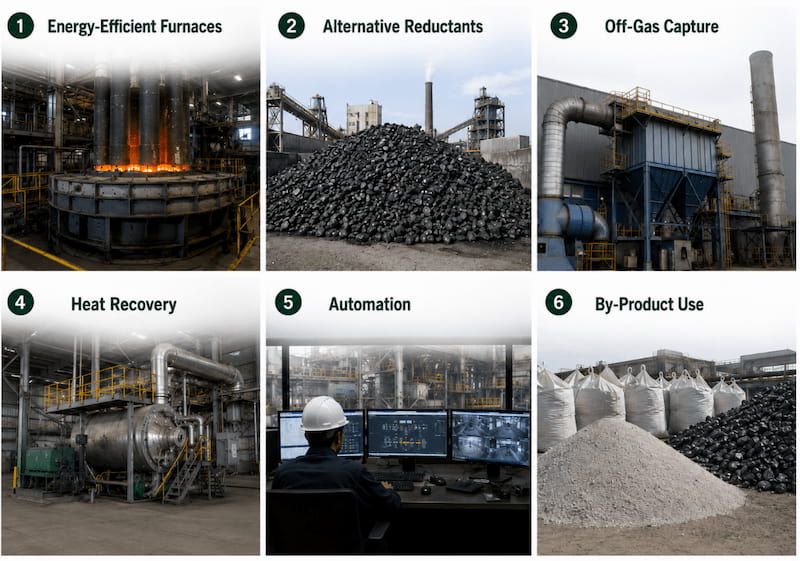
Lower-Carbon Electricity Can Reduce Production Emissions
Silicon furnaces are electricity-intensive, so the carbon intensity of local power supply has a major effect on the environmental footprint of silicon metal.
Lower-carbon electricity, improved energy recovery and more efficient furnace operation can reduce the impact of silicon extraction without changing the core chemistry.
Off-Gas Recovery Can Improve Plant Efficiency
Carbon monoxide-rich off-gas can be burned or recovered for energy where plant infrastructure allows. Silica fume can also be captured and sold rather than released as particulate emissions.
These improvements can increase resource efficiency while reducing waste.
Higher-Purity Metallurgical Silicon Is a Growing Focus
Upgraded metallurgical-grade silicon is receiving continued attention for solar-related applications. These routes aim to improve silicon purity through refining and controlled solidification without relying entirely on traditional chemical purification routes.
What Does Silicon Extraction Mean for Buyers and Engineers?
For silicon buyers, the main takeaway is that production depends heavily on electricity, feedstock quality and furnace capability. These factors influence price, supply security, purity and sustainability performance.
For silicone buyers, the effect is more indirect but still relevant. Silicon metal is the upstream feedstock used to create the organosilicon intermediates that later become silicone polymers. Material traceability and consistent raw-material control therefore support more reliable downstream silicone manufacturing.
Flexion’s silicone manufacturing process explains how silicon moves from extraction through synthesis, polymerisation and finished silicone part production.
Conclusion: Why Does Silicon Extraction Matter?
Silicon extraction turns stable silica into a versatile industrial material used across electronics, aluminium, solar and chemical industries. The process depends on high-purity quartzite, carbon reductants, controlled furnace operation and substantial electrical energy.
At Flexion, we understand that reliable silicone parts begin with a dependable raw-material chain. While silicon extraction is only the first stage, its quality influences the consistency of the silicone materials used later in moulding, sealing and industrial applications. For projects requiring enhanced resistance to fuels, oils and aggressive fluids, our Flurosilicone solutions can be specified around the actual chemical, temperature and mechanical demands of the finished part.
Frequently Asked Questions About Silicon Extraction
How Much Electricity Does It Take to Produce One Tonne of Silicon?
A modern silicon furnace commonly uses around 10–13 MWh of electricity per tonne of silicon, although actual consumption varies by furnace efficiency, raw materials and operating conditions.1
Why Is Silicon Smelting Done in Three-Phase Furnaces?
Three-phase AC provides a balanced electrical load and helps distribute heat across the furnace. The three-electrode configuration also supports stable operation at the high currents required for silicon production.
What Is the Difference Between Silicon Metal and Ferrosilicon?
Silicon metal contains low levels of iron and is used in aluminium, chemical and silicone applications. Ferrosilicon contains much higher iron content and is mainly used in steelmaking and cast iron production.
Why Is the Furnace Tapped Every Few Hours?
Molten silicon collects in the furnace hearth as reduction continues. Tapping removes the accumulated metal and helps maintain a stable molten pool and furnace operating condition.
Can Silicon Be Extracted Without Carbon?
Alternative reduction methods using metals or electrochemical systems have been studied, but carbothermic reduction remains the established commercial route for bulk silicon production because it is currently the most scalable process.
Why Is Off-Gas Burned or Treated?
Furnace off-gas can contain carbon monoxide, which is toxic and flammable. Gas-treatment systems control emissions, recover silica fume and may recover energy where practical.
How Is High-Purity Silicon Produced for Electronics?
Electronic-grade silicon requires further purification after metallurgical silicon production. The silicon is converted into purified chemical intermediates, distilled and deposited as high-purity polysilicon through processes such as the Siemens process.
What Happens if the Furnace Runs Too Hot or Too Cold?
Poor temperature control can reduce silicon yield and increase energy use. Low temperatures can limit reduction reactions, while excessive heat can increase silicon losses, electrode wear and refractory damage.
Why Is Quartzite Preferred Over Beach Sand?
Quartzite is generally more consistent, lower in moisture and easier to control in the furnace. Beach sand can contain fine particles and impurities that interfere with gas flow, slag chemistry and silicon purity.
How Much Silica Fume Is Produced per Tonne of Silicon?
Silica fume output varies by furnace design and gas-cleaning performance, but it can be a significant by-product of silicon production. The collected material is widely used in high-performance concrete and cement systems.