

Every silicone gasket, mould and seal begins with quartz. Quartz sand, silicon dioxide in its most common mineral form, is the raw material that eventually becomes room-temperature-vulcanising, or RTV, silicone used in cookware, medical devices, automotive electronics and industrial mould-making.
The path from a granular mineral to a flowable two-part elastomer involves four major industrial transformations, each requiring controlled chemistry, energy input and quality assurance.
This guide explains the complete chain, from quartz to RTV-2 silicone, and where two-part RTV systems fit within the wider silicone family.
Why Does the Full Quartz-to-Silicone Chain Matter for Product Designers?
Many resources explain only one stage of silicone production, such as the Müller-Rochow process, RTV cure chemistry or silicone moulding. However, understanding the full chain helps product designers and engineers make better material decisions.
The purity of the silicon metal, the monomers produced and the final cure system can all influence the mechanical properties, biocompatibility, consistency and regulatory suitability of the finished silicone part.
RTV silicones are especially useful because they cure at room temperature and can be formulated for mould-making, sealing, potting, encapsulation and prototyping.
What Will You Learn in This Post?
This guide covers:
- The four industrial stages that convert quartz sand into two-part RTV silicone
- Carbothermic reduction, the direct process and hydrolytic polycondensation
- How M, D and T monomer units influence silicone polymer architecture
- The differences between RTV-1 and RTV-2 silicone systems
- How silicone materials move from raw silicon to application-specific formulations
What Is the Silicon Value Chain From Mineral to Polymer?
The journey from quartz to RTV silicone passes through four main industrial stages:
| Stage | Input | Output | Key Process |
| 1. Carbothermic reduction | Quartz, SiO₂, and carbon | Metallurgical-grade silicon, approximately 98–99% pure | Submerged electric arc furnace at approximately 1,500–2,000 °C |
| 2. Direct process | Silicon and chloromethane, CH₃Cl | Methylchlorosilanes, mainly dimethyldichlorosilane | Fluidised-bed reactor with copper catalyst |
| 3. Hydrolysis and polymerisation | Dimethyldichlorosilane and water | Polydimethylsiloxane, PDMS, base polymer | Hydrolytic polycondensation |
| 4. Formulation | PDMS, crosslinker, catalyst and fillers | One-part or two-part RTV silicone | Compounding and packaging |
Each stage has a distinct purpose, moving the material from a naturally occurring mineral to a specialised silicone elastomer.
How Is Quartz Turned Into Metallurgical-Grade Silicon?
Quartz and Silica Are the Starting Materials
Quartz is crystalline silicon dioxide, SiO₂, and one of the most abundant minerals in the Earth’s crust. High-purity quartzite or vein quartz is preferred for silicon production because impurities such as aluminium, iron and boron can affect downstream material performance.
Carbothermic Reduction Extracts Silicon From Silica
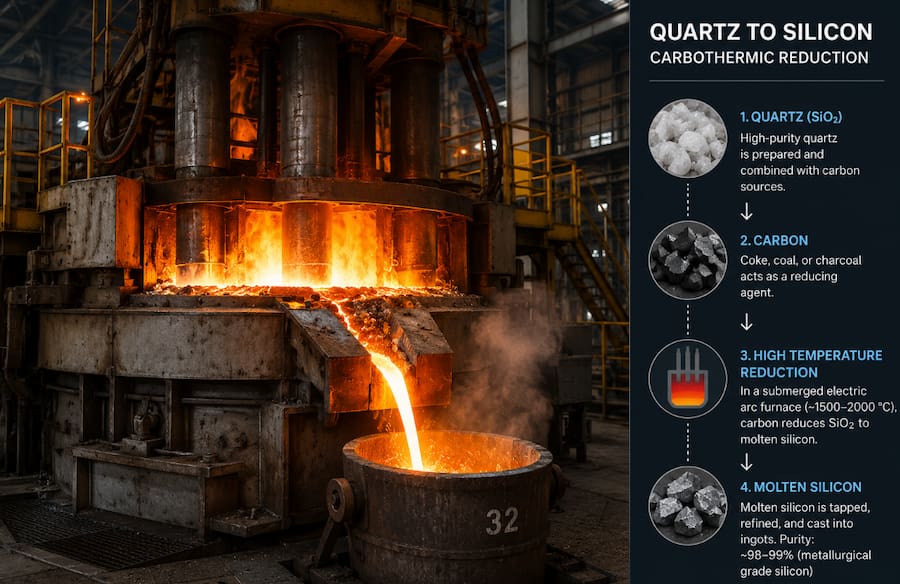
Carbothermic reduction is the industrial process used to extract elemental silicon from silica by reacting quartz with carbon at extremely high temperatures.
The simplified overall reaction is:
SiO₂ (s) + 2 C (s) → Si (l) + 2 CO (g)
In practice, the reaction occurs through several intermediate stages, including gaseous silicon monoxide. The furnace charge must remain porous enough for gases to circulate effectively.
The process takes place in a submerged electric arc furnace at approximately 1,500–2,000 °C. Quartz is mixed with carbon sources such as coal, coke, charcoal and wood chips.
The liquid silicon is tapped from the furnace, refined to control impurities such as aluminium and calcium, then cast into ingots. The result is metallurgical-grade silicon, typically around 98–99% pure.
Metallurgical-Grade Silicon Is Suitable for Silicone Production
Metallurgical-grade silicon is suitable for silicone production. By comparison, solar and semiconductor applications require much higher-purity silicon produced through additional refining steps.
For two-part RTV silicone manufacturing, the metallurgical-grade silicon route provides the appropriate feedstock.
How Is Silicon Converted Into Methylchlorosilanes?
Silicon Must First Be Functionalised
Elemental silicon does not readily react with most organic molecules under normal conditions. To form the silicon-carbon bonds required for silicone production, silicon must first be converted into reactive organosilicon intermediates.
The Müller-Rochow Process Produces Key Silicone Intermediates
The direct process, also called the Müller-Rochow process, reacts metallurgical-grade silicon powder with chloromethane gas in a fluidised-bed reactor. The reaction typically occurs at approximately 250–350 °C using copper-based catalysts.
The simplified reaction is:
Si (s) + 2 CH₃Cl (g) → (CH₃)₂SiCl₂ (g) + by-products
The main target product is dimethyldichlorosilane, (CH₃)₂SiCl₂, which is used to produce linear PDMS. However, the process produces a mixture of methylchlorosilanes.
Common products include:
- Dimethyldichlorosilane, (CH₃)₂SiCl₂: Used to produce linear PDMS
- Methyltrichlorosilane, CH₃SiCl₃: Used to form branched silicone resins
- Trimethylchlorosilane, (CH₃)₃SiCl: Used as an end-capping agent
- Methyldichlorosilane, CH₃HSiCl₂: Used in hydride-functional silicone systems
What Are M, D, T and Q Units in Silicone Chemistry?
Chemists use M, D, T and Q shorthand to describe silicone polymer architecture:
- M unit: Monofunctional, (CH₃)₃SiO₁/₂, which caps a polymer chain end
- D unit: Difunctional, (CH₃)₂SiO₂/₂, which forms the repeating unit in linear PDMS
- T unit: Trifunctional, CH₃SiO₃/₂, which creates branching and crosslinking points
- Q unit: Tetrafunctional, SiO₄/₂, which creates highly crosslinked, silica-like structures in resins and gels
A two-part RTV silicone commonly uses long D-unit PDMS chains with end groups and reactive crosslinking chemistry. The molecular structure helps determine key properties such as flexibility, viscosity, tear strength and hardness.
How Is Polydimethylsiloxane Produced From Methylchlorosilanes?
Hydrolytic Polycondensation Creates PDMS
Hydrolysis converts dimethyldichlorosilane into polydimethylsiloxane, or PDMS, the base polymer used in many silicone elastomers.
The reaction is:
(CH₃)₂SiCl₂ + H₂O → HO–[(CH₃)₂SiO]ₙ–H + HCl
When dimethyldichlorosilane contacts water, its Si-Cl bonds are replaced with silanol, Si-OH, groups. Hydrochloric acid is produced as a by-product.
The silanol groups then condense to form siloxane, Si-O-Si, bonds while releasing water. This creates long PDMS chains with reactive end groups that can later be crosslinked.
PDMS Chain Length Determines Viscosity
The degree of polymerisation determines the viscosity of PDMS.
Shorter chains form low-viscosity liquids used in cosmetic formulations and reactive diluents. Longer chains form higher-viscosity gums used in stronger RTV systems and heat-cured silicone rubber.
For two-part RTV silicone systems, viscosity can vary widely depending on the application, filler loading, processing method and required mechanical performance.
For a broader overview of how PDMS becomes finished silicone materials, see our guide to silicone manufacturing processes.
How Is PDMS Formulated Into Two-Part RTV Silicone?
What is RTV
RTV stands for room-temperature vulcanising. In silicone chemistry, vulcanisation refers to the crosslinking process that transforms a liquid or paste-like polymer into an elastic three-dimensional network.
RTV silicones cure at ambient temperature, typically around 20–25 °C, without requiring a heated mould or oven.
What Is the Difference Between RTV-1 and RTV-2 Silicone?
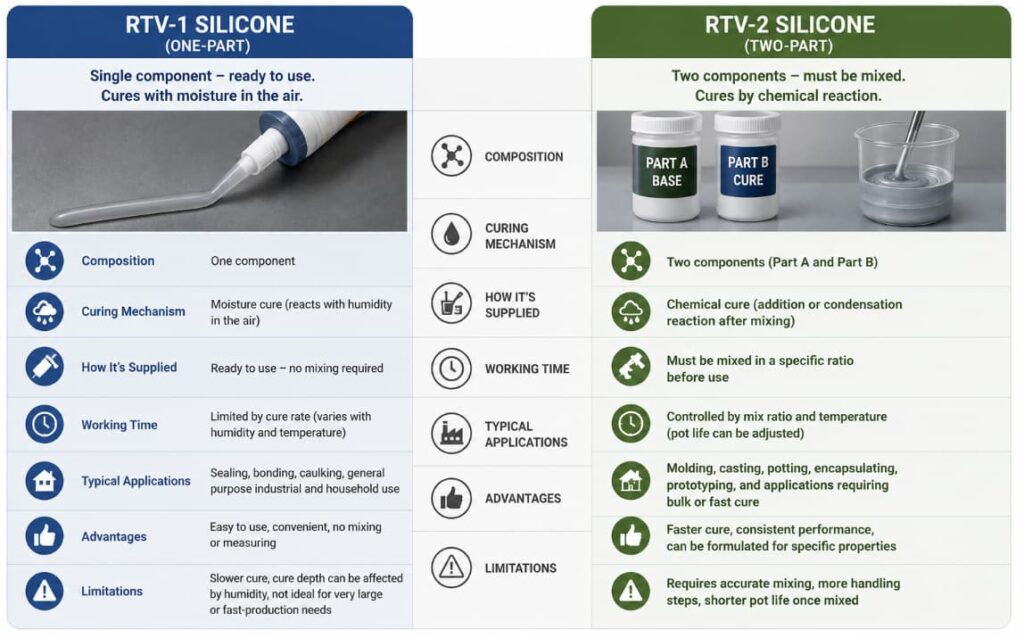
RTV-2 is generally more practical for industrial mould-making, encapsulation and thick castings because it cures throughout the material rather than relying on moisture to penetrate from the surface.
RTV-1 products are usually packaged in airtight cartridges or tubes. Once exposed to air, atmospheric moisture begins the curing process from the outside inward.
RTV-2 systems begin curing when Parts A and B are mixed. This provides a more predictable pot life and demould time, which is particularly useful for industrial applications.
For more detail on curing behaviour, applications and selection, explore this room-temperature vulcanised silicone guide.
What Is Included in a Two-Part RTV Silicone Kit?
A typical two-part RTV silicone kit includes a base component and a curative component.
Part A Contains the Base Silicone Formulation
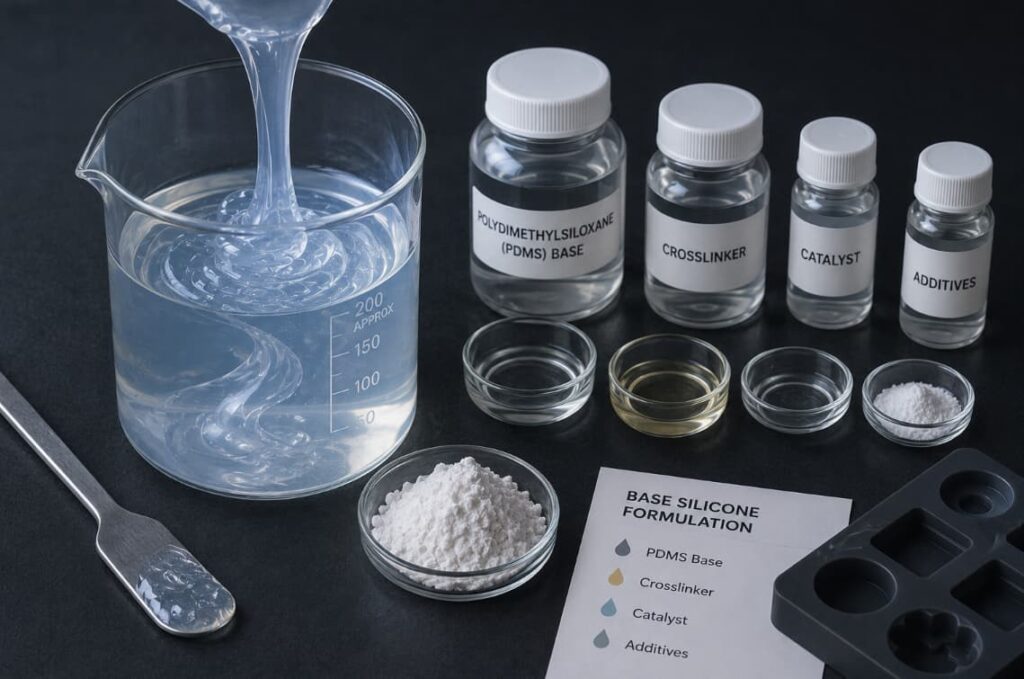
Part A may include:
- Vinyl-terminated PDMS polymer
- Silica filler for strength and thixotropy
- Pigments
- Adhesion promoters
- Flame retardants or other application-specific additives
- A catalyst, depending on the formulation
Part B Contains the Crosslinking Components
Part B may include:
- PDMS polymer
- Si-H functional crosslinker in addition-cure systems
- Cure-control additives or pot-life retarders
- Fillers and other formulation additives
When Parts A and B are mixed at the specified ratio, commonly 1:1 or 10:1 by weight, the curing chemistry forms a crosslinked silicone network.
In platinum-cured addition systems, vinyl-functional silicone reacts with Si-H functional crosslinker groups. In condensation-cure systems, silanol-functional PDMS reacts with a crosslinker to form siloxane bonds.
The final material can be tailored for different Shore hardness levels, elongation, tear strength, colour, viscosity and processing requirements.
How Do Addition-Cure and Condensation-Cure RTV Silicones Differ?
Two primary cure systems are used for two-part RTV silicone:
Addition cure, platinum-catalysed: Vinyl groups react with Si-H groups in the presence of a platinum catalyst. This system produces no volatile by-products and is valued for low shrinkage, clean cure behaviour and dimensional precision. However, it can be inhibited by contaminants such as sulfur, amines and tin compounds.
Condensation cure, often tin-catalysed: Silanol-terminated PDMS reacts with an alkoxy crosslinker, releasing a small alcohol as a by-product. Condensation-cure systems may experience slight shrinkage but are often more tolerant of contaminants.
The right cure chemistry depends on the moulding process, required dimensional stability, material compatibility and finished-part requirements.
How Is the Silicone Supply Chain Structured?
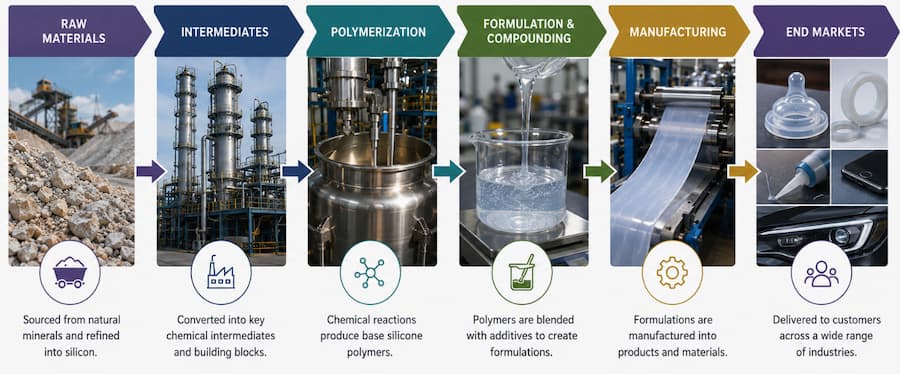
The silicone supply chain begins with silicon metal and silicone intermediates, then moves through PDMS production and formulation into application-specific materials.
At the final stage, silicone manufacturers formulate base polymers into products suited to specific functions, including mould-making, sealing, electronics protection, cookware components and industrial parts.
This is why material selection should account for the complete application, including operating environment, geometry, production volume, hardness requirement and compliance needs.
Where Does Two-Part RTV Silicone Perform Best?
The quartz-to-RTV value chain produces silicone materials suitable for a wide range of industrial applications, including:
- Custom mould-making for low-volume production runs
- Prototyping silicone parts before committing to production tooling
- Encapsulation and potting of electronic assemblies
- Rapid overmoulding onto 3D-printed or machined substrates
- Vacuum casting for short-run production of end-use parts
For higher-volume production, silicone injection moulding may be a more efficient choice because it supports automated, repeatable manufacture after tooling has been approved.
What Is the Typical M/D/T Composition of a Two-Part RTV Silicone?
A representative addition-cure RTV silicone may use vinyl-terminated PDMS with D-unit chains and vinyl-functional end groups. It can be reinforced with fumed silica and crosslinked using Si-H functional PDMS.
The hydride-to-vinyl ratio and crosslinker structure influence crosslink density, which affects the final Shore A hardness, elongation and tear strength.
T units are generally limited or absent in flexible RTV-2 elastomers because these systems are designed to remain linear or only lightly branched. Higher levels of T and Q units are more common in silicone resins, where rigidity and high crosslink density are required.
Key Takeaways
- The transformation from quartz sand to two-part RTV silicone involves carbothermic reduction, the direct process, hydrolysis, polymerisation and formulation.
- The Müller-Rochow direct process produces dimethyldichlorosilane, a key precursor to PDMS.
- M, D, T and Q units describe silicone polymer architecture and influence final material properties.
- RTV-2 cures throughout the mixed material, making it suitable for thick castings, mould-making and encapsulation.
- Selecting the right silicone system depends on the intended application, processing method and performance requirements.
At Flexion, we help engineering teams select silicone materials and manufacturing processes around the actual demands of each part, from curing behaviour and substrate compatibility to durability and compliance. For businesses sourcing Silicone Rubber Thailand, we provide practical support from early material selection through to scalable silicone production.
Have questions about specifying RTV-2 silicone for your next project? Contact Flexion to discuss your application, technical requirements and production goals.
Frequently Asked Questions
What Is the Difference Between Silicon and Silicone?
Silicon, without the “e”, is a chemical element with atomic number 14. It occurs naturally in silica and silicate minerals.
Silicone, with the “e”, refers to synthetic polymers built around a silicon-oxygen backbone with organic side groups. The quartz-to-silicone chain converts silicon-containing minerals into silicone polymers.
Why Is Quartz Used as the Starting Material?
Quartz is preferred because high-purity quartzite and vein quartz contain fewer impurities than lower-grade silica sources. Impurities such as iron, aluminium and boron can be difficult to remove and may affect downstream silicone production.
How Much Energy Does Carbothermic Reduction Consume?
Carbothermic reduction is energy-intensive because it requires submerged electric arc furnaces operating at very high temperatures. Energy consumption varies by furnace design, raw material quality, operating conditions and production site.
What Is Fumed Silica and Why Is It Added to RTV Silicone?
Fumed silica is a high-purity, nano-scale silicon dioxide filler. It is commonly used in RTV silicones to improve tear strength, viscosity control and thixotropy.
Thixotropy helps silicone resist sagging when applied to vertical surfaces while still allowing the material to flow under mixing or dispensing pressure.
Can Two-Part RTV Silicone Be Pigmented?
Yes. Two-part RTV silicone can be pigmented using compatible silicone pigment pastes, dry pigments or selected dyes.
Pigments are usually added before Parts A and B are mixed. Excessive pigment loading may affect cure behaviour, particularly in platinum-catalysed systems, so pigment compatibility should always be tested.
What Is the Shelf Life of a Two-Part RTV Silicone Kit?
Most commercial RTV-2 kits have a shelf life of approximately 6–12 months when stored unopened under the manufacturer’s recommended conditions.
Platinum-cure systems are particularly sensitive to contamination from sulfur, amines and tin compounds. Storage, handling and cleanliness are important for maintaining predictable cure performance.
Is Silicone Production Environmentally Sustainable?
Silicone production has opportunities for improved energy efficiency, recycling and responsible resource use. However, carbothermic reduction remains energy-intensive because of the high temperatures required to produce silicon metal.
The overall environmental impact depends on factors including electricity source, production efficiency, raw-material sourcing, waste management and the durability of the finished silicone product.