
Aerospace applications require materials that can remain reliable under some of the harshest operating conditions in manufacturing. Components may experience temperatures from approximately -65°C to +315°C, rapid thermal cycling, vacuum exposure, vibration, radiation, ultraviolet light and contact with aggressive fluids.
Silicone elastomers can meet many of these challenges, but aerospace-grade silicone requires more than a high-temperature material label. The final part must be designed around its exact operating environment, including pressure, movement, fluid contact, sealing force, outgassing limits and installation method.
From aircraft engine compartments and fuel systems to satellite housings, optical assemblies and cryogenic equipment, aerospace silicone components must retain flexibility, dimensional stability and mechanical strength where conventional rubber materials may become brittle, soften or degrade.
What Makes Aerospace Silicone Different From Standard Silicone?
Aerospace silicone is developed for applications where failure can cause leakage, contamination, electrical issues or costly maintenance. It may need to withstand extreme heat, low temperatures, vibration and chemical exposure while continuing to perform for long service periods.
Standard silicone can provide good flexibility and heat resistance, but aerospace applications often require additional properties. These may include improved compression set resistance, low outgassing, fuel resistance, low-temperature flexibility or stronger tear resistance.
The final performance depends on several factors:
- Silicone family and polymer chemistry
- Fillers and additives
- Cure system
- Post-curing process
- Part geometry
- Surface preparation
- Manufacturing method
- Service environment
Aerospace silicone should therefore be treated as an engineered material solution rather than a one-size-fits-all elastomer.
What Temperature Range Must Aerospace Silicone Handle?
Aerospace systems operate across temperature ranges that can damage many conventional elastomers. At high altitude and in space, components may be exposed to temperatures below -55°C. Many rubber compounds become brittle at these temperatures, lose elasticity and crack under stress.
Silicone can remain flexible at lower temperatures, helping seals, grommets, boots and cable-protection components continue performing in cold-flight environments. This is important when a component must maintain compression or movement during take-off, high-altitude flight, orbital operation or exposure to cryogenic conditions.
At the other end of the range, engine compartments, avionics housings and spacecraft equipment can exceed +200°C. Standard silicone compounds may gradually lose mechanical strength during prolonged heat exposure, so high-temperature silicone formulations may be required for demanding locations.
Rapid temperature changes create another challenge. A silicone component may repeatedly expand and contract alongside surrounding metal, composite or plastic structures. Over time, this movement can reduce sealing force, weaken bonded joints or create cracks in areas with sharp corners or thin walls.
Why Does Thermal Cycling Matter in Aerospace Applications?

Thermal cycling is the repeated movement between low and high temperatures. It can place stress on silicone components even when the temperatures themselves remain within the material’s rated operating range.
Silicone has a higher coefficient of thermal expansion than many metals. This means it may expand and contract more than aluminium, stainless steel, titanium or other surrounding materials. If the component is tightly constrained, this difference can create stress in the seal, bonded interface or housing.
Thermal cycling can lead to:
- Reduced compression force
- Cracks around sharp transitions
- Bond separation from metal inserts
- Seal relaxation
- Distortion in thin or uneven sections
- Leakage after repeated heating and cooling
Good aerospace silicone design accounts for this movement from the start. Proper gland dimensions, radiused corners and consistent wall thicknesses can help reduce stress and improve long-term performance.
How Does Vacuum Exposure Affect Silicone Components?
Vacuum exposure is especially important for spacecraft, satellite equipment, optical systems and vacuum-sensitive electronics. Under vacuum conditions, volatile ingredients can escape from elastomers and condense on nearby surfaces.
This process is known as outgassing. It can contaminate lenses, sensors, mirrors, electronics and other sensitive components. Even a small amount of deposited residue can affect optical clarity, reflectivity or sensor accuracy.
NASA uses ASTM E595 testing to assess material outgassing. Common low-outgassing screening values include:
| Outgassing Measurement | Typical Screening Limit |
| Total Mass Loss | Less than 1.0% |
| Collected Volatile Condensable Materials | Less than 0.10% |
These values should be treated as screening criteria rather than universal approval requirements. The acceptable outgassing level depends on the part location, nearby equipment, mission duration and contamination sensitivity.
Low-outgassing silicone formulations use carefully selected ingredients and controlled post-curing to reduce residual volatiles before installation.
How Do Radiation and Ultraviolet Exposure Affect Aerospace Silicone?
Aerospace materials may be exposed to ultraviolet light, radiation and atomic oxygen, particularly in space-related applications. These exposures can gradually affect polymer chains, surface appearance and mechanical performance.
The level of risk depends on the mission environment. A silicone component inside a protected housing may experience very different conditions from an exposed component on an external spacecraft surface.
Material selection should consider:
- Expected radiation exposure
- Ultraviolet exposure
- Mission duration
- Shielding design
- Surface location
- Temperature cycling
- Required mechanical performance
Silicone can remain useful in many demanding environments, but long-term exposure should be validated through testing rather than assumed from general material properties.
Which Silicone Types Are Used in Aerospace?
Different silicone families provide different balances of temperature resistance, low-temperature flexibility, fluid resistance and mechanical durability.
| Silicone Type | Typical Continuous Service Temperature | Typical Peak Exposure Temperature | Common Aerospace Use |
| Standard VMQ | -55°C to +200°C | Up to +230°C | General seals, boots and insulation components |
| High-Temperature PVMQ | -60°C to +230°C | Up to +260°C | Heat-exposed seals and protective covers |
| Fluorosilicone FVMQ | -60°C to +200°C | Up to +230°C | Fuel and oil-resistant seals |
| Phenyl Silicone | Down to approximately -115°C | Up to +315°C, formulation dependent | Extreme low-temperature applications |

Standard VMQ silicone is suitable for many general sealing, insulation and protective applications. It provides broad temperature stability and flexibility, making it useful for components that are not exposed to aggressive fuels or solvents.
High-temperature PVMQ silicone can provide improved performance in elevated-temperature environments. It may be used near engines, heat-producing equipment, exhaust-adjacent assemblies or other locations where standard silicone would gradually lose mechanical strength.
Phenyl silicone can improve low-temperature flexibility. It is relevant for high-altitude, cold-flight and space-related applications where conventional elastomers may become brittle.
When Should Aerospace Engineers Choose Fluorosilicone?
Fluorosilicone, also known as FVMQ, is typically selected when a component needs both silicone-like temperature flexibility and improved resistance to fuels, oils, lubricants or hydrocarbon-based fluids.
This makes it useful for:
- Fuel-system O-rings
- Fuel-resistant gaskets
- Static seals
- Connector seals
- Protective boots
- Fluid-exposed moulded components

Standard silicone can swell when exposed to hydrocarbons. Fluorosilicone is often a better option where chemical exposure could cause premature seal failure.
Flexion’s Flurosilicone material page explains that FVMQ is commonly used for custom O-rings, gaskets and moulded sealing components exposed to fuels, oils and solvents.
However, fluorosilicone is not suitable for every application. It may not be the best choice for highly abrasive or heavily dynamic sealing environments. Engineers should assess the component’s movement, pressure, friction and service life before specifying the material.
What Mechanical Properties Matter for Aerospace Silicone?
Aerospace silicone must retain key mechanical properties throughout service. Temperature resistance alone does not guarantee reliable sealing or durability.
A compression set is especially important for O-rings, gaskets and flange seals. It shows how well a material can retain contact force after being compressed for long periods. A seal with poor compression-set performance may lose its ability to maintain a reliable barrier.
Other important properties include:
| Property | Why It Matters |
| Hardness | Influences sealing force, flexibility and installation |
| Tensile strength | Helps the part withstand stretching and handling |
| Elongation | Indicates how far the material can stretch before breaking |
| Tear resistance | Important around thin sections, corners and mounting points |
| Compression set | Shows long-term sealing-force retention |
| Low-temperature flexibility | Helps prevent cracking in cold environments |
| Fluid resistance | Protects against swelling or property loss |
| Outgassing performance | Reduces contamination risks in vacuum applications |
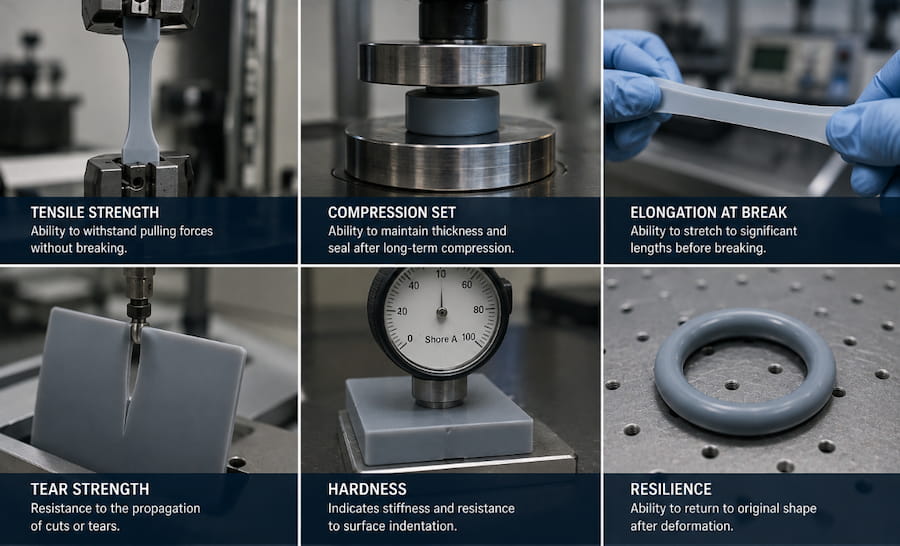
The correct balance depends on the component. A soft connector boot, fuel-system gasket and vibration-control mount may all use silicone, but each requires a different property profile.
Where Is Silicone Used in Aerospace Sealing Systems?
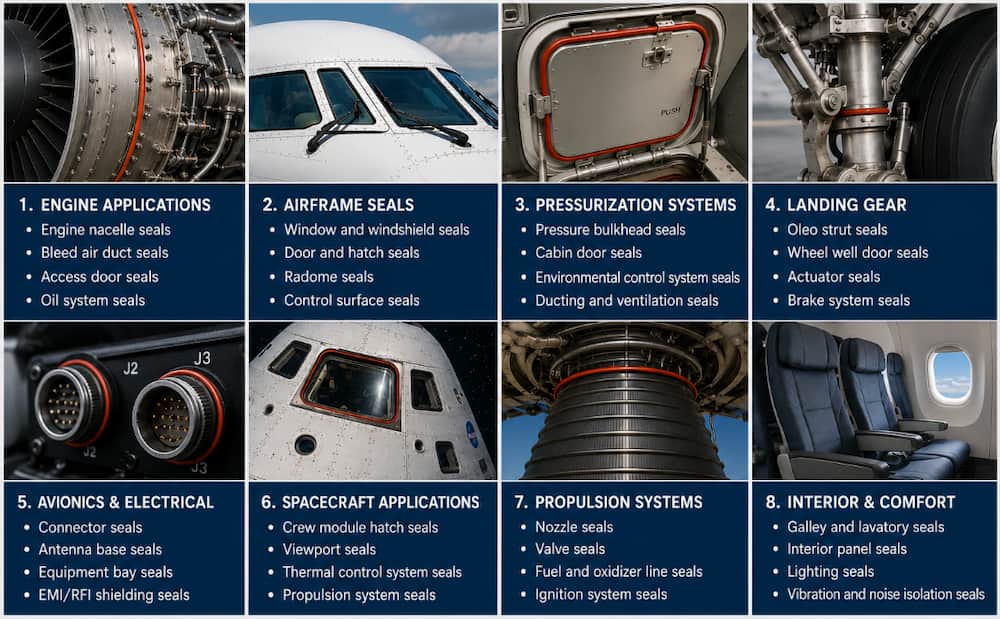
Silicone seals are used across aircraft and spacecraft systems where flexible sealing is required across changing temperatures.
Common applications include:
- O-rings
- Gaskets
- Flange seals
- Access-panel seals
- Connector seals
- Cable-entry seals
- Protective boots
- Environmental system seals
Fuel systems, hydraulic lines and environmental control systems often require stable compression properties and broad operating-temperature capability. Where aviation fuel or hydrocarbon exposure is present, fluorosilicone may be required.
Diaphragm seals, flexible valve components and selected piston-seal applications also need to accommodate movement while maintaining containment. Silicone can be useful in some moving applications, although it is not suitable for every high-pressure or high-wear dynamic seal.
How Is Silicone Used Around Aerospace Wiring and Electronics?
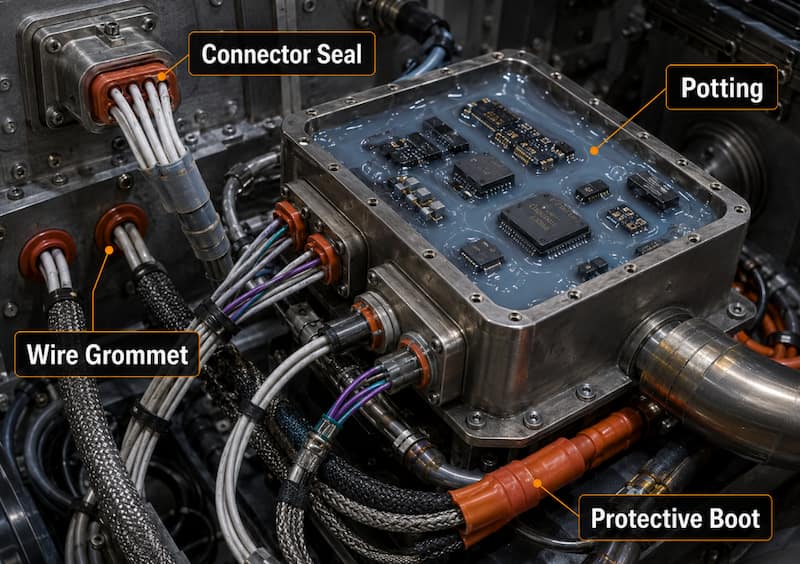
Silicone is commonly used around electrical connectors, cable assemblies and electronic equipment. Its flexibility helps protect connection points from moisture, vibration and changing temperatures.
Typical electrical and electronic applications include:
- Cable boots
- Connector seals
- Grommets
- Strain-relief components
- Protective covers
- Electrical insulation layers
- Sensor housings
Silicone can help reduce the risk of brittleness in cold conditions while protecting sensitive components from environmental exposure. Its electrical insulation properties can also make it useful in wiring and electronics assemblies.
For applications near high-temperature zones, heat-resistant silicone boots and covers can protect wiring, sensors and connectors without adding unnecessary stiffness.
How Does Silicone Support Aerospace Thermal Protection?
Silicone-coated fibre blankets and flexible protective materials can help protect aerospace equipment from heat while remaining lightweight and conformable.
These materials may be used around:
- Wiring systems
- Sensors
- Connectors
- Equipment housings
- Thermal barriers
- Flexible protection layers
Silicone coatings can contribute thermal resistance, electrical insulation and waterproof protection when applied to suitable substrates. Flexion’s silicone rubber coating process explains how silicone coatings can provide thermal resistance, electrical insulation and environmental protection for engineered components.
The final coating system should still be tested for its exact substrate, thickness, thermal exposure and mechanical demands.
How Is Silicone Used for Vibration Isolation?
Vibration can affect the performance and service life of aerospace equipment. Silicone pads, mounts and spacers can help reduce vibration transfer between rigid structures and sensitive components.
These parts may support:
- Electronic modules
- Sensors
- Optical equipment
- Connectors
- Avionics components
- Lightweight assemblies
Vibration-control components must retain their shape and mechanical behaviour across expected temperatures. A material that becomes too soft at high temperature or too rigid at low temperature may not provide consistent isolation performance.
The component design, mounting arrangement and vibration profile should be validated together.
Can Silicone Be Used in Optical and Space Systems?
Low-outgassing silicone can be used in optical bench mounts, lens housings, sensor assemblies and related space equipment where thermal movement must be accommodated without contaminating sensitive surfaces.
These applications require special care because volatile materials may deposit onto nearby optics or sensors. Low-outgassing testing, controlled post-curing and clean manufacturing processes can help reduce this risk.
Silicone should be selected only after assessing:
- Vacuum level
- Optics sensitivity
- Component location
- Expected mission duration
- Thermal cycling
- Bonding requirements
- Outgassing limits
Cryogenic systems involving liquid hydrogen or liquid oxygen require specialised sealing systems. Silicone should only be specified when the selected compound has been qualified for the exact temperature, pressure and fluid exposure.
What Aerospace Silicone Properties Should Be Tested?
The following values may be useful as early project targets. They are not universal aerospace requirements and should be adjusted according to the component’s function and customer specification.
| Property | Typical Requirement | Test Method |
| Hardness | 40–70 Shore A | ASTM D2240 |
| Tensile Strength | >7 MPa | ASTM D412 |
| Elongation | >250% | ASTM D412 |
| Tear Strength | >20 kN/m | ASTM D624 |
| Compression Set | <15% at 200°C for 22 hours | ASTM D395 |
| Low-Temperature Flexibility | No cracking at -65°C | ASTM D2137 |
| Outgassing TML | <1.0% | ASTM E595 |
| Outgassing CVCM | <0.1% | ASTM E595 |
These targets should be considered alongside pressure, fluid exposure, service life, movement and installation conditions.
Which Aerospace Standards May Apply to Silicone Components?
Aerospace silicone parts may need to meet different standards depending on the application, customer and certification route.
Relevant requirements may include:
- AS9100D supplier quality requirements
- FAR 25.853 aircraft interior flammability requirements
- ASTM E595 vacuum outgassing testing
- RTCA DO-160 environmental testing
- Relevant AMS material specifications
- Relevant military material specifications
The required standard depends on whether the component is used in an aircraft interior, fuel system, avionics assembly, satellite system or another aerospace environment.
Documentation is also important. Material data sheets, batch traceability, inspection reports, cure records and validation results may all be required as part of qualification.
How Should Aerospace Silicone Components Be Designed?
Part geometry has a major effect on sealing reliability, moulding consistency and long-term durability.
Proper seal-groove dimensions help achieve enough compression without overstressing the material. Too little compression can create a leak path. Too much compression can cause excessive stress, tearing or permanent deformation.
Good design practices include:
- Use radiused corners where possible
- Avoid sharp thickness transitions
- Maintain consistent wall thicknesses
- Account for thermal expansion
- Reduce unnecessary stress concentrations
- Consider mould flow and demoulding
- Validate dimensions after thermal cycling
Uniform wall thickness can improve curing consistency and reduce internal stress during cooling. Thick and thin areas may cure differently, affecting part stability.
Why Does Surface Preparation Matter for Silicone Bonding?
Silicone does not naturally bond strongly to many substrates. Where it must adhere to metal, plastic or composite surfaces, controlled cleaning and suitable primers may be required.
Surface preparation may involve:
- Removing oils and contaminants
- Applying primers
- Controlling handling conditions
- Preparing metal inserts
- Testing bond strength after cycling
Where silicone is moulded onto metal inserts, bond integrity should be validated through thermal cycling, vibration testing and environmental exposure.
A successful bond depends on more than the adhesive or primer. Surface finish, insert geometry, moulding conditions and cure process can all influence the final result.
Which Manufacturing Method Is Best for Aerospace Silicone?
The manufacturing route should match the part geometry, tolerance requirements and volume.
| Manufacturing Method | Suitable Aerospace Use |
| Liquid silicone rubber injection moulding | Detailed, high-volume parts |
| Compression moulding | Medium-volume seals and durable profiles |
| Extrusion | Continuous silicone profiles |
| Transfer moulding | Specific geometries and insert-moulded parts |
| Silicone coating | Flexible protective layers and coated materials |

Flexion’s silicone materials and manufacturing overview explains how injection moulding, compression moulding, extrusion and casting can be selected according to geometry, tolerance and production needs.
Material selection and manufacturing methods should be considered together. A compound may offer excellent thermal performance but still be difficult to mould into a thin, detailed or tightly toleranced component.
How Is Aerospace Silicone Tested and Validated?
Aerospace silicone components should be tested under conditions that reflect actual service demands. A general data sheet is useful, but the final part geometry and assembly conditions must also be validated.
Common qualification tests include:
- Thermal cycling
- Vibration testing
- Fluid-resistance testing
- Accelerated ageing
- Compression-set testing
- Outgassing testing
- Tensile and tear testing
- Dimensional inspection
- Bond-strength testing
Thermal cycling checks whether the material retains sealing performance across low and high temperatures. Vibration testing confirms that the component does not shift, crack or leak under sinusoidal or random vibration.
Fluid-resistance testing assesses the effect of aviation fuels, hydraulic fluids, lubricants, de-icing compounds and cleaning agents. The final test should use the real fluid and expected temperature conditions where possible.
For vacuum-sensitive applications, ASTM E595 testing can verify low-outgassing performance before approval.
What Production Checks Are Needed for Aerospace Silicone?
Each production lot may require routine verification to confirm that the components match the approved specification.
Typical checks include:
- Hardness testing
- Dimensional inspection
- Visual examination
- Cure-state confirmation
- Material certification review
- Lot traceability
- Bond inspection
- Packaging and cleanliness checks
The inspection level should reflect the part’s role. A low-risk protective cover may not require the same verification as a fuel-system seal, vacuum-compatible component or critical electronics part.
Conclusion: How Can Flexion Support Aerospace Silicone Projects?
Aerospace silicone must be selected around real operating conditions, not broad temperature capability alone. Heat exposure, low-temperature flexibility, fluid contact, vacuum requirements, vibration and part geometry all influence whether a silicone component will perform reliably in service.
At Flexion, we work with engineers to develop custom aerospace silicone components for demanding environments. Our capabilities include high-temperature silicone, phenyl silicone for low-temperature applications and fuel-resistant Flurosilicone for aerospace seals exposed to hydrocarbons. We also help match the material to the right production route, including precision moulding, extrusion, coating and transfer moulding, helping support reliable performance from prototype development through production.
Frequently Asked Questions
What temperature range can aerospace silicone tolerate?
Standard aerospace silicone commonly operates from approximately -55°C to +200°C continuously. Special high-temperature compounds can extend this range to around +260°C or higher for short-term exposure, while phenyl silicone can improve low-temperature flexibility to approximately -115°C.
Why is outgassing important for aerospace silicone?
In vacuum environments, volatile ingredients can escape from elastomers and condense on nearby surfaces. This can contaminate optical systems, sensors and sensitive electronics. ASTM E595 testing is commonly used to assess outgassing performance.
What silicone type resists aviation fuel?
Fluorosilicone, or FVMQ, is commonly used for aviation fuel exposure because it provides improved resistance to hydrocarbons, oils and many aviation fluids compared with standard silicone.
Can silicone be used in cryogenic aerospace systems?
Silicone can be used in selected low-temperature applications, but cryogenic systems involving liquid hydrogen or liquid oxygen require specialised testing. The selected material must be qualified for the exact temperature, pressure and fluid exposure.
What tests validate aerospace silicone performance?
Qualification testing may include thermal cycling, vibration testing, fluid-resistance testing, accelerated ageing, compression-set testing and ASTM E595 outgassing testing. Production lots may also require hardness checks, dimensional inspection and traceability documentation.