
Two-part RTV silicone is a widely used material for prototyping, mould making, vacuum casting and electronics encapsulation. It is commonly used to create flexible resin moulds, seal or protect electronic components, and prototype silicone gaskets before a project moves into dedicated production tooling.
Whether you are producing a detailed casting mould, testing a soft-touch component or protecting sensitive electronic assemblies, understanding how 2-part RTV silicone cures is essential. The final result depends on the formulation, mix ratio, handling process and cure conditions.
This article explains what 2-part RTV silicone is, how its two components react and how to avoid the most common mistakes. For a broader explanation of the material supply chain, read our guide on how silicon is turned into 2-part RTV silicone.
What Is a 2-Part RTV Silicone?
2-part RTV silicone is a room-temperature-vulcanising elastomer supplied as two separate components: Part A, the base, and Part B, the curative. Once mixed at the correct ratio, the two parts react and cure into a flexible silicone rubber.
“RTV” stands for room-temperature vulcanising. This means the material can cure at ambient temperatures, typically around 20–25 °C, without needing an oven, heated mould or UV light.
The “2-part” designation distinguishes it from RTV-1, or one-part, sealants. RTV-1 products cure by reacting with moisture in the air, so their cure starts at the exposed surface and moves inward. RTV-2 systems cure throughout the complete mixed mass, making them far more suitable for thick castings, moulds, potting and encapsulation work.
What Is 2-Part RTV Silicone Used For?
2-part RTV silicone is used wherever a flexible, durable and accurately formed elastomer is needed. Its ability to cure at room temperature makes it particularly useful for prototypes, short-run production and applications that do not require high-volume moulding from the start.
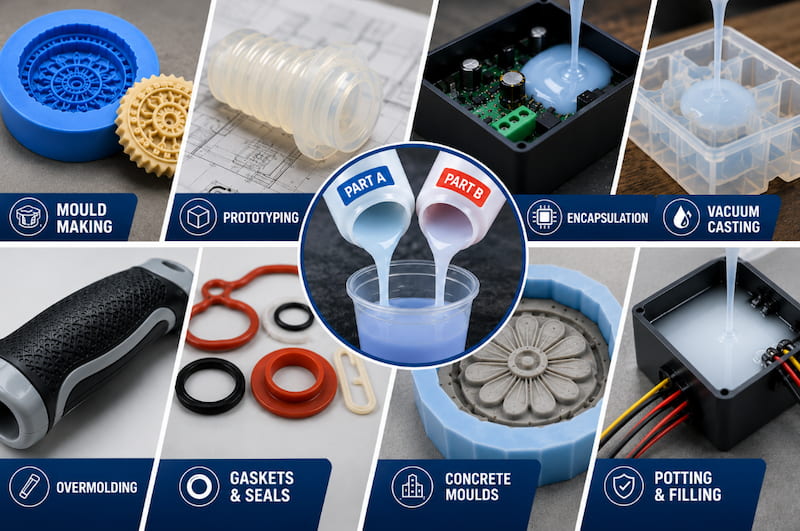
Common applications include:
- Mould making for casting resins, wax, concrete, plaster and low-melt metals
- Prototyping flexible parts before committing to production tooling
- Electronics encapsulation and potting to protect components from moisture, vibration and thermal stress
- Vacuum casting for short-run parts and product validation
- Overmoulding onto 3D-printed or machined substrates to add soft-touch grips, seals and gaskets
- Special effects and prop making for film, theatre and display work
- Gaskets and seals for low-volume industrial or consumer-product applications
According to Grand View Research, the global RTV silicone market is valued at approximately USD 4 billion, reflecting continuing demand from electronics, industrial production and custom manufacturing.
What Is in a 2-Part RTV Silicone Kit?
Part A Contains the Base Polymer
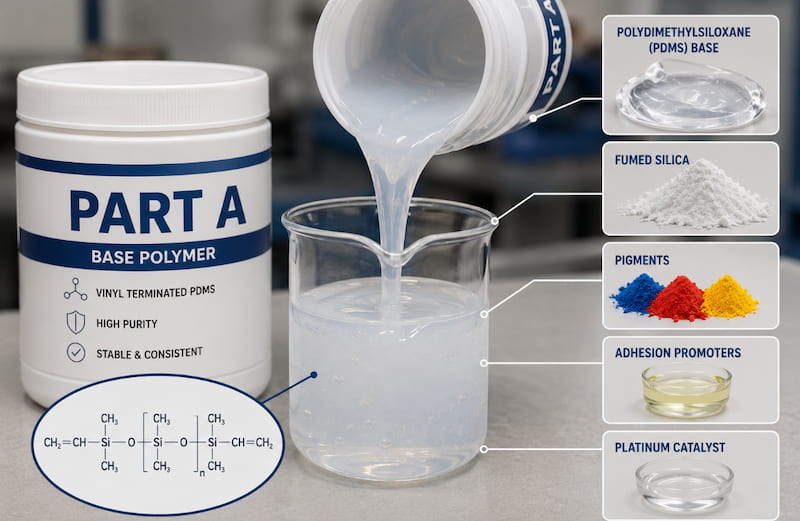
Part A is typically based on vinyl-functional polydimethylsiloxane, or PDMS. PDMS is made from long, flexible silicon-oxygen chains with methyl side groups and reactive vinyl end groups.
Depending on the formulation, Part A may also include:
- Fumed silica filler to improve reinforcement, tear strength and thixotropy
- Pigments to colour-code Parts A and B, making incomplete mixing easier to identify
- Adhesion promoters for systems designed to bond to certain substrates
- Platinum catalyst in addition-cure systems, held separately from the crosslinker until mixing begins
The base component provides the bulk of the silicone material and determines much of the finished product’s flexibility, appearance and handling behaviour.
Part B Contains the Curative Components

Part B is the curative component. It commonly contains:
- PDMS carrier polymer, often similar to Part A
- Si-H functional crosslinker, a shorter PDMS chain containing silicon-hydrogen groups
- Pot-life retarder to control how quickly the mixture begins to gel
- Fumed silica filler for reinforcement and body
When Parts A and B are combined, the catalyst activates the reaction between vinyl groups in Part A and Si-H groups in Part B. This creates Si–CH₂–CH₂–Si bonds that connect the polymer chains into a flexible three-dimensional silicone network.
Why Is 2-Part RTV Silicone Supplied Separately?
If the catalyst and crosslinker were stored together, the silicone would cure inside the container before it could be used. Keeping the reactive components separate gives the user a predictable working time, known as pot life.
Once mixed, the silicone remains workable for a defined period before it starts to thicken and gel. This allows manufacturers, engineers and makers to pour, brush, inject or apply the material before the cure advances too far.
The exact pot life depends on the formulation, mix ratio and surrounding temperature. Warmer environments generally shorten working time, while colder environments slow the reaction.
How Does 2-Part RTV Silicone Cure?
Addition-Cure RTV Silicone Uses Platinum Catalysis
Addition-cure RTV-2 silicone cures through a chemical reaction called hydrosilylation. In this system, the Si-H bond in the crosslinker reacts with the vinyl groups in the base polymer:
≡Si–H + H₂C=CH–Si≡ → ≡Si–CH₂–CH₂–Si≡
A platinum catalyst accelerates the reaction at room temperature. Because the reaction does not release a small-molecule byproduct, addition-cure silicone generally offers very low shrinkage, strong dimensional stability and a clean surface finish.
This makes platinum-cure RTV silicone useful for high-detail moulds, optical applications, food-contact components, medical-grade formulations and parts where tight dimensional control matters.
However, platinum-cure systems can be sensitive to contamination. Sulfur, amines, tin compounds and certain plastics can interfere with curing and leave the silicone tacky or uncured at the contact surface.
Condensation-Cure RTV Silicone Uses Tin Catalysis
Condensation-cure RTV-2 silicone uses a different chemistry. Silanol-terminated PDMS reacts with an alkoxy-functional crosslinker and releases alcohol, such as methanol or ethanol, as a byproduct:
≡Si–OH + RO–Si≡ → ≡Si–O–Si≡ + ROH
A tin catalyst drives this reaction. As the alcohol byproduct evaporates, the silicone may shrink slightly more than an addition-cure system.
Condensation-cure silicones are often more forgiving when used with different mould materials or contaminated surfaces. They are also generally more cost-effective, which makes them popular for general mould making, art casting, concrete moulds and non-critical prototype work.
Should You Choose Addition-Cure or Condensation-Cure Silicone?
| Property | Addition Cure, Platinum | Condensation Cure, Tin |
| Byproducts | None | Alcohol, such as methanol or ethanol |
| Shrinkage | Very low | Slightly higher |
| Cure inhibition | Sensitive to sulfur, amines and tin | More forgiving |
| Cost | Higher | Lower |
| Shelf life | Typically around 12 months when uncontaminated | Usually 6–12 months |
| Working time | Adjustable | Adjustable |
| Best for | Food-contact, medical, optical and precision moulds | General prototyping, art casting and concrete moulds |
Addition-cure silicone is often selected where precision, cleanliness and low shrinkage are critical. Condensation-cure silicone is often selected where cost, ease of use and tolerance for different mould materials are more important.
For food-contact or medical applications, it is important to check the specific certification and documentation for the exact silicone grade rather than assuming that every addition-cure product is suitable.
How Do You Use 2-Part RTV Silicone?
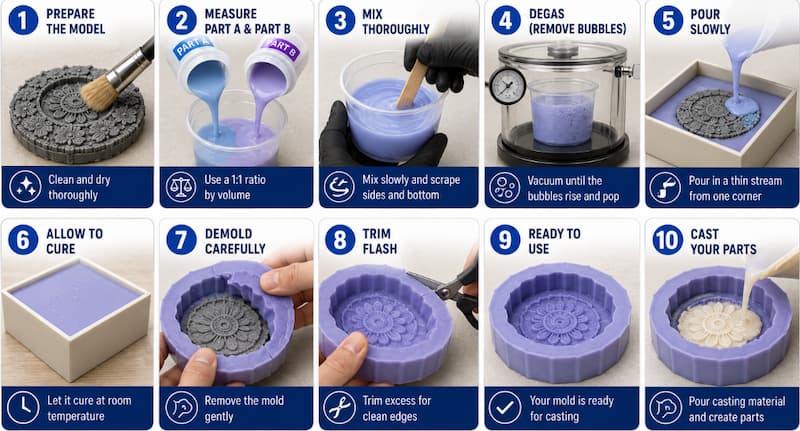
Step 1: Measure by Weight
Always measure silicone by weight rather than volume. Part A and Part B may have different densities, so measuring by volume can introduce ratio errors even when the quantities look equal.
Use a digital scale accurate to at least 0.1 g. This is especially important for systems with a 10:1 ratio, where a small weighing error can significantly affect cure quality.
Step 2: Mix Thoroughly but Gently
Combine Parts A and B at the manufacturer’s specified ratio, commonly 1:1 or 10:1 by weight. Mix slowly using a flat spatula or dedicated mixing stick.
Scrape the sides and bottom of the container repeatedly. Incomplete mixing can leave streaks of uncured silicone or create weak areas in the finished part.
Avoid whipping air into the mixture. Fast or aggressive stirring can trap bubbles that remain in the cured mould or component.
Step 3: Vacuum Degas When Surface Detail Matters
For clear castings, detailed moulds or parts with fine surface features, place the mixed silicone in a vacuum chamber for a few minutes. Under vacuum, trapped air expands and rises to the surface before collapsing.
Vacuum degassing is particularly useful for:
- Optical-grade parts
- Fine-detail moulds
- Transparent silicone castings
- Thin sections where bubbles are highly visible
- Parts requiring a smooth cosmetic finish
For rough mould surfaces or opaque castings, degassing may be less critical, but it can still improve consistency.
Step 4: Pour or Apply the Silicone
Pour mixed silicone slowly from a single point to reduce new air entrapment. Allow the material to flow naturally around the pattern or cavity rather than pouring it rapidly across the entire surface.
For brush-on moulds, apply the first layer carefully to capture fine surface details. Additional layers can then be built up after the previous layer has partially cured.
Step 5: Allow the Silicone to Cure Fully
Typical cure timings include:
- Pot life: Usually 5–60 minutes, depending on formulation
- Demould time: Often 4–8 hours
- Full cure: Usually 24 hours at 25 °C
- Thicker parts: May require 48–72 hours to reach full properties
Higher temperatures can accelerate curing, while lower temperatures can slow it considerably. Silicone may feel solid before it reaches full mechanical strength, so demoulding or stressing the part too early can cause deformation.
What Do Common 2-Part RTV Mix Ratios Mean?
The two most common mix ratios are 1:1 and 10:1 by weight.
- 1:1 by weight: Equal parts are simple to measure and help reduce mixing errors. This ratio is common in consumer-grade kits, rapid prototyping materials and general mould-making products.
- 10:1 by weight: A smaller quantity of Part B activates a larger amount of Part A. This ratio is common in industrial mould-making systems and requires a more accurate scale.
Always follow the manufacturer’s specified ratio. Adding extra Part B does not make silicone cure more effectively. Too much Part A can leave silicone tacky or uncured, while too much Part B can make the material brittle, shorten pot life or affect final mechanical properties.
How Do You Specify the Right Silicone Hardness?
Shore A Measures Silicone Hardness
Shore A is the standard hardness scale for flexible elastomers, including RTV silicone. A Shore A durometer presses a blunt needle into the cured material under a defined force and measures penetration depth.
The scale runs from 0, which is very soft and gel-like, to 100, which is closer to rigid plastic. Most 2-part RTV silicones used for mould making and industrial applications fall between Shore A 10 and Shore A 80.
Hardness affects how the silicone handles, how easily it releases from undercuts and how well it resists tearing during repeated use.
Shore A Hardness Affects Mould Performance
| Shore A | Feel | Best for |
| 10–20 | Gel-like, very soft | Skin-safe prosthetics and soft-touch overmoulds |
| 20–30 | Soft and flexible | Concrete moulds and delicate prototypes |
| 30–45 | Medium-soft mould rubber | Resin casting and general prototyping |
| 45–60 | Firm and less flexible | High-detail moulds and technical parts |
| 60–80 | Very firm, almost rigid | Gaskets, mechanical parts and repeated casting |
Softer silicones are useful for complex geometry because they can flex around undercuts and release delicate castings more easily. However, they may tear more easily during repeated use.
Firmer silicones provide more dimensional stability and better tear resistance. They are useful for gaskets, technical parts and repeated casting, but they may be less suitable for deep undercuts or complex part removal.
What Are the Most Common 2-Part RTV Silicone Mistakes?
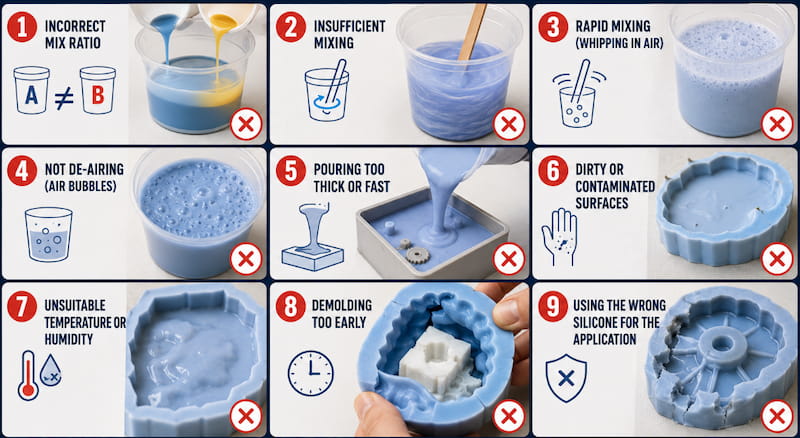
Off-Ratio Mixing Causes Cure Failures
Incorrect ratios are one of the most common causes of tacky, brittle or incompletely cured silicone. Always use a calibrated scale and follow the manufacturer’s stated mixing ratio.
Do not estimate the amount visually, especially with 10:1 systems. Small errors can affect cure speed, surface finish and final properties.
Inadequate Mixing Leaves Uncured Areas
Streaky, soft or partially cured areas usually indicate inadequate mixing. Mix for at least three minutes, scraping the sides and bottom of the container several times.
Where possible, use colour-coded Part A and Part B systems. A uniform colour usually indicates that the components have been blended more thoroughly.
Skipping Degassing Creates Bubble Defects
For clear castings or high-detail moulds, skipping vacuum degassing can leave visible bubbles and surface defects. Bubbles can also weaken fine mould features or create imperfections in thin silicone sections.
Degassing may be less important for rough, opaque or low-detail applications, but it is strongly recommended where cosmetic finish or precision matters.
Contaminants Can Inhibit Platinum-Cure Silicone
Addition-cure silicone can be affected by sulfur, amines, tin and certain plastics. Common sources of contamination include:
- Sulfur-containing modelling clay, such as Plastilina
- Latex gloves, where nitrile gloves are safer
- Some 3D-printed resins, especially SLA prints with residual photoinitiator
- Cross-contamination from tin-cure silicone systems
- Certain adhesives, paints, sealants and release agents
When cure inhibition occurs, the silicone surface may remain tacky, soft or liquid. Use approved mould materials, nitrile gloves and compatible release agents to reduce this risk.
Demoulding Too Early Can Permanently Deform Parts
RTV silicone can feel solid before full cure is complete. Removing a part too early may permanently deform thin sections, distort mould walls or reduce tear strength.
Always follow the manufacturer’s full-cure guidance before applying significant stress, stretching the material or beginning repeated casting cycles.
How Do You Choose the Right 2-Part RTV Silicone?
Choosing the correct RTV-2 silicone depends on the application, part geometry, production volume and required performance.
- What will be cast into the mould? Resins, wax, concrete, plaster, low-melt metals and food-contact materials all have different compatibility requirements.
- How many castings are required? A standard Shore A 25–40 system may suit one-off prototypes, while repeated casting normally requires higher tear-strength silicone.
- What is the part geometry? Deep undercuts, detailed textures and delicate patterns usually need softer silicone. Simple geometry can often use firmer grades.
- Is food-safe or medical-grade silicone required? Look for specific documentation, such as FDA 21 CFR 177.2600 or USP Class VI certification, where the application requires it.
- What level of dimensional accuracy is needed? Addition-cure silicone is generally better suited to high-precision work because it has very low shrinkage.
- What is the budget? Condensation-cure systems are often more economical for non-critical applications, while platinum-cure systems are usually worth considering for precision, food-contact or sensitive applications.
For projects moving from prototype moulds to repeatable production, compare RTV casting with silicone injection moulding for higher-volume precision parts. For lower to medium production volumes or parts with simpler geometry, silicone compression moulding may also be suitable.
Conclusion
2-part RTV silicone is a room-temperature-curing elastomer made from a base, Part A, and a curative, Part B. The right cure chemistry, hardness, mix ratio and handling process all affect the quality of the finished mould, casting or silicone component.
At Flexion, we help customers select the right material and manufacturing route for their requirements. As a trusted Silicone Rubber Thailand manufacturer, we support teams from RTV prototyping and early-stage validation through to silicone injection moulding, silicone compression moulding, extrusion and scalable silicone production.
Ready to discuss your project? Contact our engineering team with your application, material requirements, drawings and expected volumes. You can also explore our silicone materials to compare RTV, LSR, HCR and fluorosilicone options.