
Silicone materials play an important role in renewable energy systems because they can withstand heat, UV exposure, moisture, electrical stress, and harsh outdoor conditions. These properties make silicone useful in solar panels, wind turbines, electric vehicles, battery storage systems, and emerging clean energy technologies.
According to the Global Silicones Council, silicone products can save around 14 times more greenhouse gases than are emitted during their production and end-of-life treatment. This makes silicone especially valuable in long-life clean energy applications.
Why Is Silicone Important in Renewable Energy?
Silicone provides sealing, insulation, protection, and long-term durability.
Renewable energy systems often operate outdoors for 15 to 25 years or more. Silicone helps protect these systems from environmental damage while supporting safe electrical and thermal performance.
| Silicone Property | Why It Matters |
| Temperature resistance | Performs from -60°C to 200°C+, with some grades reaching 300°C |
| UV stability | Resists sunlight damage, yellowing, and cracking |
| Electrical insulation | Helps protect high-voltage systems |
| Hydrophobicity | Repels water and reduces moisture damage |
| Flexibility | Handles vibration and thermal movement |
| Long service life | Supports 25+ year renewable energy systems |
How Is Silicone Used in Solar Energy?
Silicone protects solar panels from moisture, UV exposure, and electrical failure.
Solar panels are exposed to sunlight, rain, heat, humidity, and temperature changes for decades. Silicone helps protect sensitive solar components and improves long-term reliability.
According to the International Renewable Energy Agency, solar energy contributed 511 GW of new renewable power capacity in 2025, showing the growing need for durable solar materials.
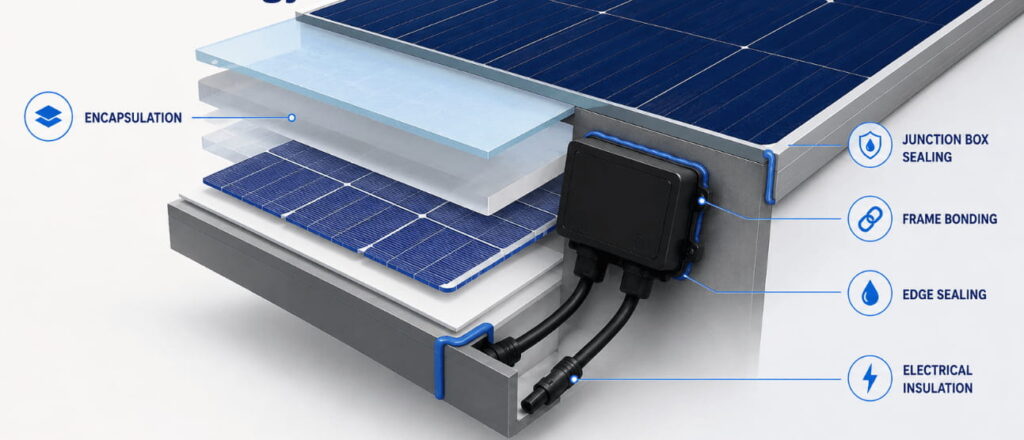
| Solar Component | Silicone Function | Benefit |
| PV encapsulation | Protects solar cells | Reduces moisture and stress damage |
| Junction box sealing | Seals electrical connections | Prevents water and dust ingress |
| Frame bonding | Bonds glass and aluminum | Improves structural stability |
| Edge sealing | Blocks moisture entry | Extends panel life |
| Electrical insulation | Prevents current leakage | Supports safe operation |
Silicone encapsulants are especially useful for high-performance solar panels, floating solar systems, bifacial panels, and extreme-climate installations because they resist UV damage and yellowing better than many standard materials.
How Does Silicone Support Wind Energy?
Silicone protects wind turbines from erosion, weather, lightning, and electrical stress.

Wind turbines operate in harsh environments with rain, hail, dust, UV exposure, vibration, and temperature changes. Silicone materials help protect turbine blades, cables, nacelles, and electrical systems.
According to the International Renewable Energy Agency, wind energy added 159 GW of capacity in 2025.
| Wind Turbine Area | Silicone Use | Purpose |
| Blade leading edge | Protective coating | Reduces erosion |
| Lightning system | Insulation and sealing | Protects connections |
| Cables | Silicone insulation | Supports flexibility and voltage protection |
| Nacelle | Gaskets and sealants | Blocks moisture and dust |
| Access panels | Seals | Maintains weather protection |
Silicone coatings can protect turbine blade leading edges from erosion caused by rain, hail, and dust. According to the Global Silicones Council Wind Energy Efficiency Study, silicone-based leading edge protection can improve wind turbine energy generation by up to 8% over the turbine lifetime.
What Role Does Silicone Play in EV Batteries?
Silicone supports battery cooling, sealing, and high-voltage protection.
Electric vehicles are closely linked to renewable energy because they help store and use clean electricity. Silicone is used in EV battery packs, high-voltage systems, connectors, and power electronics.
According to the International Energy Agency, global electric car sales exceeded 17 million in 2024, increasing demand for safe and reliable battery materials.

| Battery Area | Silicone Use | Benefit |
| Battery cells | Thermal interface material | Transfers heat |
| Battery enclosure | Gaskets and seals | Blocks water and contaminants |
| High-voltage cables | Silicone insulation | Protects electrical systems |
| Connectors | Seals and boots | Prevents moisture ingress |
| Power electronics | Potting and encapsulation | Protects sensitive parts |
Silicone thermal interface materials help move heat from battery cells to cooling plates. This supports battery safety, performance, and long-term reliability.
| Requirement | Typical Value |
| Thermal conductivity | 1.0–5.0 W/mK |
| Dielectric strength | >10 kV/mm |
| Operating temperature | -40°C to 150°C |
| Service life target | 15+ years |
How Is Silicone Used in Energy Storage Systems?
Silicone helps protect large battery systems from heat, weather, vibration, and moisture.
Grid-scale energy storage systems often use containerized battery units installed outdoors. These systems need durable sealing, thermal management, and electrical protection.
According to Wood Mackenzie, global energy storage reached 106 GW of new capacity additions in 2025.
| ESS Component | Silicone Function | Benefit |
| Battery containers | Weather sealing | Protects against rain and dust |
| Battery modules | Thermal gap filling | Improves heat transfer |
| Cable penetrations | Sealing and insulation | Reduces moisture risk |
| Fire-rated areas | Flame-retardant sealing | Supports safety |
| Mounting systems | Vibration isolation | Protects components |
What Emerging Clean Energy Applications Use Silicone?
Silicone is also used in green hydrogen and concentrated solar power systems.
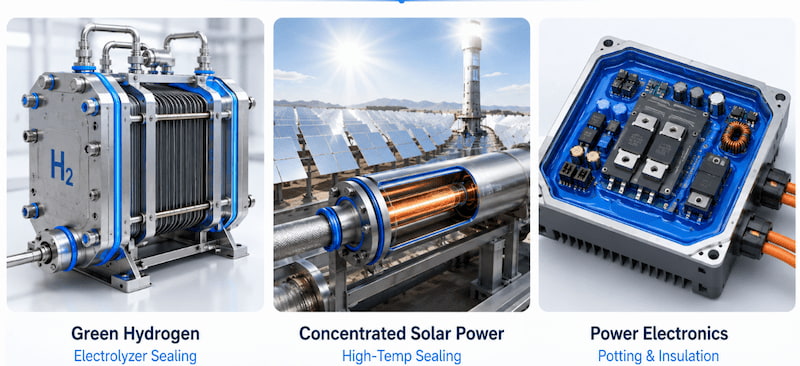
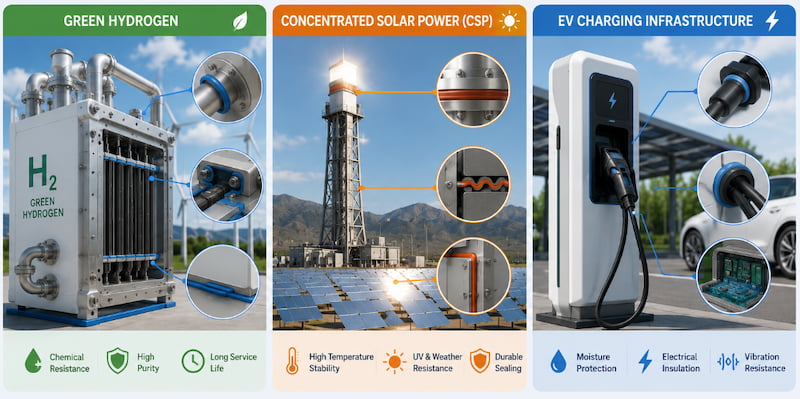
As clean energy technology develops, silicone is being used in newer applications that require purity, heat resistance, and chemical resistance.
| Application | Silicone Role |
| Green hydrogen electrolyzers | High-purity sealing |
| Concentrated solar power | High-temperature sealing |
| Battery storage | Thermal and electrical protection |
| EV charging systems | Cable and connector protection |
In green hydrogen systems, platinum-cure silicone rubbers may be used because they offer purity and chemical resistance. In concentrated solar power systems, high-temperature silicone formulations can support sealing in hot operating environments.
How Does Silicone Compare with Other Materials?
Silicone often performs better in long-term outdoor and high-temperature conditions.
| Application | Silicone | Alternative | Silicone Advantage |
| Solar encapsulation | Silicone gel or RTV | EVA | Better UV stability |
| Wind blade coating | Silicone coating | Polyurethane | Durability and repairability |
| Battery TIM | Silicone gap filler | Acrylic or epoxy | Flexibility and reliability |
| Cable insulation | Silicone rubber | XLPE or EPR | Wider temperature range |
| High-voltage sealing | Silicone rubber | EPDM or fluorocarbon | Strong cost-performance balance |
Although some alternatives may have lower upfront costs, silicone often offers better long-term value because it lasts longer and reduces maintenance needs.
How Fast Is Demand Growing?
Demand is growing because solar, wind, EV, and storage markets are expanding.
| Market Signal | Publisher | Statistic |
| Renewable power growth | International Renewable Energy Agency | 692 GW added in 2025 |
| Solar growth | International Renewable Energy Agency | 511 GW added in 2025 |
| Wind growth | International Renewable Energy Agency | 159 GW added in 2025 |
| EV sales | International Energy Agency | 17+ million electric cars sold in 2024 |
| Energy storage | Wood Mackenzie | 106 GW added in 2025 |
These growth areas increase demand for silicone sealants, gaskets, encapsulants, thermal interface materials, coatings, and electrical insulation.
How Should Silicone Be Selected for Renewable Energy Applications?
The right silicone depends on heat, UV exposure, service life, electrical needs, and chemical compatibility.
| Selection Factor | What to Check |
| Service life | Can it support 15–25+ years? |
| Temperature range | Can it handle operating heat and cold? |
| UV exposure | Is it suitable for outdoor sunlight? |
| Electrical insulation | Does it meet voltage requirements? |
| Chemical resistance | Can it resist coolants, oils, or electrolytes? |
| Flame resistance | Is UL94 V-0 or another rating required? |
| Compression set | Will it maintain sealing over time? |
For solar applications, silicone should be selected based on UV stability, optical clarity, and adhesion. For wind energy, erosion resistance and weather durability are important. For EV batteries and energy storage, thermal conductivity, dielectric strength, flame resistance, and sealing performance are key.
Conclusion
Silicone materials have become essential to the renewable energy transition. Across solar, wind, EV batteries, and grid-scale energy storage, silicone provides the durability, electrical insulation, UV resistance, sealing performance, and thermal stability needed for clean energy systems designed to operate for decades.
As renewable energy deployment accelerates, demand for silicone is expected to grow alongside it. Solar panel manufacturing, wind turbine construction, battery production, and energy storage systems all rely on silicone for performance-critical applications. According to the Global Silicones Council, silicone products save 14 times more greenhouse gases than are emitted during their manufacture, further supporting their role in climate-related solutions.
For manufacturers, engineers, and procurement teams, understanding silicone’s capabilities helps improve material selection and supplier engagement. As renewable energy systems become more advanced, with higher-efficiency solar panels, larger wind turbines, and faster-charging batteries, silicone materials will continue to evolve to meet stricter performance requirements.
At Flexion, we understand how important reliable material performance is for clean energy applications. As we support industries looking for durable silicone solutions, we focus on helping customers select materials that can perform under demanding environmental, electrical, and thermal conditions. For companies searching for Silicone rubber Thailand, we aim to provide dependable silicone expertise that supports long-lasting products and sustainable industrial growth.
FAQ
Why is silicone used in solar panels?
Silicone is used in approximately 90% of solar panels, according to Silicones Europe, for encapsulation, junction box sealing, and frame bonding. Its UV stability, electrical insulation, and 25+ year durability help protect solar cells and support long-term panel performance.
How does silicone improve wind turbine performance?
Silicone leading edge coatings protect turbine blades from erosion caused by rain, hail, dust, and insects at high tip speeds. According to the Global Silicones Council Wind Energy Efficiency Study, this protection can improve energy generation by up to 8% over the turbine lifetime.
What role does silicone play in electric vehicle batteries?
Silicone is used in EV batteries for thermal interface materials, formed-in-place gaskets, enclosure sealing, cable insulation, connector protection, and high-voltage electrical insulation. These applications rely on silicone’s thermal stability, electrical properties, flexibility, and long-term reliability.
How long do silicone materials last in renewable energy applications?
Silicone materials are often designed to match or exceed the 25-year design life of solar panels and wind turbines. Accelerated aging tests and field experience show that silicone can maintain performance over long service periods.
Are there alternatives to silicone for renewable energy applications?
Yes, alternatives exist. EVA is commonly used for PV encapsulation because it is lower cost, while polyurethane is often used for wind blade coatings. However, silicone typically offers stronger UV stability, flexibility, temperature resistance, and long-term durability.
What is the market growth outlook for silicone in renewable energy?
The renewable energy silicone market is growing at approximately 7–10% annually. This growth is driven by solar and wind capacity expansion, EV adoption, and energy storage deployment.
How do I specify silicone materials for renewable energy applications?
Specification should consider required service life, temperature extremes, UV exposure, electrical requirements, chemical compatibility, and relevant industry standards such as IEC for solar, DNV for wind, and automotive standards for EV battery systems.
Is silicone environmentally friendly?
Silicone production does have environmental impacts. However, according to the Global Silicones Council, silicone products typically save 14 times more greenhouse gases than are emitted during their manufacture. In renewable energy applications, this benefit is especially significant because silicone helps support clean energy generation.