
Room Temperature Vulcanizing (RTV) silicone is widely used for sealing, bonding, gasketing, potting, and protection across industries such as electronics, automotive, construction, glazing, and industrial equipment.
Unlike heat-cured silicone systems that require ovens, RTV silicone cures at room temperature. This makes it useful for production work, field repairs, and applications involving large or heat-sensitive parts. Once cured, it forms a flexible rubber-like material that can resist heat, moisture, weathering, vibration, and many chemicals.
This guide explains what RTV silicone is, how RTV-1 and RTV-2 systems differ, why RTV silicone is used in industrial applications, how it cures, and how engineers can choose the right formulation.
What Is RTV Silicone?
RTV silicone is a silicone rubber that cures at room temperature

RTV silicone refers to silicone rubber compounds that cure without external heat. The term “vulcanizing” describes the crosslinking process that turns liquid or paste-like silicone into an elastic solid.
During curing, polymer chains connect to form a three-dimensional structure. This gives RTV silicone its flexibility, sealing ability, and long-term durability. Because it cures at room temperature, it is practical for factory production, maintenance work, and field applications.
What Is RTV Silicone Made Of?
RTV silicone contains polymers, crosslinkers, fillers, catalysts, and additives
RTV silicone formulations usually contain several components that work together to control curing, strength, flexibility, adhesion, and final performance.
- Siloxane polymer backbone: Gives silicone its thermal stability, flexibility, and chemical resistance.
- Crosslinking agents: Connect polymer chains during curing and affect the cure method, cure speed, and final properties.
- Fillers: Improve strength, texture, cost, or functional properties such as thermal or electrical conductivity.
- Catalysts: Speed up curing reactions. Platinum and tin compounds are common examples.
- Additives: Pigments, adhesion promoters, and modifiers help customize RTV silicone for bonding, sealing, potting, or insulation.
This combination allows RTV silicone to be adjusted for different applications, from soft electronics encapsulation to durable industrial sealing.
What Is the Difference Between RTV-1 and RTV-2 Silicone?
RTV-1 is one-component, while RTV-2 is two-components
RTV silicone is commonly divided into RTV-1 and RTV-2 systems. Both cure at room temperature, but they differ in handling, curing control, and suitable applications.
RTV-1 Silicone Is Ready to Use
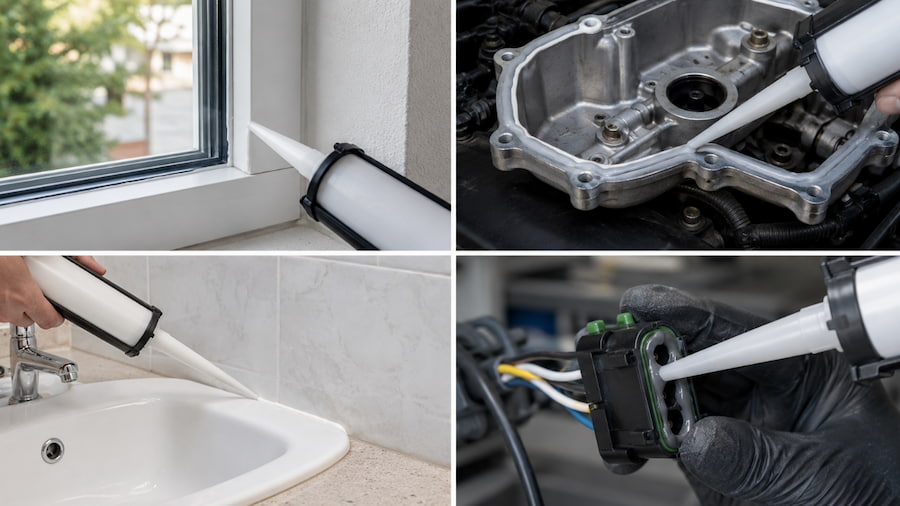
RTV-1 silicone comes as a single-component material. It does not need mixing, making it convenient for repairs, sealing, bonding, and assembly work.
RTV-1 cures when exposed to moisture in the air. The cure begins at the surface and moves inward, so it works well for thinner applications but may be less suitable for very thick sections. Skin-over usually occurs within 15 to 60 minutes, while full cure normally takes 24 to 72 hours depending on humidity, thickness, and formulation.
RTV-1 is commonly used for:
- Sealing
- Gasketing
- Field repairs
- General bonding
- Assembly work
RTV-2 Silicone Gives Better Cure Control
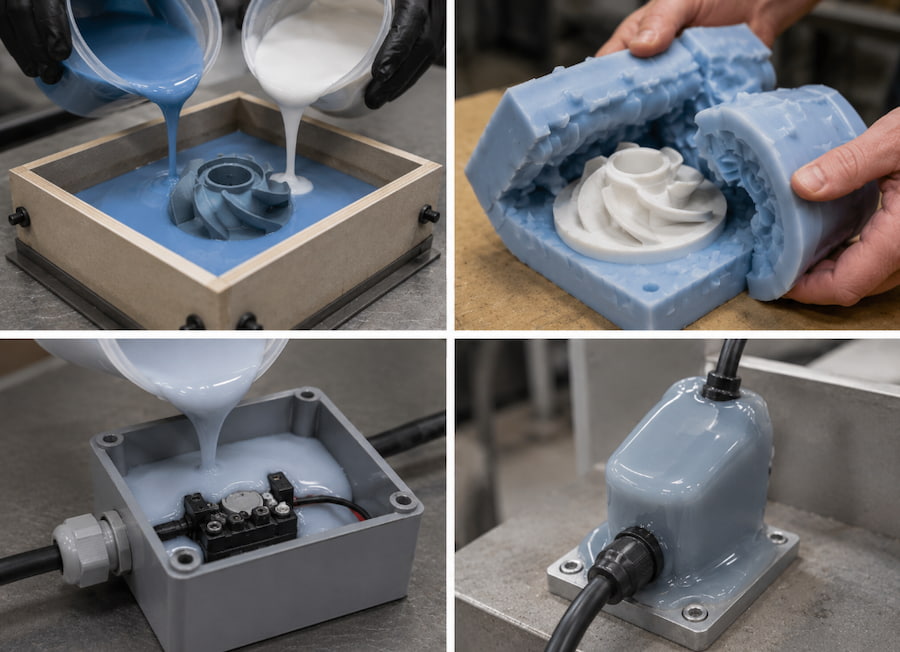
RTV-2 silicone comes as two components: a base and a curing agent. These are mixed before use, which gives better control over cure speed and final properties.
Unlike RTV-1, RTV-2 cures through a chemical reaction after mixing. This allows it to cure more uniformly through thicker sections. It is often used for molding, potting, encapsulation, and applications that require precise cure control.
| Feature | RTV-1 Silicone | RTV-2 Silicone |
| Components | Single-part | Two-part, base + curing agent |
| Cure Trigger | Atmospheric moisture | Chemical catalyst reaction |
| Cure Control | Environment-dependent | Highly controllable |
| Mixing Required | No | Yes |
| Thick Section Curing | Limited | Excellent |
| Pot Life | Not applicable | Adjustable |
| Typical Applications | Sealing, gasketing, field repairs | Molding, potting, encapsulation |
Why Is RTV Silicone Used in Industrial Applications?
RTV silicone offers heat resistance, weather resistance, flexibility, insulation, and easy processing
RTV silicone combines several useful properties in one material. It can withstand high and low temperatures, resist moisture and weathering, provide electrical insulation, absorb vibration, and cure without oven processing.
Key benefits include:
- High and low temperature resistance
- UV, ozone, moisture, and weather resistance
- Electrical insulation
- Flexibility and vibration absorption
- Room-temperature curing
- Strong sealing and bonding performance
- Low cure shrinkage
- Long-term durability
These qualities make RTV silicone suitable for demanding environments where standard sealants, adhesives, or organic rubbers may not perform reliably.
How Well Does RTV Silicone Handle Temperature?
RTV silicone remains stable in hot and cold conditions
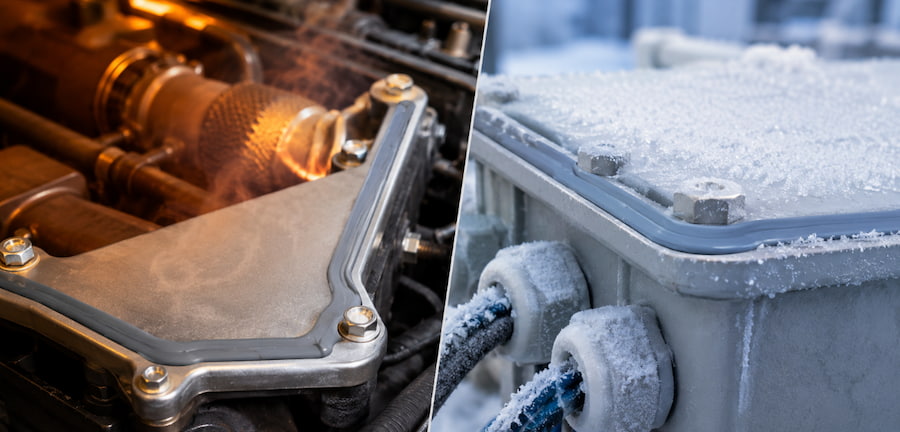
Standard RTV silicone can operate continuously at around 200°C, or 392°F. High-temperature grades can extend performance to 300°C+, or 572°F+, depending on the formulation.
This makes RTV silicone useful for under-hood automotive applications, industrial equipment sealing, electronics protection, and other heat-exposed environments.
RTV silicone also remains flexible at low temperatures. Many organic rubbers become brittle below -40°C, but RTV silicone can stay flexible down to around -60°C, or -76°F. It also handles repeated heating and cooling better than many elastomers, helping seals maintain performance during thermal cycling.
How Does RTV Silicone Perform Outdoors?
RTV silicone resists UV, ozone, moisture, and weathering
RTV silicone performs well outdoors because it resists UV exposure and weathering. Unlike many organic materials, silicone does not easily crack, harden, or degrade under sunlight.
It also resists ozone, moisture, water, salt solutions, dilute acids and bases, and many organic chemicals. This makes it useful for outdoor sealing, marine uses, glazing, bathrooms, kitchens, and industrial environments.
RTV silicone is commonly chosen for outdoor applications because it can help resist:
- Sunlight and UV exposure
- Rain and humidity
- Ozone exposure
- Salt and moisture
- Weather-related expansion and movement
Why Is RTV Silicone Used for Electrical Applications?
RTV silicone provides reliable electrical insulation
RTV silicone is commonly used in electrical and electronic applications because it has strong insulating properties. It helps prevent current leakage, protect components, and maintain performance in harsh environments.
Typical dielectric strength values range from 15 to 25 kV/mm, while volume resistivity often exceeds 10^15 ohm-cm. These properties make RTV silicone useful for potting electronics, insulating high-voltage components, sealing connectors, and protecting electrical systems from moisture, dust, vibration, and heat.
In electrical applications, RTV silicone is often used for:
- Circuit board potting
- Sensor encapsulation
- Connector sealing
- High-voltage insulation
- Thermal management with electrically insulating grades
What Mechanical Properties Make RTV Silicone Useful?
RTV silicone provides flexibility, recovery, and strength options
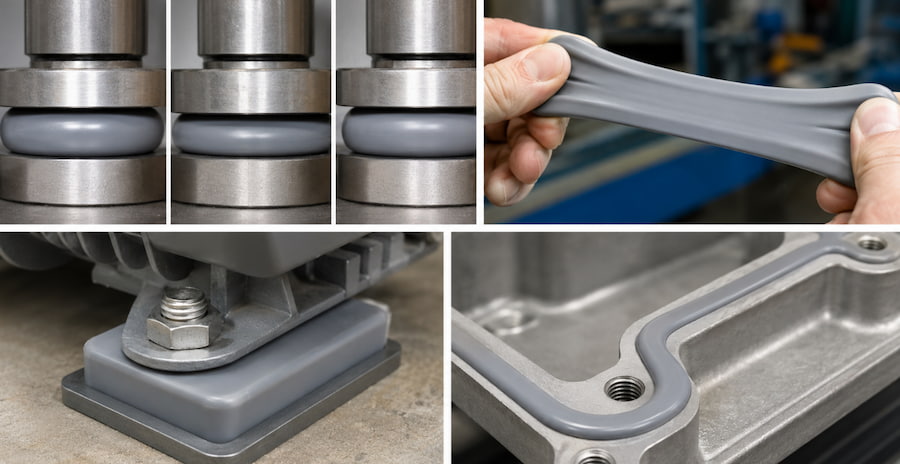
RTV silicone has good elastic recovery, which helps seals, gaskets, and O-rings maintain performance after long periods of compression.
With typical elongation at break of 200% to 500%, it can absorb movement, vibration, and expansion without cracking or tearing. Formulations can also be made soft or firm, with Shore A hardness ranging from around 10 to 80.
This makes RTV silicone suitable for delicate electronics potting, vibration damping, sealing, gasketing, and structural bonding applications. Softer grades are useful where flexibility is needed, while firmer grades can support stronger sealing or bonding requirements.
Why Is RTV Silicone Easier to Process?
RTV silicone cures without ovens and supports flexible production
RTV silicone cures at room temperature, removing the need for heat-curing equipment. This can reduce capital investment, energy use, and processing complexity.
It is easier to process because it offers:
- Room-temperature curing: Removes the need for ovens or heat-curing systems.
- Lower processing complexity: Helps reduce production steps and energy use.
- Suitability for large parts: Useful for components that cannot easily fit into ovens.
- Compatibility with heat-sensitive parts: Suitable for electronics and delicate assemblies.
- Low cure shrinkage: Typically around 0.1% to 0.5%, helping maintain dimensional accuracy.
- Color and clarity options: Available in pigmented, translucent, and clear versions.
RTV-2 systems can also cure uniformly through thick sections, making them suitable for potting large assemblies or creating molds.
How Does RTV Silicone Cure?
RTV silicone cures through moisture-cure, addition-cure, or tin-cure systems
RTV silicone can cure through different mechanisms depending on the formulation. The curing method affects cure depth, speed, substrate compatibility, and final performance.
How Do Moisture-Cure RTV-1 Systems Work?
RTV-1 silicone reacts with moisture in the air
Most RTV-1 silicones cure through condensation reactions with atmospheric moisture. The cure starts at the surface and moves inward.
Acetoxy systems release acetic acid during curing and usually have a vinegar-like smell. They cure quickly and bond well but may corrode sensitive metals.
Alkoxy systems release alcohol and are more suitable for sensitive substrates. Oxime systems provide good adhesion with neutral-cure characteristics.
The main limitation is thick section curing. Since moisture must travel inward, very thick applications may cure slowly or may not fully cure in the center.
How Do Addition-Cure RTV-2 Systems Work?
Platinum-catalyzed RTV-2 systems cure without byproducts
Platinum-catalyzed RTV-2 systems cure through an addition reaction. No byproducts are produced, which makes them suitable for deep section curing, electronics encapsulation, and food-contact applications.
They can also cure faster with heat while still offering useful working time at room temperature. However, substances containing sulfur, nitrogen compounds, tin, or certain other materials can interfere with the catalyst and prevent curing.
How Do Tin-Cure RTV-2 Systems Work?
Tin-cure systems are less sensitive to inhibition but have limits
Tin-catalyzed RTV-2 systems cure through a condensation mechanism. They are often less sensitive to inhibition than platinum systems and may cost less.
However, they release cure byproducts such as alcohols, which can limit deep section curing. They also usually have lower temperature stability than platinum-cured materials.
Where Is RTV Silicone Used?
RTV silicone is used in electronics, automotive, construction, glazing, and industrial equipment
RTV silicone is used across many industries because it can seal, bond, protect, insulate, and absorb movement. Its flexibility and durability make it suitable for both production and maintenance applications.
How Is RTV Silicone Used in Electronics and Electrical Applications?
It protects components from moisture, vibration, dust, and heat
In electronics, RTV-2 silicones are used for potting and encapsulation. They protect circuit boards, sensors, connectors, and electronic assemblies from moisture, dust, vibration, and thermal shock.
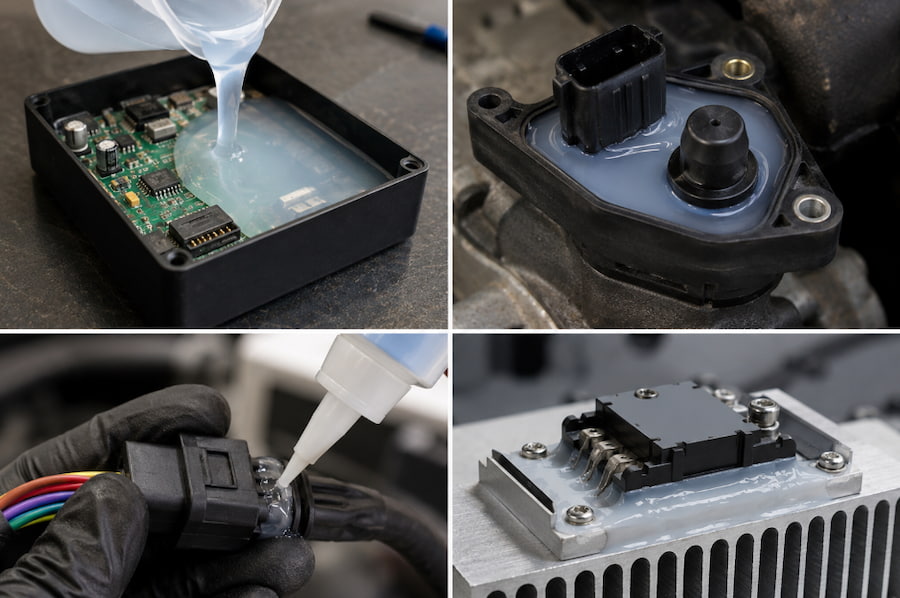
Clear formulations allow visual inspection, while thermally conductive grades help transfer heat while maintaining electrical isolation. RTV-1 silicones are also used to seal connectors and protect electrical systems.
Common uses include:
- Potting circuit boards
- Encapsulating sensors
- Sealing electrical connectors
- Protecting components from dust and moisture
- Supporting heat transfer in electronic assemblies
How Is RTV Silicone Used in Automotive Applications?
It seals engine parts and protects sensors
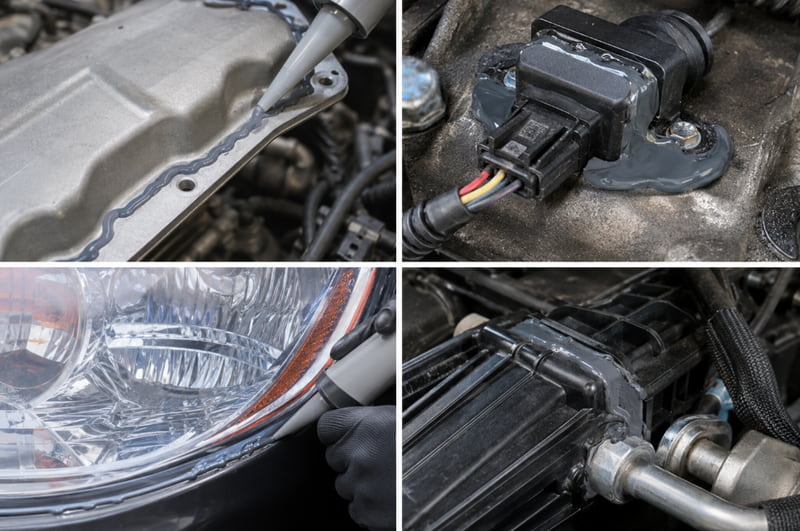
High-temperature RTV silicones are used to seal engine components, oil pans, valve covers, and other areas where traditional gaskets may be replaced or supported.
RTV silicone also protects sensors from heat, fluids, and vibration. In lighting assemblies, it helps prevent moisture intrusion while allowing thermal expansion. HVAC systems use RTV silicone seals because they can withstand temperature cycling and refrigerant exposure.
How Is RTV Silicone Used in Construction and Glazing?
It provides durable sealing, bonding, and weather protection
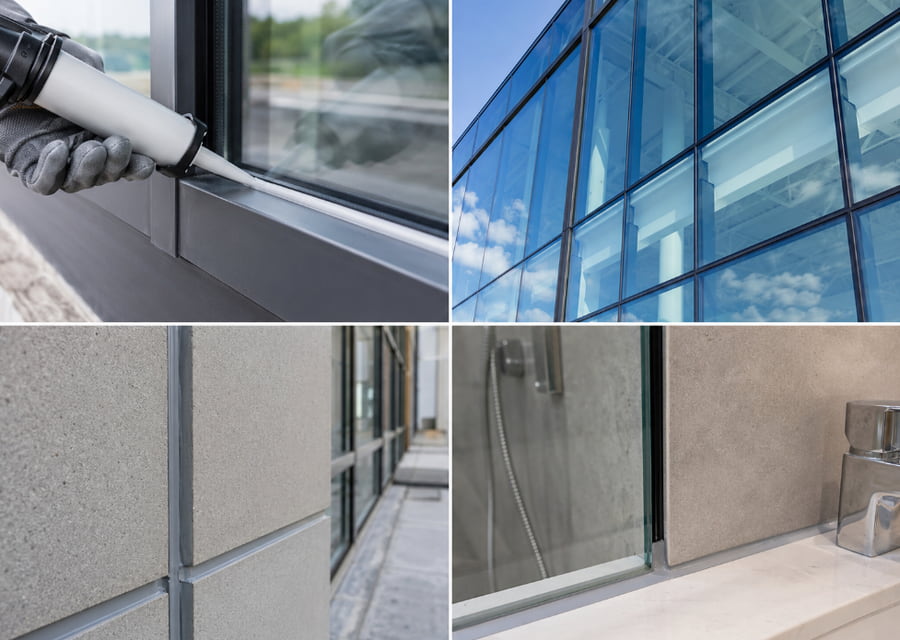
RTV silicone is widely used in construction and glazing because it resists UV exposure, weathering, moisture, and building movement.
In structural glazing, high-strength RTV silicone can bond glass panels to building frames. It is also used for windows, doors, curtain walls, exterior joints, expansion joints, bathrooms, and kitchens.
Because buildings naturally move due to wind, temperature changes, and settlement, flexible sealing materials are important. RTV silicone helps maintain weather protection while allowing controlled movement.
How Is RTV Silicone Used in Industrial Equipment?
It supports gasketing, molding, vibration damping, and repairs
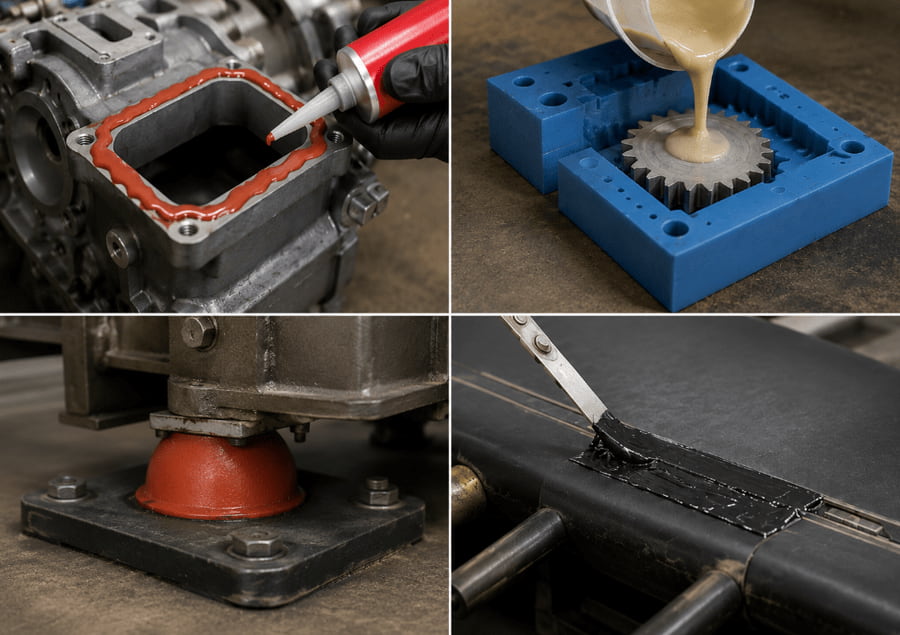
RTV silicone is useful in industrial equipment because it can seal irregular surfaces, form custom gaskets, absorb vibration, and support repair work.
Common industrial uses include:
- Gasket formation: RTV-1 gasket maker compounds can create custom gaskets in place.
- Molding: RTV-2 systems can make flexible molds for casting plastics, concrete, and other materials.
- Vibration damping: Softer RTV formulations can help isolate movement and absorb impact.
- Belt repairs: RTV compounds may be used for repairs and splices on rubber or synthetic conveyor belts, depending on the application.
How Should Engineers Choose the Right RTV Silicone?
Selection depends on temperature, environment, processing needs, performance, and cost
Choosing the right RTV silicone requires looking at the operating environment and the performance needed from the final part or seal.
Engineers should consider:
- Operating temperature
- UV, moisture, chemical, or outdoor exposure
- Cure speed and working time
- Substrate compatibility
- Required hardness and flexibility
- Electrical or thermal conductivity needs
- Food-contact or medical requirements
- Total lifecycle cost
What Temperature Range Should Be Considered?
The working temperature helps determine the suitable RTV type
| Temperature Range | Recommended RTV Type | Notes |
| -60°C to 150°C | Standard RTV-1 or RTV-2 | General-purpose use |
| 150°C to 200°C | High-temperature RTV-2 | Heat-resistant grades |
| 200°C to 300°C | Specialized high-temperature RTV | Limited color options |
| Cyclic thermal shock | Addition-cure RTV-2 | Better thermal stability |
What Environmental Exposure Should Be Considered?
Outdoor, chemical, food, and medical exposure affect material choice
For outdoor or UV exposure, UV-stabilized RTV silicone formulations are preferred. Alkoxy or oxime cure systems may be selected when acetic acid byproducts could affect nearby materials.
For chemical exposure, compatibility with the specific chemicals involved should be checked. Fluorosilicone RTV can improve resistance to fuels and solvents.
For food-contact applications, FDA-compliant platinum-cure RTV-2 systems are typically used. For medical applications, USP Class VI certified biocompatible grades may be required.
What Processing Factors Matter?
Production volume, cure speed, and substrate compatibility influence selection
High-volume production often benefits from fast-cure RTV-2 systems and automated dispensing. Low-volume applications, repairs, and field sealing may be better suited to RTV-1 systems.
Cure speed also matters. Rapid assembly may need fast-skinning RTV-1 or heat-accelerated RTV-2. Large castings may require longer pot life for pouring and deaeration.
Some low-surface-energy plastics, such as polypropylene and polyethylene, may require surface treatment or primers for reliable bonding.
What Performance Requirements Should Be Prioritized?
Flexibility, strength, clarity, conductivity, and insulation should match the application
Different RTV silicone grades are designed for different performance needs. The right choice depends on whether the application needs softness, strength, transparency, heat transfer, or electrical behavior.
For example:
- Soft grades: Useful when high flexibility is required.
- Firm grades: Better for stronger or more structural applications.
- Clear grades: Suitable for lens applications or visible encapsulation.
- Thermally conductive grades: Support heat transfer.
- Electrically conductive grades: Help with EMI shielding or static dissipation.
- Insulating grades: Used for standard electrical protection.
Is RTV Silicone Cost-Effective?
RTV silicone can cost more upfront but may offer better lifecycle value
RTV silicone usually costs more per kilogram than many organic sealants and adhesives. However, cost should not be judged only by initial material price.
In outdoor applications, RTV silicone can offer a 20 to 40 year service life, which may reduce maintenance, downtime, and replacement needs. Room temperature curing can also reduce processing costs by removing the need for oven curing equipment and related energy use.
For production applications, bulk procurement may reduce per-unit cost. Any pricing or cost comparisons should remain in baht or USD if the article is targeting regional or international buyers.
Conclusion
RTV silicone offers a strong balance of temperature resistance, weather durability, electrical insulation, flexibility, and processing convenience. These qualities make it useful across electronics, automotive, construction, glazing, and industrial equipment applications.
Understanding the differences between RTV-1 and RTV-2 systems, the curing methods, and the key selection factors helps engineers and procurement teams choose the right material for each application. While RTV silicone may have a higher upfront material cost than some organic alternatives, its long service life and reliability can offer better lifecycle value.
For companies sourcing custom products, branded components, POS displays, corporate gifts, promotional items, or production support in the region, we at Flexion help manage the process from product design and sourcing to production, prototyping, and delivery. Our experience across branded merchandise, POS materials, corporate gifts, retail items, and printed materials allows us to support businesses that need practical sourcing knowledge and reliable production coordination. For brands exploring material-led product development or Silicone rubber in Thailand solutions, we can help connect product ideas with suitable manufacturing possibilities in the region.
As performance demands increase, RTV silicone remains a valuable material for critical sealing, bonding, insulation, and protection applications. Its proven performance across demanding environments gives engineers and buyers confidence when specifying it for industrial use.
FAQ
What does RTV silicone stand for?
RTV stands for Room Temperature Vulcanizing. It refers to silicone materials that cure into elastic rubber at room temperature without requiring external heat.
What is the difference between RTV-1 and RTV-2 silicone?
RTV-1 is a single-component material that cures when exposed to moisture in the air. RTV-2 is a two-component system made of a base and curing agent. RTV-2 provides better cure control and is more suitable for thicker sections.
How long does RTV silicone take to cure?
RTV-1 typically skins over in 15 to 60 minutes and fully cures in 24 to 72 hours depending on humidity and thickness. RTV-2 pot life can range from minutes to hours, with full cure usually achieved within 24 hours at room temperature or faster with heat.
Is RTV silicone food safe?
Certain RTV silicone formulations are suitable for food-contact applications. These are typically FDA-compliant platinum-cure RTV-2 systems. Specific certifications should always be checked before use.
What temperature can RTV silicone withstand?
Standard RTV silicone typically operates from -60°C to 200°C, or -76°F to 392°F. High-temperature grades can extend to around 300°C, or 572°F.
Can RTV silicone be used outdoors?
Yes, RTV silicone performs well outdoors because it resists UV exposure, ozone, moisture, and weathering.
What materials does RTV silicone not stick to?
RTV silicone can struggle to bond to polyethylene, polypropylene, PTFE, also known as Teflon, and other low-surface-energy plastics without surface treatment or primers. It also does not bond well to oily or contaminated surfaces.
How do I remove cured RTV silicone?
Mechanical removal with scraping tools is usually most effective. Chemical removal is difficult because cured silicone is chemically resistant.
Is RTV silicone electrically conductive?
Standard RTV silicone is an electrical insulator. Specialized formulations with conductive fillers such as carbon or silver can provide electrical conductivity for EMI shielding or static dissipation.
Can I paint over RTV silicone?
Paint generally does not adhere well to cured silicone. Specialized primers or paintable silicone formulations may be needed where coating compatibility is required.