
HCR SILICONE FOR INDUSTRIAL MACHINERY
2026

HCR SILICONE FOR INDUSTRIAL
MACHINERY 2026: ANTI-VIBRATION
MOUNTS, HIGH-TEMPERATURE ROLLER
COVERINGS, ROTARY SHAFT SEALS,
OVERMOLDING, VIBRATION DAMPING,
AND 20-YEAR LIFECYCLE GUIDE
High Consistency Rubber (HCR) silicone is a heat-cured, high-molecular-weight polydimethylsiloxane elastomer formulated with fumed silica, heat stabilizers, and performance fillers. In industrial machinery, it stands out for its low compression set, tunable damping, strong dielectric properties, and broad continuous service range from sub-zero conditions up to high-heat operating environments. Specialty grades can go even further, making HCR a go-to material when other elastomers begin to harden, crack, drift, or lose sealing force.
That combination of thermal stability, vibration control, and long-term dimensional retention is why HCR is widely used in anti-vibration mounts, roller coverings, rotary shaft seals, custom diaphragms, bellows, cable protection parts, and overmolded components. In real factory environments, these parts are often exposed to heat, oil mist, ozone, cyclic loads, washdowns, and constant vibration. HCR performs well because it keeps its shape, damping behavior, and sealing force longer than many traditional organic rubbers.
The industrial machinery market is also becoming less forgiving. Tolerances are tighter, downtime is more expensive, and maintenance teams are under pressure to extend asset life without sacrificing reliability. In that environment, HCR is not just a premium elastomer choice. It is often a lifecycle decision. It helps reduce mount drift, premature roller wear, seal leakage, vibration-related bearing damage, and repeated recalibration costs that quietly accumulate over time.

CORE MATERIAL
SCIENCE AND WHY IT
WORKS
At the heart of HCR silicone is its silicon-oxygen backbone. This structure gives the material much of its well-known thermal and oxidative stability. Reinforcing silica helps increase tear strength while preserving elasticity, and the cure system controls how soft, resilient, damped, or compression-resistant the final compound becomes.
In practical terms, that means HCR can be tuned for very different machinery duties. One formulation may prioritize damping and vibration isolation. Another may prioritise a low compression set for long-term sealing. Another may be engineered for grip, release, oil resistance, or electrical insulation. That flexibility is one reason HCR remains relevant across such a wide range of equipment types.
WHY THESE MECHANISMS MATTER IN MACHINERY
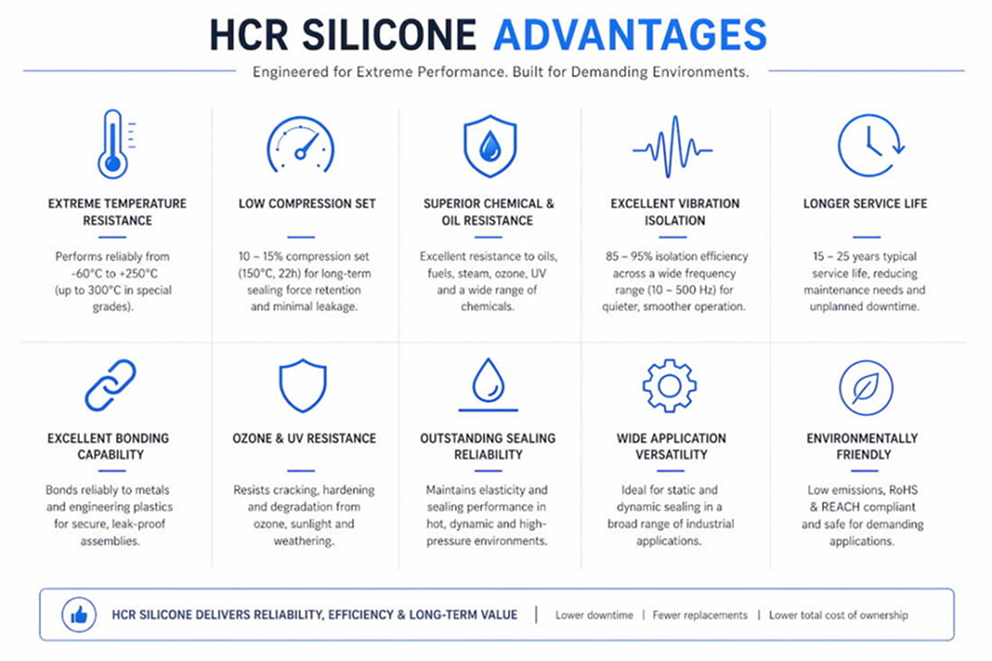
- Vibration damping allows HCR to absorb and convert part of the mechanical energy into heat, helping reduce transmitted vibration and noise.
- Low compression set helps parts keep their sealing force and dimensional stability over long operating periods, especially in hot environments.
- Surface tunability allows compounds to be adjusted for either traction or release, depending on whether the application is conveying, processing, laminating, or sealing.
- Environmental resistance helps HCR resist cracking, hardening, and degradation caused by UV, ozone, temperature swings, oils, and many industrial cleaning conditions.
- Bonding capability allows HCR to be overmolded or bonded to metal and engineering plastics for multi-material parts that need both structural support and elastomer performance.
VIBRATION ISOLATION AND ANTI-VIBRATION
MOUNTS
Vibration in industrial machinery does more than create noise. It shortens bearing life, reduces machining accuracy, accelerates fatigue, loosens fasteners, and can affect product quality. A good anti-vibration mount must do two things at once: support the equipment load and isolate disturbing frequencies without excessive creep or drift.
HCR is especially valuable where long-term consistency matters. Traditional rubbers may provide decent damping at first, but they often lose performance as they age under heat, oil exposure, or ozone. That change can alter the natural frequency of the mount, which reduces isolation efficiency and forces recalibration or replacement sooner than expected.
HCR VS TRADITIONAL MOUNT
MATERIALS
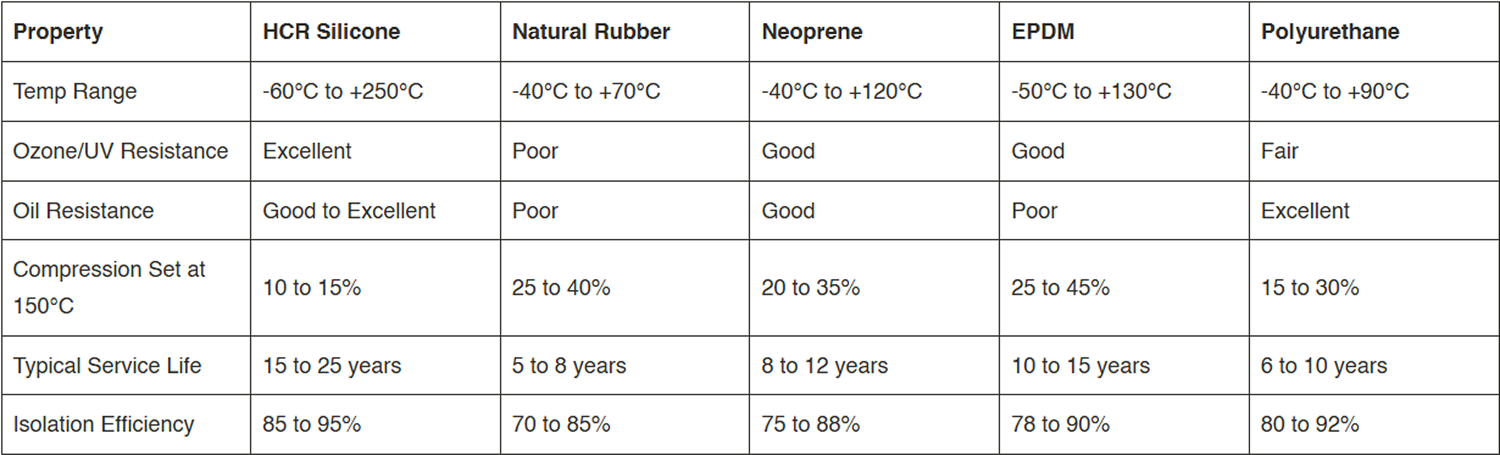
The key takeaway is not that HCR beats every material in every category. It is that HCR keeps performing in the categories that matter most when machinery runs hot, continuously, and under real-world environmental stress.
TYPICAL MACHINERY FIT
ROLLER COVERINGS, BELTING SURFACES, AND
RELEASE APPLICATIONS
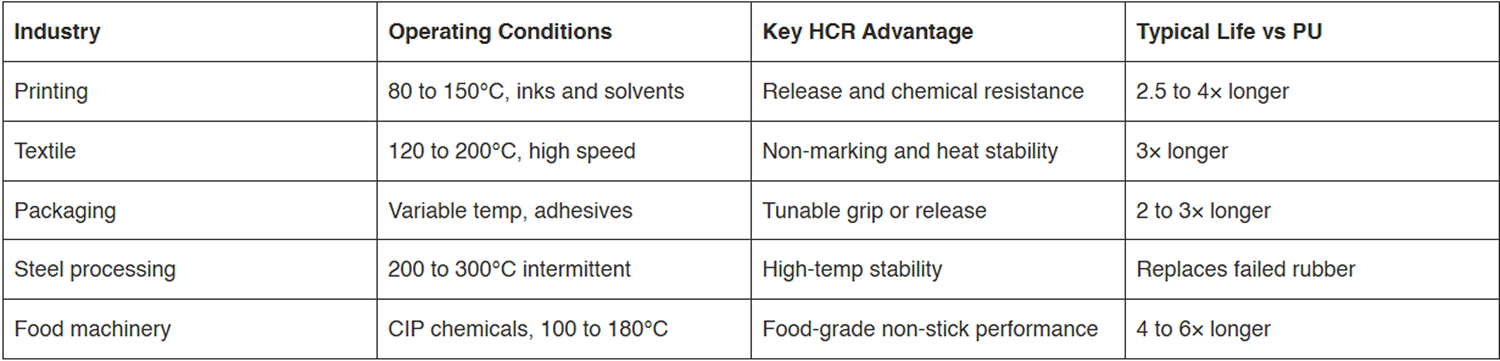
HCR roller coverings are especially useful when heat resistance, chemical resistance, release performance, or cleanliness are more important than raw abrasion resistance alone. That is why they often outperform standard rubber and sometimes justify replacing polyurethane in hot-process environments.
In printing, packaging, textiles, food processing, and some steel-related operations, the real issue is not simply wear. It is whether the roller can maintain surface stability, grip, release, and dimensional consistency while being exposed to heat, chemicals, speed, and cleaning cycles. HCR performs well because it can be formulated for either low-friction release or high-grip transport while staying stable across repeated thermal cycles.
SEALING SOLUTIONS FOR HOT, DYNAMIC
SYSTEM
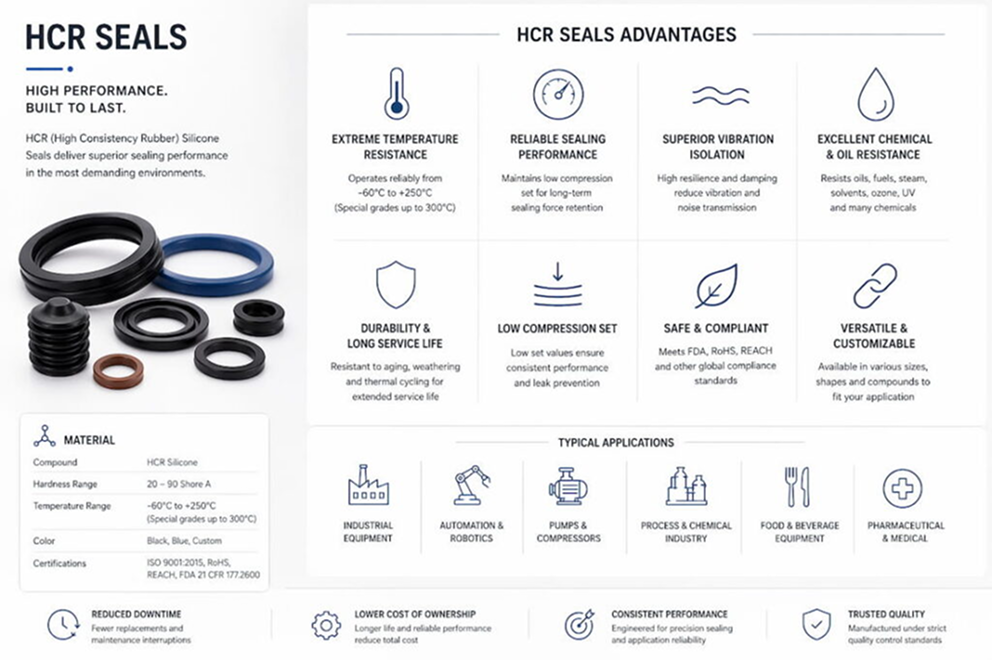
For seals, HCR becomes attractive when temperature, compression retention, washdown exposure, or long service intervals matter more than lowest initial cost. It is well suited to moderate-pressure hydraulic and fluid systems, hot oil zones, steam-adjacent applications, and rotating equipment where conventional elastomers lose sealing force too quickly.
Low-friction HCR grades can also reduce torque in rotary shaft seals, while custom profiles can support high ingress protection requirements in washdown-heavy machinery. The biggest advantage is usually stability over time. A seal that keeps its force and geometry longer tends to leak less, require fewer shutdowns, and create fewer secondary issues.

OVERMOLDING AND CUSTOM MOLDED PARTS
One of HCR’s strongest commercial advantages is that it is not limited to simple molded seals. With the right primer system and process control, it can be bonded to metals and engineering plastics to create more integrated parts. That includes actuator boots, cable grommets, damped wheels, soft interfaces, and protective covers that need both structure and flexibility.
This matters because OEMs increasingly want to reduce assembly complexity. A well-designed overmolded part can combine sealing, damping, insulation, and protection in one component. That improves reliability and often reduces part count, secondary assembly steps, and tolerance stack-up.
PERFORMANCE IN HARSH INDUSTRIAL
ENVIRONMENTS
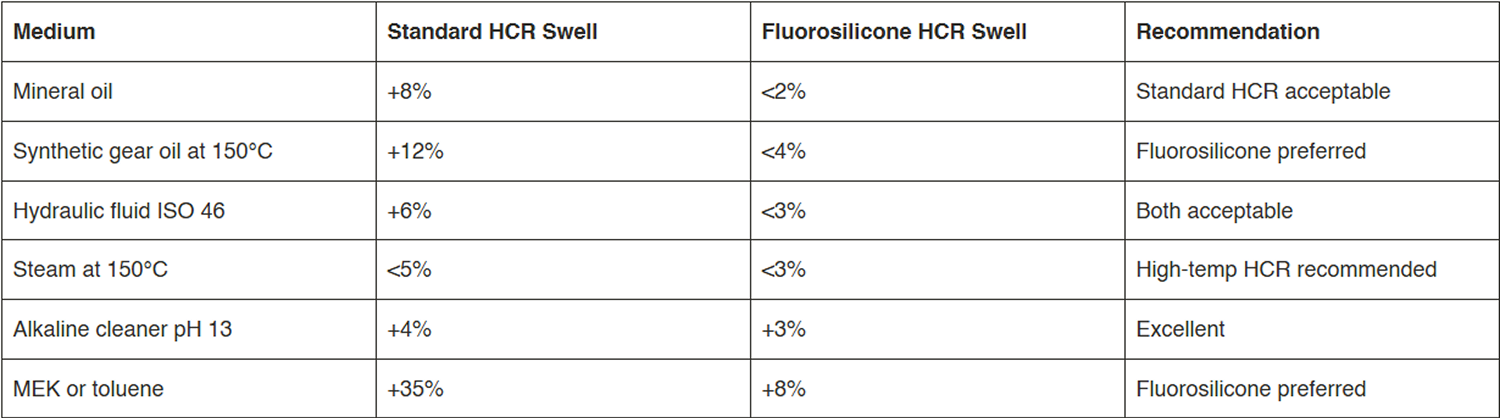
Industrial machinery rarely operates in ideal lab conditions. Heat, chemicals, oils, cleaning agents, and steam all affect elastomer life. HCR is strong in many of these environments, but compound selection still matters. Standard HCR may perform very well in hot air, ozone, UV, and moderate oil exposure, while fluorosilicone-modified grades are often better in more aggressive fuels or solvents.
STANDARDS,
TESTING, AND
SUPPLIER QUALITY
In industrial programs, material performance alone is not enough. Qualification, traceability, and process control matter just as much. Most buyers should treat ISO 9001 as the baseline. Automotive and high-compliance supply chains may also expect IATF 16949, while food, electrical, or medical-adjacent applications may require additional regulatory or test documentation.
Useful test and qualification areas include compression set, tensile properties, dynamic mechanical behavior, flame performance where relevant, and application-specific vibration validation. For critical programs, suppliers should also be able to support traceability, FMEA, PPAP or equivalent packages, and documented process control.
LIFECYCLE COST AND ROI
HCR usually loses the upfront cost comparison. It wins when downtime, recalibration, service intervals, and replacement labor are included. That is why total cost of ownership is the right framework.
15-YEAR TCO EXAMPLE
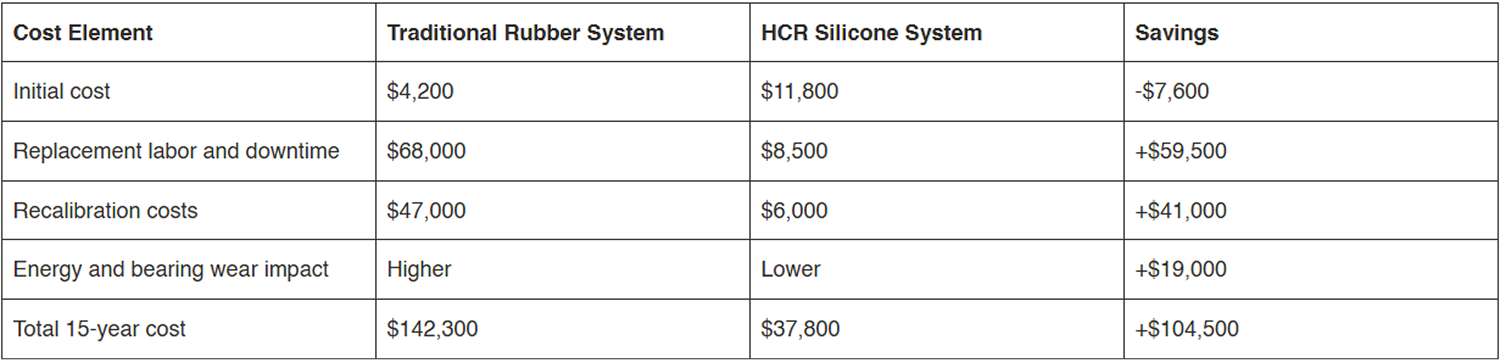
That kind of gap is why HCR often makes sense in precision equipment, high-temperature machinery, and production lines where one unplanned stop can cost more than the entire component package.

SUSTAINABILITY AND
LONG-LIFE VALUE
HCR’s sustainability case is driven more by lifespan than by low raw material cost. When a component lasts 15 to 25 years instead of 5 to 8, the reduction in replacements, logistics, maintenance labor, and associated waste becomes meaningful. Long-life parts also help support preventive maintenance programs and broader operational targets tied to waste reduction and asset efficiency.
For many buyers, this is the real sustainability story. HCR is not simply a premium elastomer. It is a way to reduce failure frequency across the life of the machine.
2026 TO 2030 TECHNOLOGY DIRECTION
The next phase of HCR in machinery is moving beyond passive parts. Sensor-enabled mounts, advanced damping layers, self-bonding grades, and faster prototyping workflows are pushing silicone components into a more active role in machine design and monitoring.

CONCLUSION
HCR silicone has become one of the most valuable elastomer choices in industrial machinery because it combines long service life, stable damping behavior, high-temperature resistance, and dependable sealing performance in one material system. That makes it especially useful in equipment where vibration, heat, chemicals, and maintenance frequency directly affect uptime, product quality, and total operating cost.
For companies moving from simple replacement thinking to full lifecycle engineering, High Consistency Rubber is often the better strategic choice, not just the better material. We, at Flexion positions ourselves as an engineering-driven silicone manufacturing partner producing silicone components in Thailand and Vietnam, with capabilities spanning custom formulations, HCR, LSR, extrusion, compression molding, transfer molding, and coated solutions, alongside compliance-focused production for industrial, food-contact, automotive, and medical-related applications. That makes us a relevant partner for OEMs and buyers who need custom HCR parts backed by process control, traceability, and manufacturing support rather than off-the-shelf commodity supply.
how we help you decide
We assess your operating fluids, temperature profile, sealing dynamics, and cost targets, then recommend fluorosilicone or alternatives where appropriate. If abrasion, dynamic motion, or strict cost caps are dominant constraints, we document why another elastomer may be better and outline the tradeoffs.
Request a Proposal or Book a Discovery Call to get a tailored materials recommendation.
book a
discovery call