
HCR SILICONE FOR ELECTRONICS INDUSTRY
2026

High Consistency Rubber (HCR) silicone is a heat-cured, high-viscosity elastomer compounded from polydimethylsiloxane (PDMS) polymers, fumed silica reinforcement (20–40%), platinum or peroxide catalysts, and functional fillers. It delivers dielectric strength of 20–25 kV/mm, volume resistivity of 10¹⁴–10¹⁵ Ω·cm, compression set below 15%, and continuous operation from -60°C to +250°C. These attributes make it the preferred material for cable insulation, connector seals, thermal interface materials (TIMs), keypads, and potting compounds in consumer electronics, industrial automation, medical devices, data centers, 5G infrastructure, and electric vehicle (EV) power electronics.
The global electronics encapsulation and sealing market is projected to reach $9.8 billion by 2028 (IDTechEx 2025), driven by demands for 15–25 year reliability in harsh environments, miniaturization, higher voltages in EVs (800V+ architectures), mmWave 5G signal integrity, and stricter regulations including UL 746, RoHS 3, REACH, and IPC-9202. HCR silicone solves persistent failure modes such as moisture ingress, thermal cycling stress, arc tracking, and EMI leakage, where EPDM, PVC, XLPE, and many thermoplastics degrade.

CORE MECHANISMS:
WHY HCR SILICONE EXCELS IN
ELECTRONIC
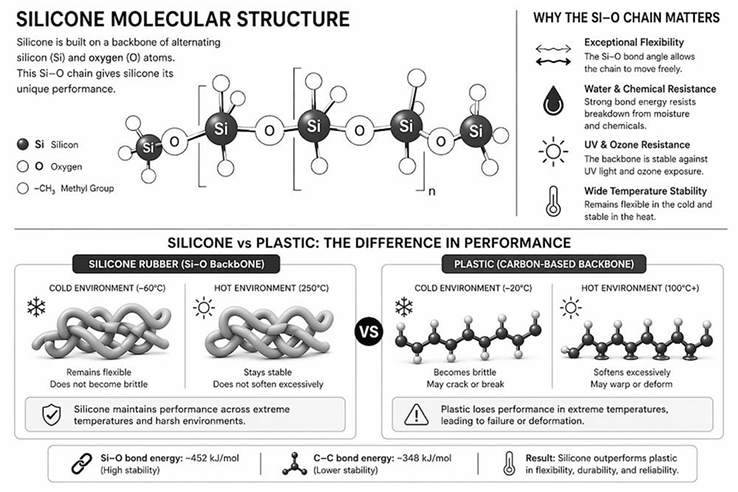
The silicon-oxygen backbone provides inherent thermal-oxidative stability (bond energy 452 kJ/mol vs 348 kJ/mol for C-C bonds). Fumed silica creates a reinforcing network that maintains mechanical integrity while preserving low modulus (1–5 MPa). Platinum-catalyzed addition cure systems minimize volatiles (<0.1% post-cure), critical for sensitive circuits and outgassing per ASTM E595.
ELECTRICAL PERFORMANCE MECHANISMS
- High dielectric strength results from low ionic impurity levels and uniform cross-link density, preventing partial discharge and tracking.
- Low dissipation factor (0.001–0.01) minimizes signal loss in RF and high-frequency applications up to 110 GHz.
- Arc resistance of 120–180 seconds allows self-extinguishing behavior without halogenated additives in many grades.
THERMAL AND MECHANICAL MECHANISMS
- Low glass transition temperature (Tg ≈ -120°C) ensures flexibility in cold-start aerospace or outdoor 5G base stations.
- Low compression set (<15% after 1,000 h at 150°C, ASTM D395) maintains contact pressure in connectors and seals through 10,000+ thermal cycles.
- Low modulus reduces stress on delicate solder joints and wire bonds by accommodating coefficient of thermal expansion (CTE) mismatches between silicon (2.6 ppm/°C), metals, and PCBs.
CHEMICAL AND ENVIRONMENTAL MECHANISMS
Hydrophobic surface (contact angle >100°) combined with chemical inertness resists oils, fuels, cleaning solvents, and humidity, supporting IP69K ratings under high-pressure steam.
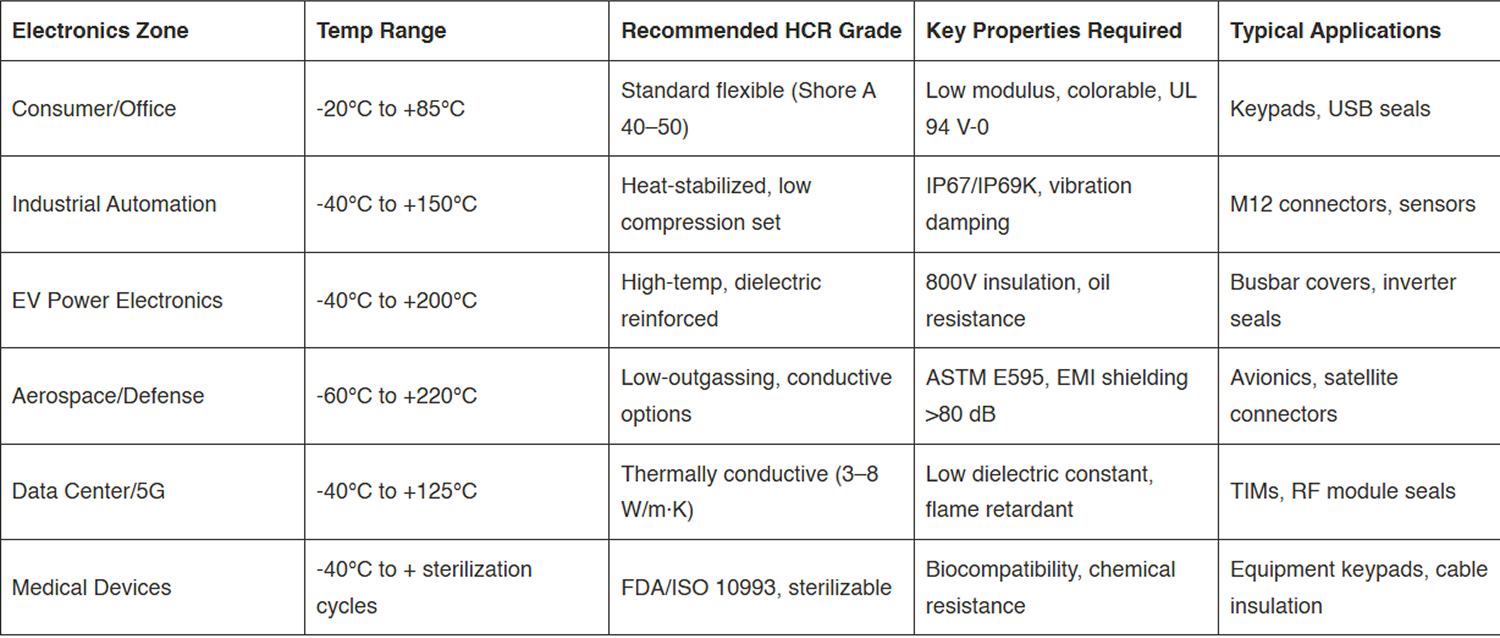
TEMPERATURE ZONES AND
GRANDE SELECTION TABLE
HEAD-TO-HEAD MATERIAL COMPARISONS
ELECTRICAL AND THERMAL
PROPERTIES MATRIX
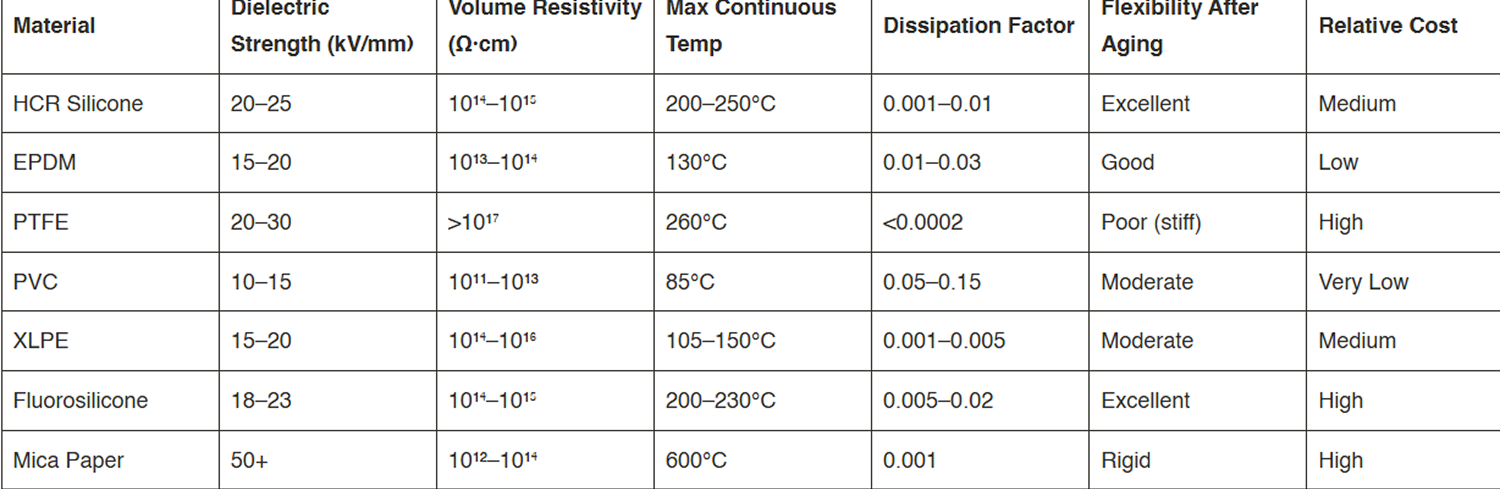
HCR consistently wins in applications requiring combined electrical reliability, flexibility, and long-term stability under thermal cycling.

FAILURE MODE ANALYSIS
AND MITIGATION
Electronics failures from sealing materials account for ~23% of field returns in industrial and automotive sectors (IPC 2024 data). Primary modes include:
- Moisture-Induced Corrosion: HCR’s low water absorption (<0.5%) and maintained sealing force prevent this; EPDM often loses compression set >30% within 2 years.
- Thermal Fatigue Cracking: Low-modulus HCR reduces stress by 60–80% on solder joints compared to rigid epoxies.
- Arc Tracking and Carbonization: High arc resistance and filler packages prevent conductive paths.
- Outgassing in Vacuum: Post-cured platinum grades meet NASA ASTM E595 (TML <1%, CVCM <0.1%).
MAJOR ELECTRONICS APPLICATIONS WITH PERFORMANCE DATA
Cable Insulation and Sheathing
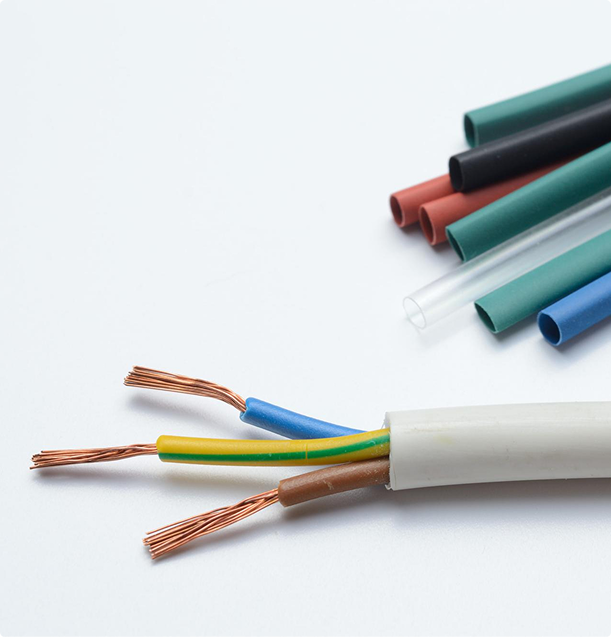
HCR compounds are extruded over conductors for high-flex, high-temperature wire. They achieve UL 758 recognition, VW-1 flame rating, and low smoke zero halogen (LSZH) performance. In EV battery harnesses, they withstand 200°C near cells while providing 20 kV/mm insulation for 800V systems. Tear strength of 15–25 kN/m resists abrasion during assembly and vibration in industrial robotics.
Connector Seals, O-Rings, and Grommets
Molded HCR seals maintain IP69K after 1,000 mating cycles and 5,000 thermal shocks (-40°C to +150°C). Low compression set (10–15%) ensures consistent interference fit. Conductive grades with nickel-graphite or silver fillers achieve 60–100 dB EMI shielding effectiveness from 30 MHz to 10 GHz (Chomerics data).
Grommets, Bushings, and Strain Reliefs
These protect wire pass-throughs from chafing, vibration fatigue (10–2,000 Hz), and EMI. Multi-durometer designs combine soft sealing lips (Shore A 30) with firmer bodies (Shore A 70). In data center servers, they reduce resonant vibration transmission by 40%.
Keypads, Overlays, and Human-Machine Interfaces (HMI)
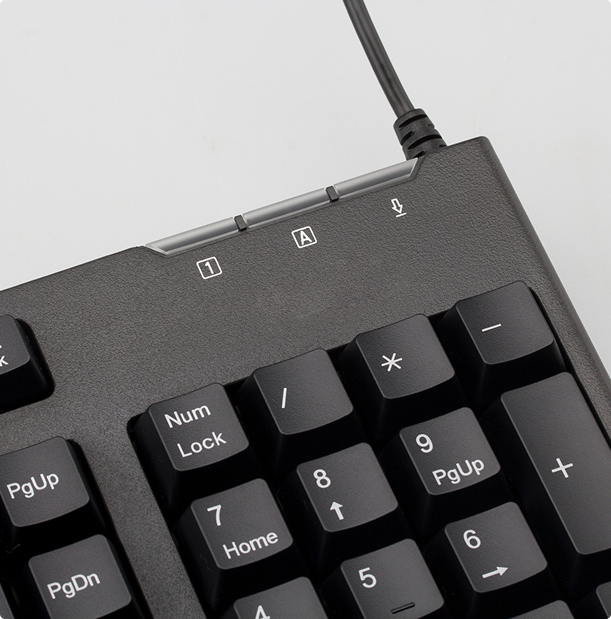
HCR silicone rubber keypads deliver snap ratios of 40–60%, actuation forces of 0.8–2.5 N, and >1 million cycles before failure. Conductive carbon or silver pills enable membrane-switch functionality. Medical versions withstand 500+ autoclave cycles or chemical sterilization while meeting ISO 10993-5 cytotoxicity requirements. UV-stable pigments prevent yellowing in outdoor control panels.
Encapsulation, Potting, and Conformal Coatings
Unlike rigid epoxy (modulus >1 GPa), HCR potting compounds (modulus 1–5 MPa) minimize stress on fine-pitch BGAs and fragile wire bonds during -55°C to +150°C cycling. Repairability is a major advantage — sections can be cut out and re-potted. Low-ion, low-outgassing grades protect satellite electronics and LED drivers.
Thermal Interface Materials (TIMs)
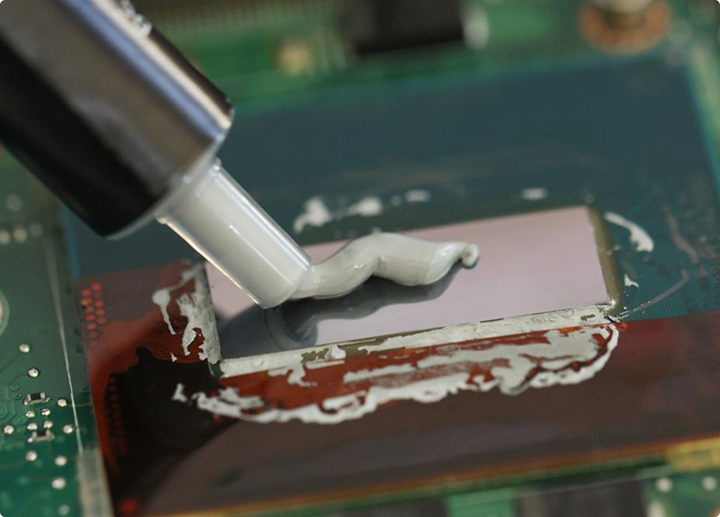
HCR-based gap fillers and pads with alumina, boron nitride, or aluminum oxide fillers achieve 1.5–8 W/m·K thermal conductivity while maintaining electrical isolation (>10¹² Ω·cm). They conform to surface irregularities under low pressure (10–50 psi), reducing thermal resistance by 30–50% versus mica or grease in power modules and 5G RF amplifiers.
High-Voltage and Power Electronics
In EV inverters and onboard chargers, HCR slot liners, busbar insulation, and terminal seals withstand partial discharge >5 kV and oil immersion. Flame-retardant grades meet UL 94 V-0 with halogen-free formulations, critical for passenger safety.

MANUFACTURING PROCESSES FOR
ELECTRONICS-GRADE HCR
PRIMARY METHODS
- Compression and Transfer Molding — Preferred for connectors, keypads, and complex seals (cycle time 2–6 min at 170–190°C).
- Extrusion — For cable insulation and continuous profiles, followed by continuous vulcanization (CV) in hot air or steam.
- Liquid Injection Molding (LIM) — For high-volume keypads and grommets using pumpable HCR variants.
- Calendering and Coating — For TIM sheets and conductive shielding layers.
PROCESS SELECTION TABLE

All processes require clean rooms for electronics grades to limit ionic contamination.
QUALITY STANDARDS, TESTING, AND
REQULATORY COMPLIANCE
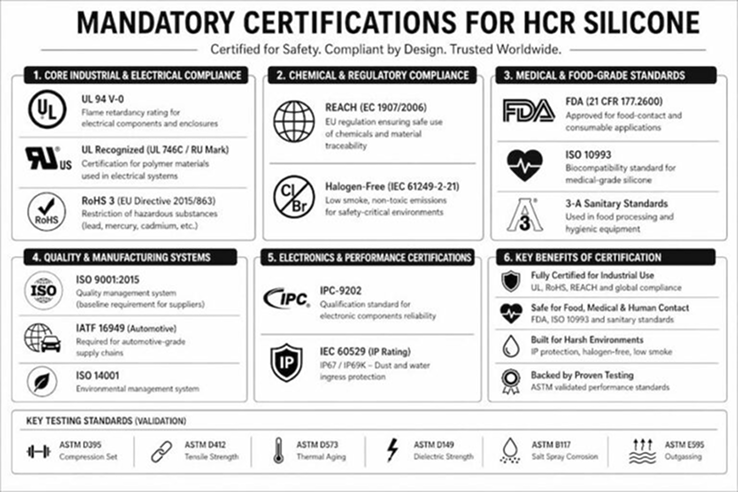
Mandatory Certifications
- UL 94 (V-0, V-1), UL 746B (long-term thermal aging), UL 1446 (insulation systems)
- IPC-CC-830 for conformal coatings
- RoHS 3, REACH SVHC compliance, Conflict Minerals
- FDA 21 CFR 177.2600 or ISO 10993 for medical/food-contact electronics
- ASTM E595 for space-grade low outgassing
Key Test Protocols
- Dielectric strength (ASTM D149), volume resistivity (ASTM D257), dielectric constant (ASTM D150)
- Thermal aging (UL 746B), thermal conductivity (ASTM D5470)
- Vibration (IEC 60068-2-6), IP testing (IEC 60529), salt spray (ASTM B117)
Regional Regulatory Snapshot
- North America: UL dominates; California Proposition 65 restricts certain additives.
- EU: REACH Annex XVII and WEEE Directive drive halogen-free, recyclable solutions.
- Asia: China GB standards and Japan’s PSE law emphasize flame retardance for consumer products.
COST STRUCTURE AND
10-YEAR ROI ANALYSIS
Example: Industrial Sensor Connector Seal Set (10,000 units/year)
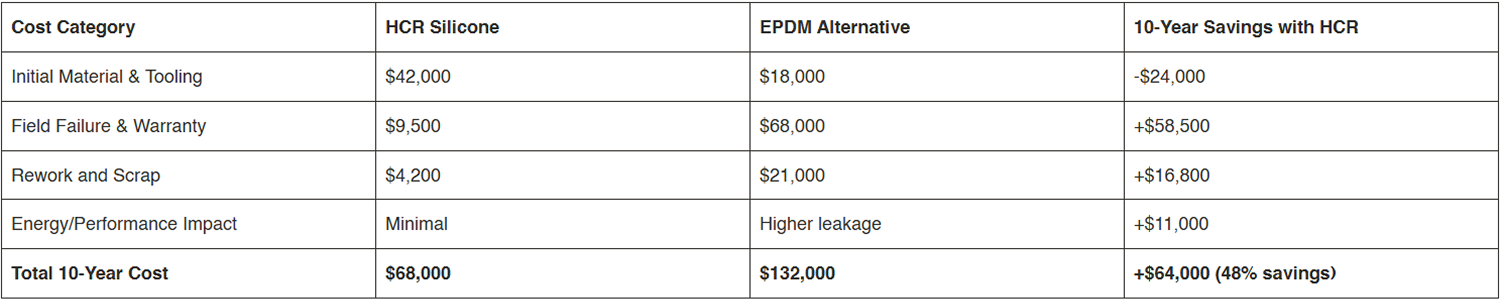
HCR reduces warranty claims by 70–85% in high-reliability applications through superior sealing and thermal stability.

SUSTAINABILITY METRICS
HCR’s 15–25 year lifespan cuts replacement frequency by 60–75% versus EPDM or TPE, lowering Scope 3 emissions. Platinum-cured systems produce near-zero VOCs. Mechanical recycling rates for production scrap reach 40% into non-electrical compounds. Several suppliers (Dow, Wacker) now offer grades with 20–30% recycled silicone content without compromising electrical properties.
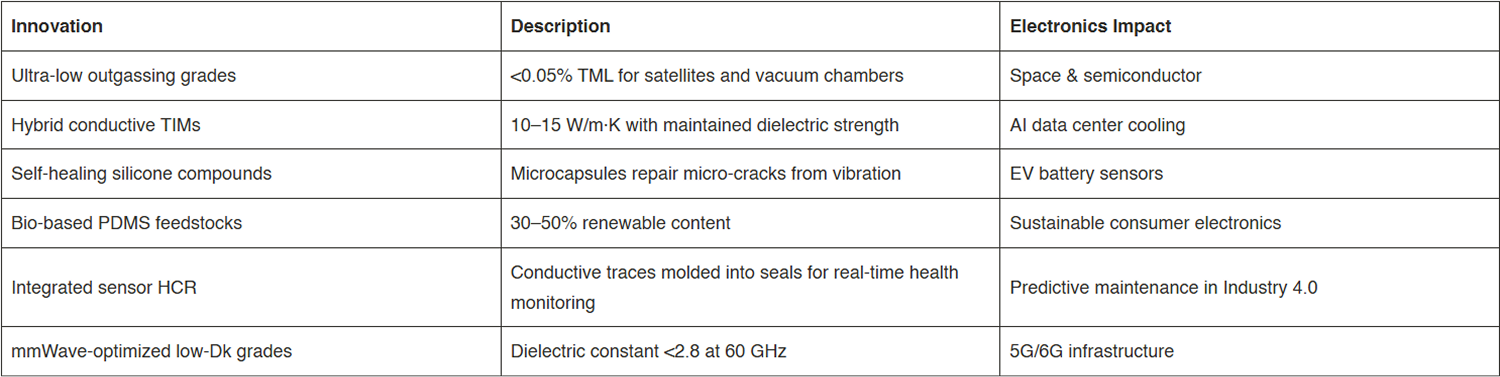
2026-2030 TECHNOLOGY TRENDS
AND INNOVATIONS
IMPLEMENTATION ROADMAP FOR OEMS AND TIER SUPPLIERS
- Map exact voltage, temperature, environmental, and regulatory requirements.
- Select base polymer and filler package with supplier (Dow, Shin-Etsu, or Momentive).
- Conduct material compatibility testing with adhesives, conformal coatings, and fluids.
- Prototype using compression or LIM tooling.
- Validate through ASTM/UL/IP test suite plus application-specific thermal cycling (minimum 2,000 cycles).
- Perform failure mode effects analysis (FMEA) focused on sealing and insulation.
- Develop PPAP or FAI documentation package.
- Qualify multiple suppliers for supply chain resilience.
- Integrate design rules into CAD libraries (compression set, minimum wall thickness, draft angles).
- Train assembly personnel on HCR handling to prevent contamination.
- Establish accelerated life testing protocol correlated to field data.
- Create end-of-life recycling pathway and track sustainability metrics.
- Monitor field performance via IoT where possible to refine next-generation specifications.
COMMON PITFALLS TO AVOID
- Selecting peroxide-cured grades in enclosed electronics without sufficient post-cure, leading to outgassing.
- Underestimating compression set at elevated temperatures, causing IP rating loss after 2–3 years.
- Ignoring CTE mismatch in potting designs, resulting in cracked components.
- Using non-electronics-grade pigments that increase dissipation factor.
CONCLUSION
HCR silicone has become indispensable for electronics reliability in 2026. Its unmatched balance of dielectric performance, thermal stability, low-stress mechanical properties, and environmental resistance delivers measurable reductions in field failures, warranty costs, and total lifecycle impact across consumer, industrial, automotive, and infrastructure applications.
At Flexion, we specialize in engineered elastomer solutions with a strong focus on High Consistency Rubber for demanding applications such as high-voltage insulation, precision sealing, and long-life components in harsh environments. Our approach combines material science expertise with manufacturability, helping OEMs and engineers move from concept to scalable production with confidence. Whether you’re optimizing for reliability, compliance, or lifecycle cost, Flexion supports every stage of development with tailored HCR formulations and application-specific guidance.
how we help you decide
We assess your operating fluids, temperature profile, sealing dynamics, and cost targets, then recommend fluorosilicone or alternatives where appropriate. If abrasion, dynamic motion, or strict cost caps are dominant constraints, we document why another elastomer may be better and outline the tradeoffs.
Request a Proposal or Book a Discovery Call to get a tailored materials recommendation.
book a
discovery call

WHAT MAKES HCR SILICONE BETTER THAN TRADITINAL RUBBER
MATERIALS?
FREQUENTLY
ASKED QUESTIONS
HCR silicone offers a rare combination of high dielectric strength, extreme temperature resistance, and long-term
flexibility. Unlike EPDM or PVC, it maintains performance over 15–25 years with minimal degradation.