
HCR SILICONE FOR AUTOMOTIVE
APPLICATIONS IN 2026
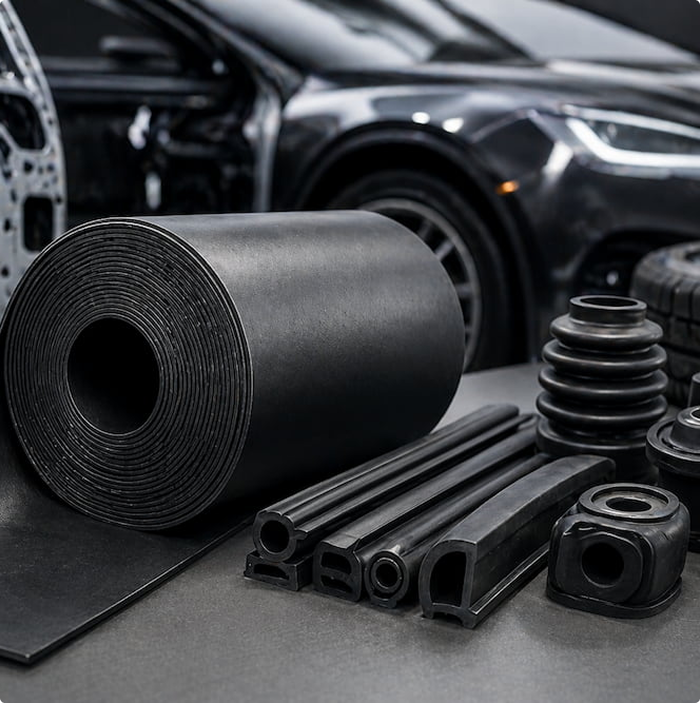
High Consistency Rubber (HCR) silicone is the preferred high-performance elastomer for demanding automotive sealing, gasketing, and insulation applications. It maintains elasticity, sealing force, and chemical resistance across extreme temperature ranges where EPDM, NBR, and many organic rubbers fail.
This guide delivers deeper technical detail than standard industry overviews. It includes expanded comparison tables, application-specific performance data, manufacturing process lists, regulatory checklists, EV-focused innovations, ROI models, sustainability metrics, 2026 technology trends, and a 20-question FAQ. All information draws from established sources including Dow SILASTIC, Wacker ELASTOSIL, Elkem Silicone, Momentive, Shin-Etsu, and reports from IDTechEx and McKinsey.
BOOK A
DISCOVERY CALL
to review your application and material spec.

WHY
AUTOMOTIVE
ENGINEERS CHOOSE
HCR SILICONE
IN 2026
- Engine bays and EV battery packs run hotter than ever
- Warranty periods now reach 8–10 years with 150,000+ mile expectations
- Strict emissions and EV safety regulations demand long-term material stability
- Need for materials that reduce warranty claims and maintenance costs
ARTICLE ROADMAP
- Core properties and mechanisms
- Head-to-head comparisons with EPDM, NBR, and FKM
- Temperature zones and material selection table
- 8 major application categories with performance lists
- Manufacturing processes and quality standards
- EV-specific battery, thermal, and motor solutions
- Cost, ROI, and lifecycle analysis
- Sustainability and recycling data
- 2026–2030 innovation trends
- Implementation roadmap
- Expanded 20-question FAQ
WHAT IS HCR SILICONE AND
WHY IT EXCLES IN AUTOMOTIVE USE
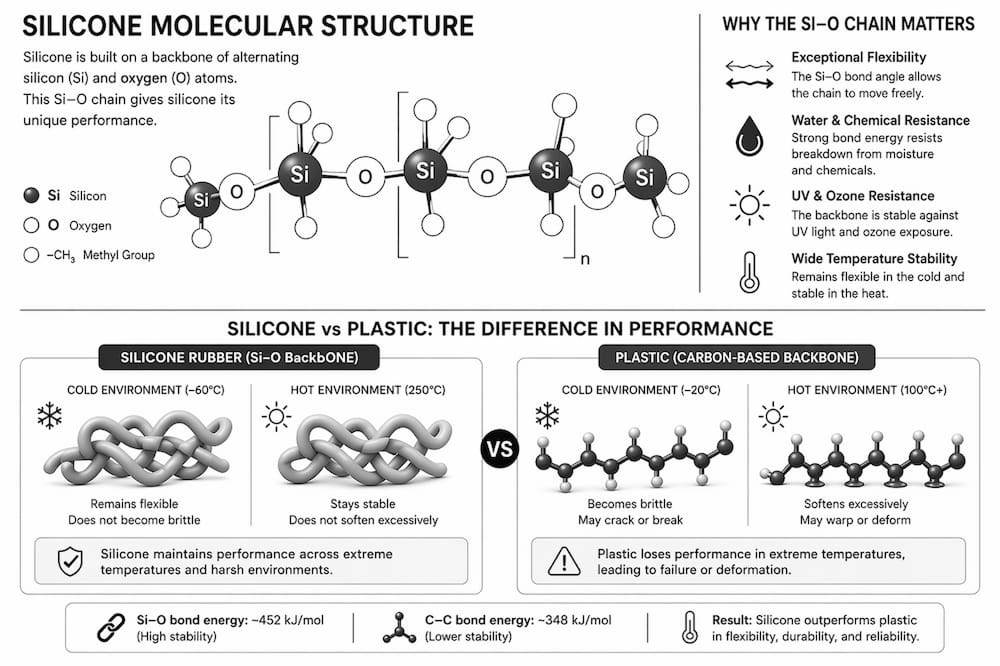
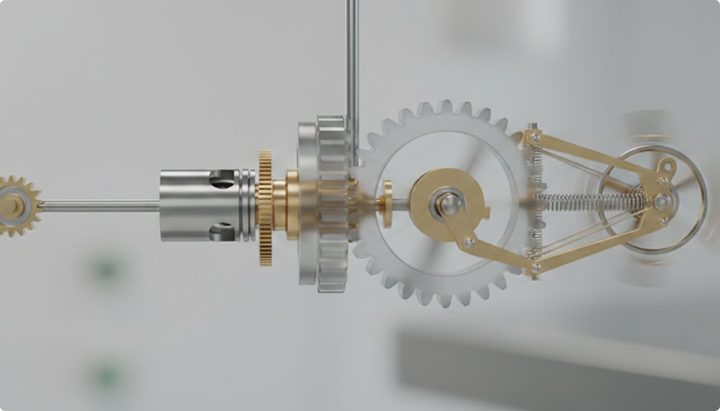
HCR silicone starts as a thick, putty-like compound. Manufacturers blend silicone polymers with reinforcing fillers (fumed silica), heat stabilizers, and catalysts. When cured under heat and pressure, it forms a durable, flexible elastomer built on a silicon-oxygen (Si-O) backbone.
CORE PERFORMANCE
MECHANISMS
- Inorganic Si-O chain provides thermal stability up to 300°C continuous
- Low compression set (typically <15% after heat aging)
- Excellent resistance to ozone, UV, and oxidation
- Broad chemical compatibility with automotive fluids
- Maintains flexibility from -50°C to +300°C depending on grade
- Dielectric strength of 20–25 kV/mm for electrical applications
Unlike carbon-based rubbers, HCR silicone does not become brittle in cold or soften excessively in heat within its operating window. This stability directly reduces leaks, electrical failures, and premature replacements.
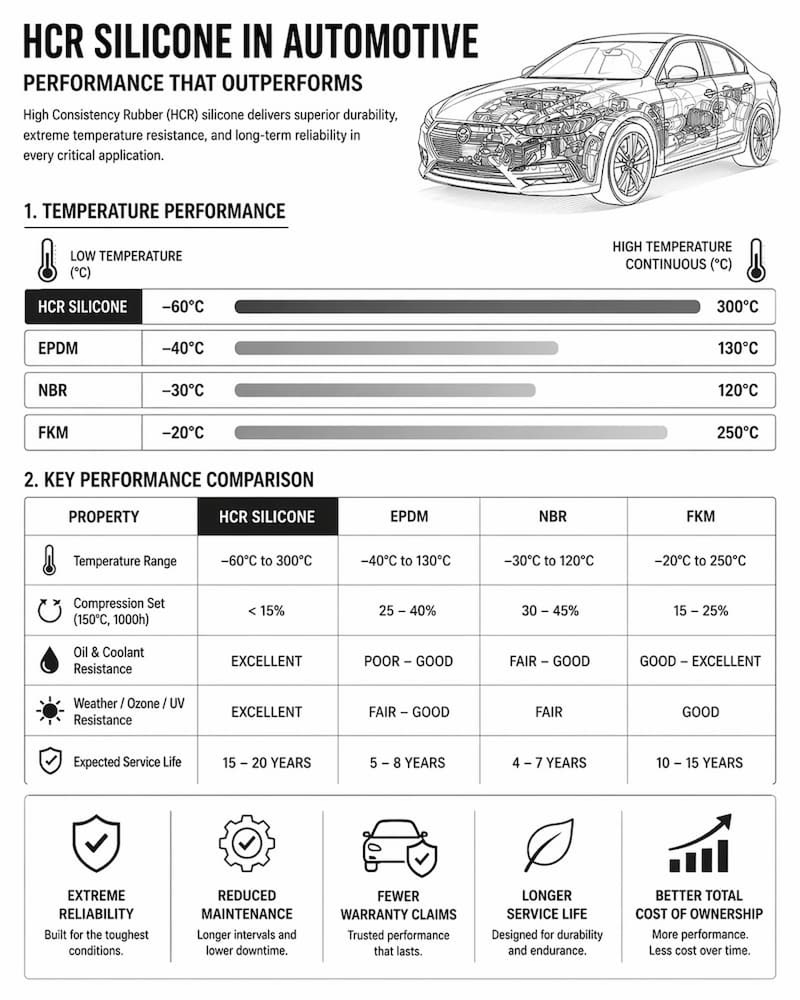
HCR SILICONE VS CONVENTIONAL AUTOMOTIVE ELASTOMERS
TEMPERATURE RESISTANCE COMPARISON

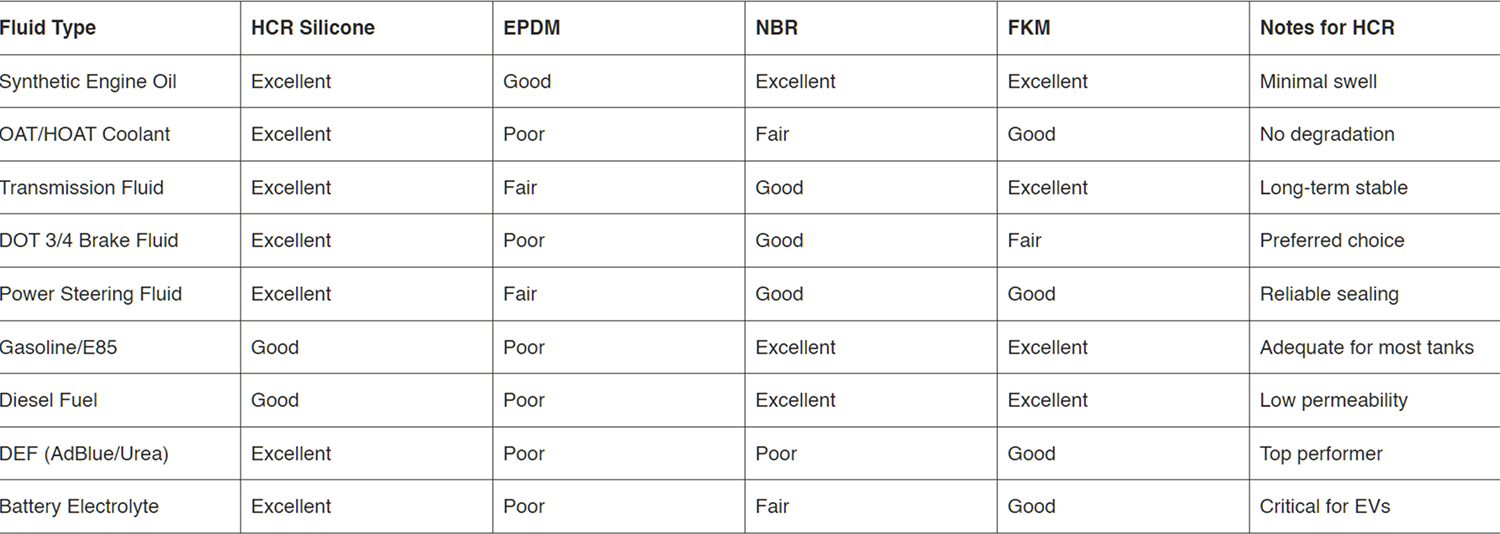
CHEMICAL RESISTANCE TO AUTOMOTIVE FLUIDS (2026 FORMULATIONS)
AGING AND WEATHERING PERFORMANCE METRICS

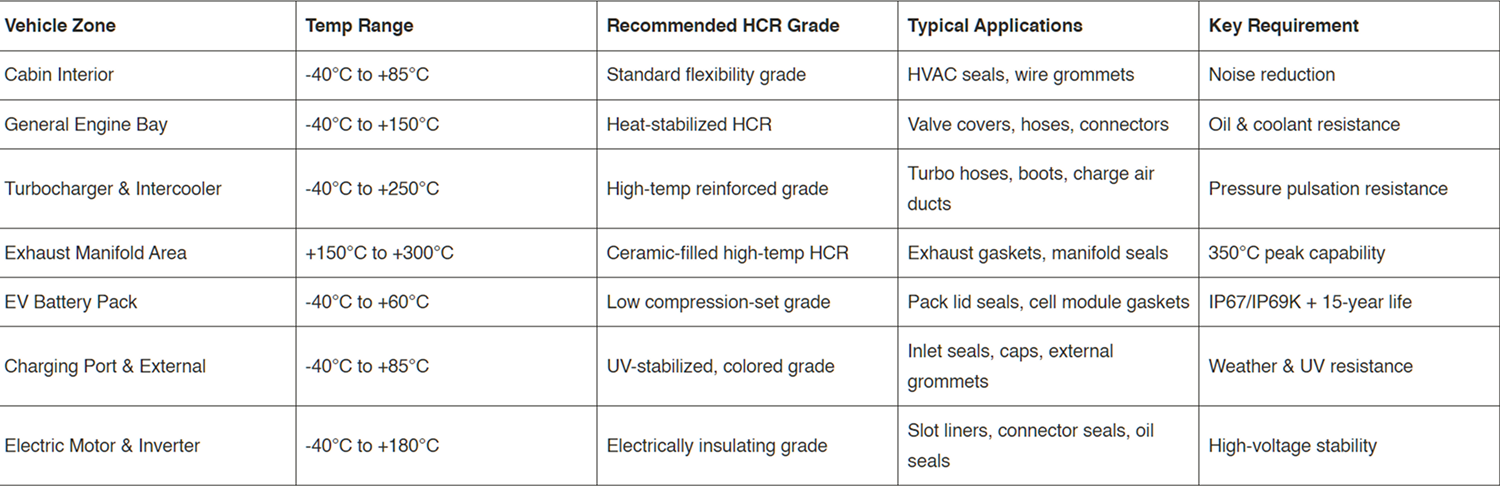
AUTOMOTIVE TEMPERATURE ZONES AND RECOMMENDED HCR GRADES
KEY AUTOMOTIVE APPLICATIONS
FOR HCR SILICONE
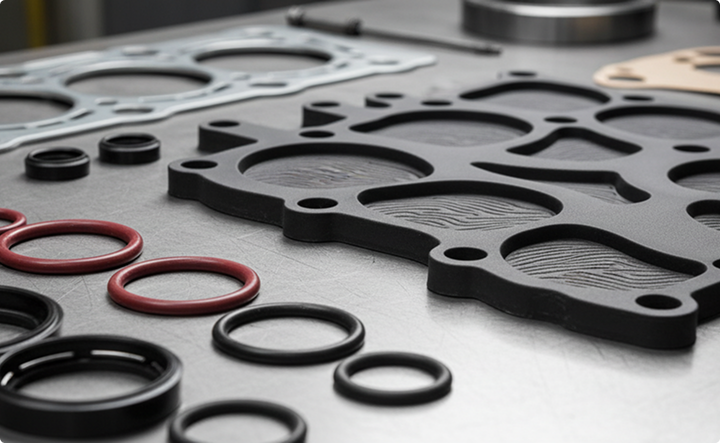
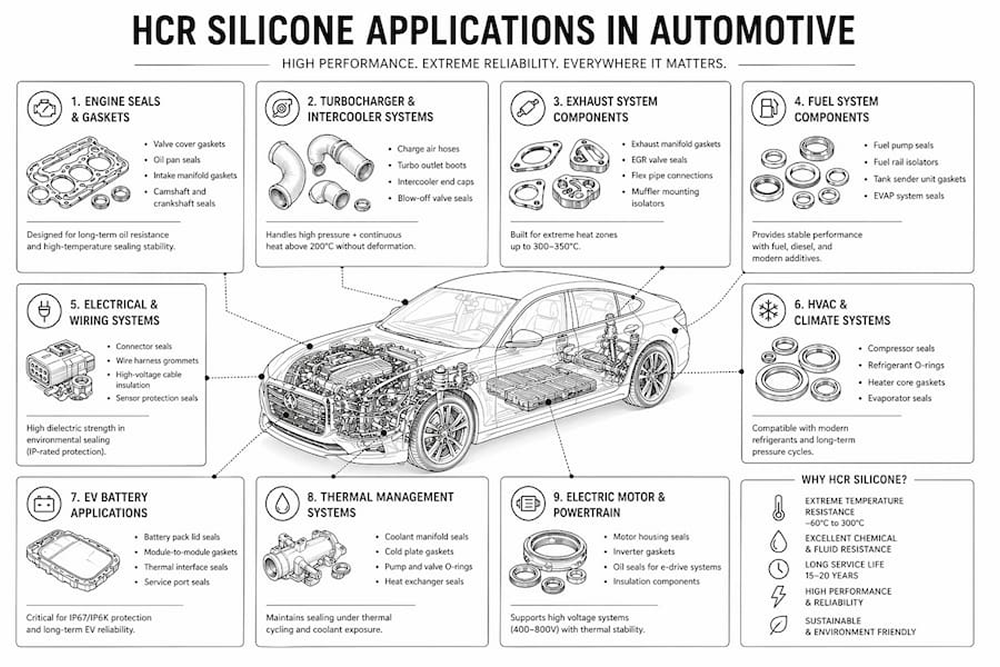
ENGINE SEALS AND GASKETS
- Cylinder head covers
- Valve covers and oil pans
- Camshaft and crankshaft seals
- Intake manifold gaskets
PERFORMANCE LIST
- Compression set typically under 15% after 1,000 hours at 150°C
- Conforms to imperfect aluminum or cast-iron surfaces
- Resists synthetic oils and modern coolants
- Reduces warranty claims related to oil leaks
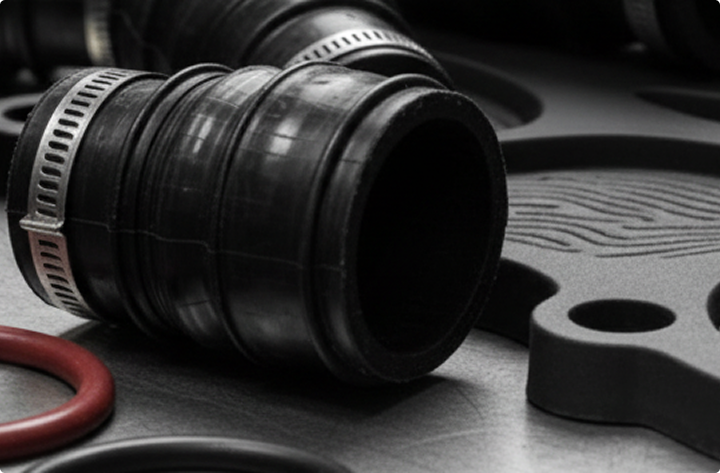
TURBOCHARGER HOSES, BOOTS, AND
INTERCOOLER COMPONENTS
- Charge air hoses
- Turbo outlet boots
- Blow-off valve seals
- Intercooler end caps
PERFORMANCE LIST
- Handles 200°C+ continuous temperatures with pressure spikes
- Tear strength of 15–25 kN/m resists installation damage
- Dampens vibration from turbo surge
- Outperforms standard silicone at lower cost than fluoropolymers
EXHAUST SYSTEM GASKETS
AND SEALS
- Exhaust manifold gaskets
- EGR valve seals
- Flex pipe connections
- Muffler mounting isolators
- Performance List
PERFORMANCE LIST
- Specialized grades withstand 300°C continuous, 350°C peaks
- Incorporate alumina or iron oxide fillers for extra heat stability
- Maintain sealing force through thermal expansion cycles
- Often reinforced with fabric for pressure containment
FUEL SYSTEM SEALS AND
COMPONENTS
- Fuel pump gaskets
- Fuel rail isolators
- Tank sender unit seals
- EVAP system valves
PERFORMANCE LIST
- Low hydrocarbon vapor permeability
- Helps vehicles meet strict evaporative emissions standards
- Cost-effective alternative to FKM for non-flex-fuel systems
- Stable in E10 and low-ethanol blends
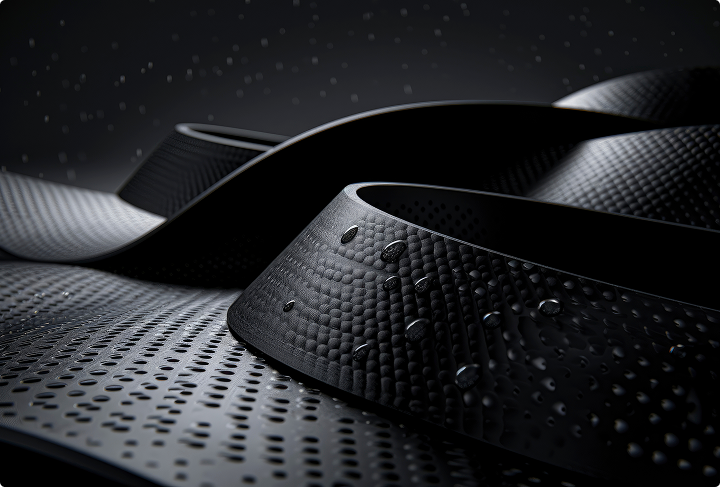

ELECTRICAL CONNECTORS,
GROMMETS, AND WIRE HARNESSES
- Engine bay wire grommets
- Connector seals
- High-voltage EV cable insulation boots
- Sensor protectors
PERFORMANCE LIST
- Dielectric strength 20–25 kV/mm
- Achieves IP67/IP69K weather sealing
- Resists salt spray, road chemicals, and abrasion
- Compatible with automated robotic assembly
HVAC AND CLIMATE CONTROL
COMPONENTS
- Fuel pump gaskets
- Fuel rail isolators
- Tank sender unit seals
- EVAP system valves
PERFORMANCE LIST
- Compatible with new low-GWP refrigerants
- Maintains flexibility across wide temperature swings
- Reduces noise and vibration transmission
- Long-term resistance to compressor oils
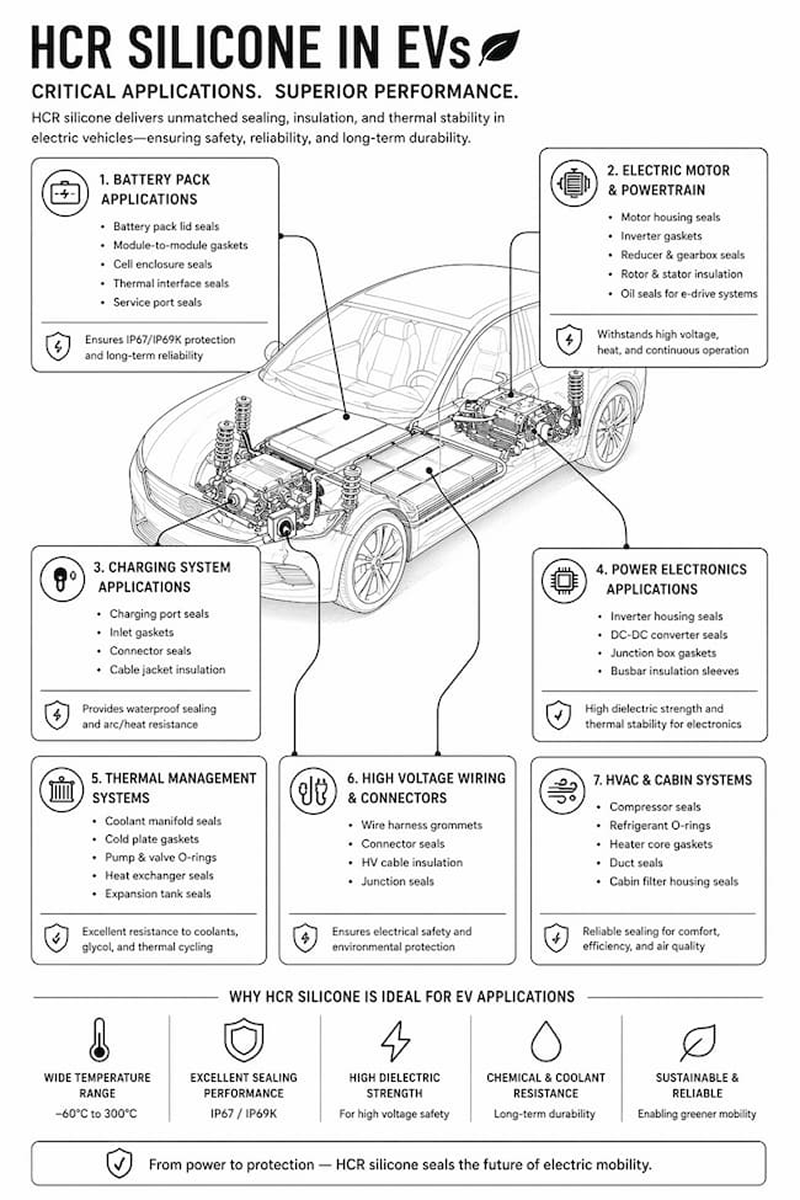
EV-SPECIFIC APPLICATIONS:
THE FASTEST-GROWING SEGMENT
BATTERY PACK SEALING AND
PROTECTION
- Main pack lid gaskets
- Module-to-module interface seals
- Busbar covers
- Service port gaskets
EV BATTERY ADVANTAGES LIST
- Maintains IP67/IP69K protection for 15+ years
- Low compression set prevents loss of sealing force
- Compatible with thermal interface materials
- Can incorporate conductive fillers for EMI shielding
- Performs from -40°C cold soak to 60°C fast-charge conditions
THERMAL MANAGEMENT
SYSTEM SEALS
- Cold plate gaskets
- Coolant manifold connections
- Pump and valve O-rings
- Battery chiller interfaces
THERMAL MANAGEMENT LIST
- Excellent resistance to glycol-water coolants
- Hydrolysis stability for long service
- Helps maintain precise temperature control for battery longevity
- Reduces risk of thermal runaway propagation


ELECTRIC MOTOR AND POWERELECTRONICS INSULATION
- Slot liners
- End-turn fillers
- High-voltage connector seals
- Inverter housing gaskets
MOTOR APPLICATION LIST
- Withstands 400–800V systems
- Oil-resistant grades handle transmission fluid exposure
- Excellent vibration damping
- Maintains dielectric properties after heat aging

MANUFACTURING
PROCESSES FOR
AUTOMOTIVE HCR
SILICONE
PRIMARY PROCESSING METHODS
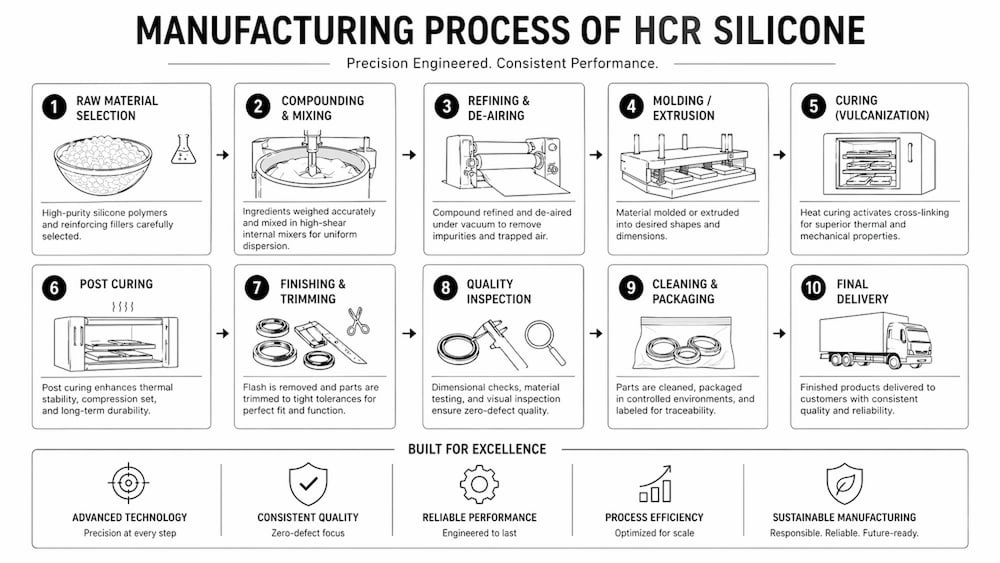
- Compression Molding — Most common for gaskets and complex seals. Material is pre-formed, placed in heated mold (160–200°C), cured under pressure.
- Transfer Molding — Used for intricate geometries and over-molding onto metal inserts. Reduces flash and improves dimensional accuracy.
- Extrusion — Ideal for hoses, tubing, and continuous profiles. Material is forced through a die and vulcanized in hot air or steam.
- Injection Molding (for specialized grades) — Higher productivity for medium-to-high volumes.
PROCESS SELECTION TABLE

QUALITY STANDARDS, TESTING, AND
REGULATORY REQUIREMENTS
MANDATORY AUTOMOTIVE
CERTIFICATIONS
- IATF 16949 quality management system
- PPAP (Production Part Approval Process) documentation
- Full material traceability from raw silicone to finished part
- ISO 14001 environmental management (increasingly required)
KEY PERFORMANCE TESTS LIST
- Compression set (ASTM D395)
- Tensile strength and elongation (ASTM D412)
- Fluid immersion aging (ASTM D471)
- Heat aging (ASTM D573)
- Low-temperature flexibility (ASTM D2137)
- Ozone resistance (ASTM D1171)
- Dielectric strength for electrical parts
- IP67/IP69K ingress protection testing for EV components
SUSTAINABILITY AND ENVIRONMENTAL
BENEFITS
SUSTAINBILITY METRICS TABLE


SUSTAINABILITY AVANTAGES LIST
- Longer life cuts total material consumption
- Inert chemistry avoids leaching harmful substances
- Several suppliers now offer grades with recycled silicone content
- Supports OEM net-zero and circular economy targets
- Reduced warranty-related scrap and replacements
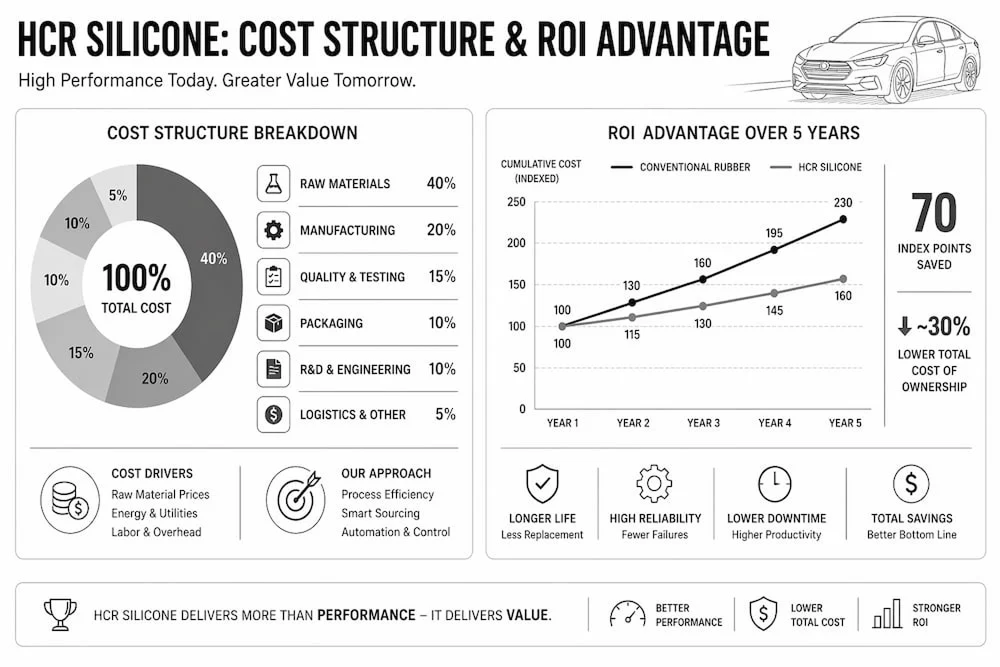
COST STRUCTURE AND ROI ANALYSIS
10-YEAR TOTAL COST OF OWNERSHIP EXAMPLE (ENGINE BAY SEAL SET)


ROI FACTORS LIST
- Fewer warranty claims (major OEM cost driver)
- Extended service intervals
- Lower inventory needs for replacement parts
- Improved customer satisfaction scores
- Better alignment with EV platform longevity goals
TECHNOLOGY TRENDS AND INNOVATIONS
FOR 2026-2030
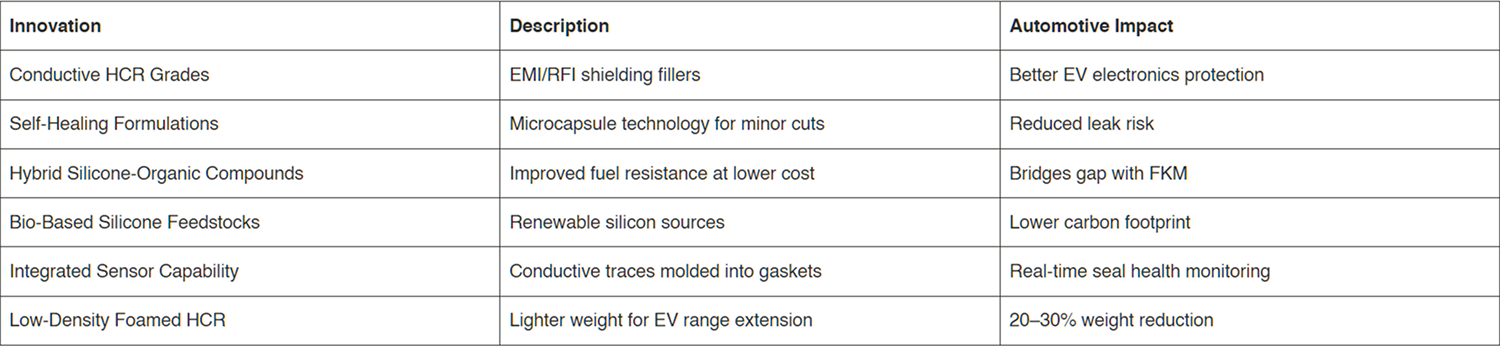
EMERGING HCR SILICONE DEVELOPMENTS
IMPLEMENTATION
ROADMAP FOR TIER
SUPPLIERS AND
OEMS
- Define exact temperature, fluid, and lifespan requirements
- Select appropriate HCR grade from Dow, Wacker, or Elkem portfolios
- Conduct material compatibility testing with specific fluids
- Choose optimal processing method and tooling
- Develop PPAP documentation package
- Validate through accelerated aging and field trials
- Secure IATF 16949 and OEM-specific approvals
- Establish supply chain traceability
- Train production staff on HCR handling
- Set up quality gates for compression set and leak testing
- Create end-of-life recycling pathway
- Monitor field performance data for next-generation improvements
CONCLUSION
HCR silicone has firmly established itself as a critical material for modern automotive engineering, offering unmatched performance in temperature resistance, durability, and chemical stability. As both ICE and EV platforms continue to evolve, the role of High Consistency Rubber will only become more central to ensuring long-term reliability and efficiency.
At this stage, working with the right manufacturing partner becomes just as important as selecting the material itself. We, at Flexion, specialise in advanced silicone solutions, providing custom-engineered components designed to meet exact application requirements. With deep expertise in High Consistency Rubber processing, Flexion supports OEMs and suppliers in developing high-performance, production-ready parts that meet strict automotive standards while optimizing both cost and durability.
how we help you decide
We assess your operating fluids, temperature profile, sealing dynamics, and cost targets, then recommend fluorosilicone or alternatives where appropriate. If abrasion, dynamic motion, or strict cost caps are dominant constraints, we document why another elastomer may be better and outline the tradeoffs.
Request a Proposal or Book a Discovery Call to get a tailored materials recommendation.
book a
discovery call