
The silicone rubber industry is entering a strong growth phase in 2026, supported by demand from electric vehicles, healthcare, renewable energy, electronics, construction, and advanced manufacturing. As industries require materials that can handle heat, pressure, electrical stress, weather exposure, and long-term use, silicone rubber continues to stand out as a high-performance material.
Unlike many conventional rubbers, silicone rubber offers a useful balance of flexibility, temperature resistance, durability, electrical insulation, and biocompatibility. This makes it suitable for everything from EV battery systems and medical devices to solar panels, seals, gaskets, and precision-molded parts.
This article explores the major silicone rubber market trends in 2026 and what they mean for manufacturers, suppliers, and end users.
Global Silicone Rubber Market Outlook
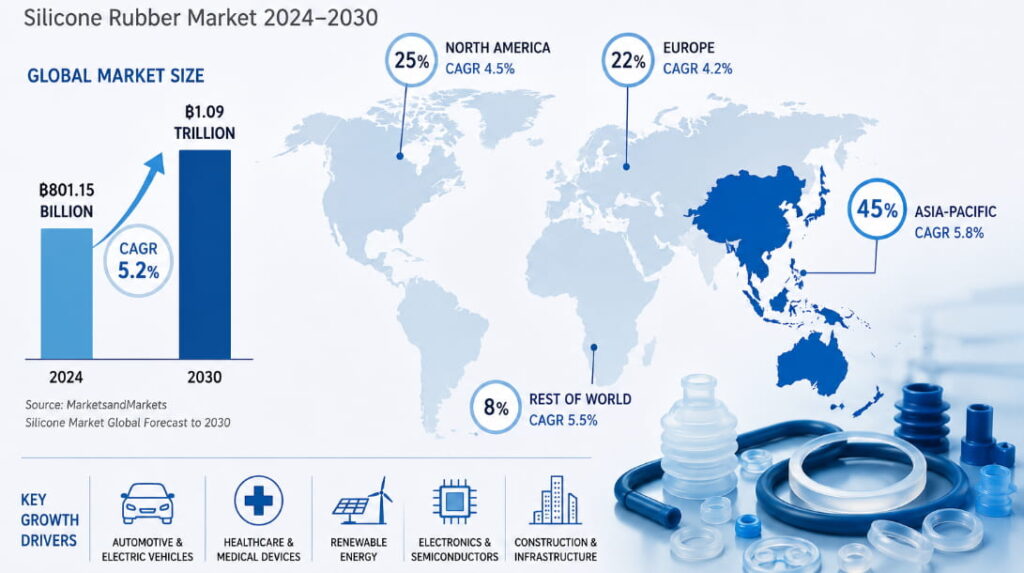
The silicone rubber market is growing steadily as more industries use silicone materials for critical applications.
According to MarketsandMarkets’ Silicone Market Global Forecast to 2030, the global silicone market reached approximately ฿801.15 billion (USD 24.5 billion) in 2024 and is projected to grow to ฿1.09 trillion (USD 33.2 billion) by 2030, representing a CAGR of 5.2%. Within this broader market, silicone rubber, also known as elastomers, remains the largest segment by both volume and value.
This growth is being driven by the material’s role in industries that need long-term reliability. Automotive companies need silicone for EV batteries and seals. Healthcare companies use it for medical-grade components. Construction companies rely on silicone sealants and gaskets, while electronics manufacturers use silicone for insulation, protection, and thermal management.
| Region | Share of Global Market | CAGR |
| Asia-Pacific | 45% | 5.8% |
| North America | 25% | 4.5% |
| Europe | 22% | 4.2% |
| Rest of World | 8% | 5.5% |
Based on the regional market distribution cited in the same market forecast, Asia-Pacific holds the largest share at 45%, followed by North America at 25%, Europe at 22%, and the rest of the world at 8%.
Asia-Pacific’s lead is mainly due to strong manufacturing activity in China, Japan, South Korea, and India. China’s large automotive market and electronics manufacturing base continue to support high silicone rubber consumption, while India and Southeast Asia are becoming increasingly important for future growth.
Why Is Liquid Silicone Rubber Growing Faster?
Liquid silicone rubber, or LSR, is one of the fastest-growing areas of the silicone rubber industry.
According to Fortune Business Insights’ Liquid Silicone Rubber Market Size Report, the global LSR market is projected to grow from ฿80.44 billion (USD 2.46 billion) in 2026 to ฿138.32 billion (USD 4.23 billion) by 2034, achieving a 6.2% CAGR.
LSR is growing faster than the broader silicone market because it is well suited for precision molding, high-volume production, and applications that require consistent quality. It is widely used in medical devices, baby care products, automotive electronics, seals, valves, wearable devices, and consumer goods.
| LSR Growth Driver | Why It Matters |
| Medical devices | Supports clean, flexible, and biocompatible components |
| Automotive electronics | Handles heat, vibration, and electrical stress |
| Baby care products | Offers softness, safety, and durability |
| Consumer goods | Allows flexible, high-quality molded parts |
| Precision components | Supports tight tolerances and repeatable production |
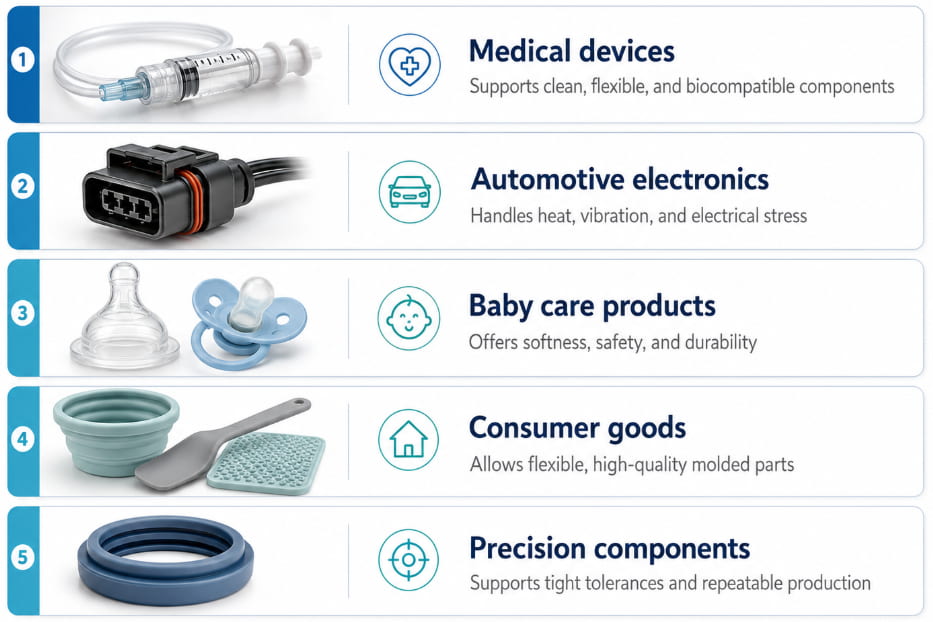
LSR also supports complex part designs that may be difficult to achieve with traditional rubber processing. This makes it useful for industries where product safety, accuracy, and long service life are important.
Key Industry Trends Shaping Silicone Rubber in 2026
Several major trends are shaping silicone rubber demand in 2026. These trends are connected to larger changes in transportation, healthcare, energy, manufacturing, and sustainability.
Key trends include:
- Growth of electric vehicles and battery systems
- Rising demand for medical-grade silicone rubber
- Expansion of solar, wind, and energy storage infrastructure
- Greater focus on sustainability and circular economy solutions
- Growth of Asia-Pacific manufacturing
- Wider use of digital manufacturing and automation
- Increased need for reliable supply chains and technical support
These trends show that silicone rubber is no longer used only as a basic sealing or insulation material. It is becoming an enabling material for advanced technologies.
How Are Electric Vehicles Driving Silicone Rubber Demand?
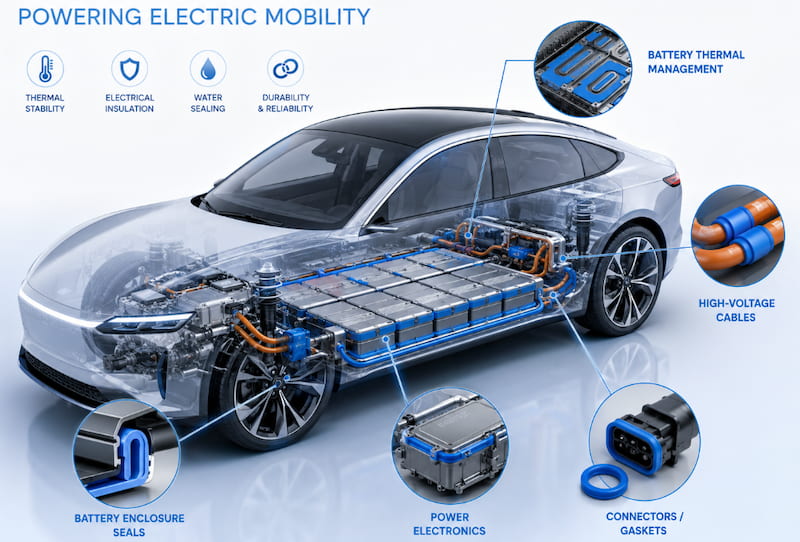
Electric vehicles are one of the strongest demand drivers for silicone rubber in 2026.
According to the International Energy Agency’s Global EV Outlook 2024, global EV sales exceeded 13.6 million units in 2023, marking a 35% year-over-year increase. This growth is increasing demand for silicone rubber in battery systems, high-voltage insulation, power electronics, and sealing applications.
Silicone rubber is useful in EVs because it can withstand heat, electrical stress, vibration, moisture, and exposure to automotive fluids. These properties are especially important as EV systems become more powerful and more compact.
| EV Application | Role of Silicone Rubber |
| Battery thermal management | Helps transfer heat while providing electrical isolation |
| High-voltage cables | Supports insulation and protection |
| Battery enclosures | Provides sealing against moisture and dust |
| Power electronics | Helps protect sensitive components |
| Connectors and gaskets | Maintains flexibility and durability under stress |
Silicone thermal interface materials help conduct heat from battery cells to cooling systems. This is important because EV batteries generate heat during charging and operation. As fast charging becomes more common, thermal management becomes even more important for safety and battery life.
EVs also operate at much higher voltages than conventional vehicles. Many EV systems use 400V to 800V, compared with 12V systems in traditional vehicles. Silicone’s dielectric strength and thermal stability make it suitable for insulating high-voltage cables, connectors, and components.
How Is Sustainability Changing Silicone Rubber Manufacturing?
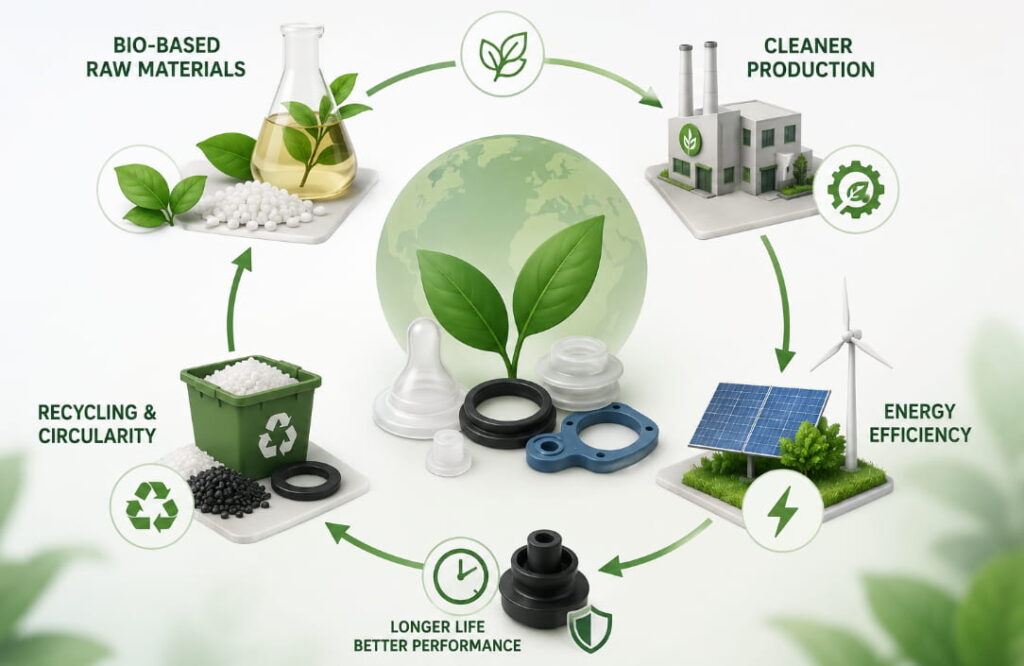
Sustainability is changing how silicone rubber is produced, selected, and evaluated. Manufacturers are under pressure to reduce carbon footprint, improve chemical safety, and support more responsible end-of-life solutions.
One major development is the rise of bio-based silicones. These use renewable feedstocks instead of relying only on petroleum-derived precursors. Although bio-based silicones currently represent a small share of the market, they are gaining attention in consumer products and packaging where sustainability claims influence purchasing decisions.
Recycling is another important area. Traditional silicone recycling is difficult because cured silicone has crosslinked structures. However, technologies such as pyrolysis and chemical depolymerization are being developed to recover silicone waste.
| Sustainability Area | Industry Direction |
| Bio-based silicones | Use of renewable feedstocks |
| Recycling technologies | Pyrolysis and chemical recovery methods |
| Lifecycle assessment | Measuring environmental impact across product life |
| Regulatory compliance | Reformulation to remove substances of concern |
| Energy efficiency | Silicone products supporting long-term energy savings |
Lifecycle assessment is also becoming more important. Silicone products may require energy-intensive production, but they can help reduce environmental impact during use. For example, silicone sealants in buildings can improve sealing performance and reduce heating and cooling energy loss over time.
Regulations such as REACH in Europe, TSCA in the United States, and emerging chemical frameworks in Asia are also pushing silicone manufacturers to improve formulations, documentation, and compliance.
Healthcare and Medical Device Expansion
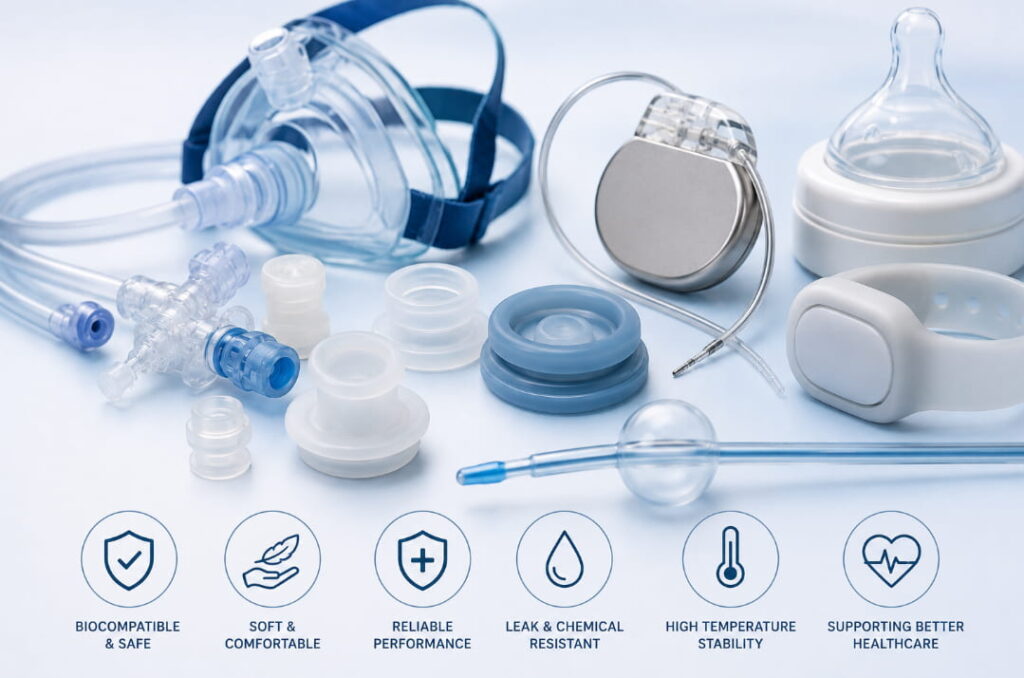
Healthcare is a major growth area for silicone rubber because medical products require clean, flexible, and biocompatible materials.
Silicone rubber is widely used in medical tubing, seals, valves, respiratory parts, wearable health monitors, drug delivery systems, and implantable devices. Its flexibility and stability make it suitable for components that come into contact with the body or need to perform reliably over time.
The medical LSR segment is growing at approximately 8% to 10% annually, based on industry estimates cited in the original market analysis. This growth is supported by minimally invasive surgery, home healthcare, wearable health devices, and drug delivery innovation.
Common medical silicone rubber applications include:
- Catheters and tubing
- Respiratory masks and valves
- Syringe seals and plunger components
- Wearable health monitor parts
- Drug delivery system components
- Pacemaker leads and implantable parts
- Surgical and diagnostic device components
Regulatory expectations are also becoming more demanding. The industry continues to move from USP Class VI testing toward ISO 10993 biocompatibility standards. This increases the need for well-documented silicone materials, strong quality control, and reliable supplier support.
How Is Renewable Energy Creating New Silicone Rubber Demand?
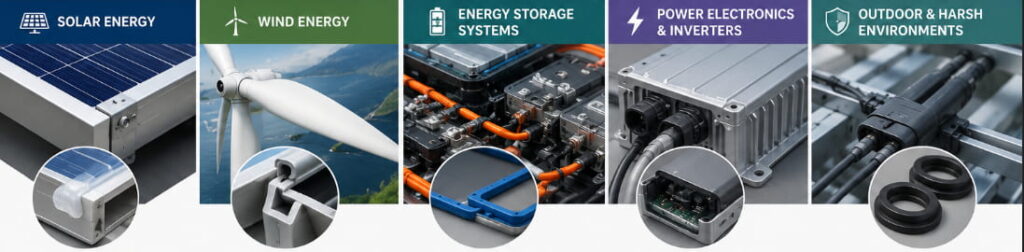
Renewable energy growth is creating new opportunities for silicone rubber in solar, wind, and battery storage systems.
According to Silicones Europe’s Uses & Benefits – Energy Applications, silicones are used in approximately 90% of photovoltaic panels for encapsulation, junction box sealing, and frame bonding. These materials help protect solar panel components from moisture, UV exposure, heat, and outdoor conditions.
In wind energy, silicone materials are used for coatings, insulation, sealing, and protection. According to the Global Silicones Council’s Socio-economic Evaluation of the Global Silicones Industry, silicone solutions can improve wind turbine energy generation by up to 8%.
| Renewable Energy Area | Silicone Rubber Use |
| Solar panels | Encapsulation, sealing, and bonding |
| Wind turbines | Blade protection, coatings, and insulation |
| Battery energy storage | Thermal management and sealing |
| Power electronics | Electrical insulation and protection |
| Outdoor equipment | Weatherproofing and durability |
Battery energy storage systems also use silicone rubber for thermal management, electrical insulation, and sealing. These systems are important for stabilizing power grids and supporting the wider use of renewable energy.
Advanced Manufacturing Technologies
Manufacturing technology is changing how silicone rubber products are designed and produced.
Silicone 3D printing is moving from prototyping into selected production applications. It is not yet as cost-effective as injection molding for high-volume production, but it is useful for complex geometries, customization, rapid prototyping, and low-volume parts.
Industry 4.0 tools are also improving silicone manufacturing. Real-time monitoring, predictive maintenance, automated quality control, and digital twins help manufacturers improve consistency and reduce production defects.
Key manufacturing changes include:
- More automated LSR molding lines
- Real-time process monitoring
- Digital quality control systems
- Faster prototyping through silicone 3D printing
- Improved traceability for regulated applications
- Better production planning through digital supply chain tools
These improvements are especially important in medical, food-contact, automotive, and electronics applications, where consistency and documentation are essential.
Asia-Pacific Manufacturing Dynamics
Asia-Pacific remains the most important region for silicone rubber manufacturing and consumption. The region has strong production capacity, large end-user industries, and growing demand from automotive, electronics, healthcare, and construction sectors.
China remains a major manufacturing center, but other Asian markets are becoming more important. India’s silicone market is growing at around 7% to 8% annually, based on industry estimates cited in the original market analysis. Growth is supported by automotive manufacturing, electronics assembly, infrastructure development, and healthcare expansion.
Southeast Asia is also attracting more investment as companies diversify supply chains beyond China. Thailand, Vietnam, and Indonesia are gaining attention because they offer manufacturing capability, domestic demand, and export potential.
| Market | Growth Factor |
| China | Automotive, electronics, infrastructure, and renewable energy |
| India | Automotive manufacturing, electronics assembly, and healthcare |
| Thailand | Regional manufacturing and export capability |
| Vietnam | Supply chain diversification and electronics production |
| Indonesia | Industrial growth and domestic consumption |
Localization is also becoming more important. Supply chain disruptions and geopolitical tensions have encouraged manufacturers to build more regional capacity and reduce dependence on long-distance logistics.
What Raw Material Issues Affect Silicone Rubber Supply?
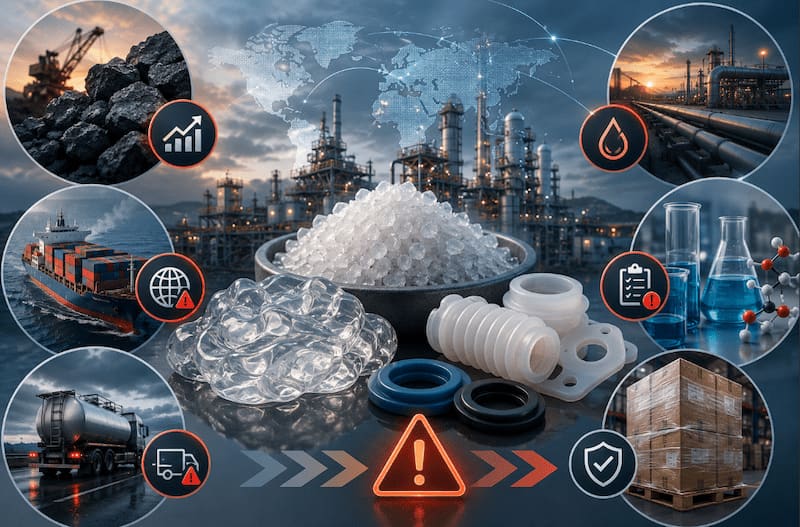
Silicone rubber production depends on raw materials and chemical intermediates that can be affected by energy costs, supply concentration, and market volatility.
Silicon metal is the main raw material used in silicone production. It is energy-intensive to produce, so electricity costs and energy availability directly affect pricing. China produces approximately 70% of global silicon metal supply, based on the supply data cited in the original market analysis, creating concentration risk for the industry.
Other important inputs include methanol and chloromethane. Methanol pricing is linked to natural gas and coal markets, which means silicone production costs can fluctuate with wider energy markets.
Supply chain concerns include:
- Silicon metal price volatility
- Energy-intensive raw material production
- Concentration of supply in China
- Methanol and chloromethane cost fluctuations
- Logistics disruptions
- Regulatory pressure on chemical inputs
To manage these risks, major silicone producers are using long-term supply agreements, backward integration, regional production, and stronger inventory planning.
Competitive Landscape
The silicone rubber industry includes several global producers as well as regional and specialty suppliers.
| Producer | Market Position |
| Dow | Large global silicone producer with a broad product portfolio |
| Wacker Chemie | Strong presence in Europe and Asia |
| Shin-Etsu | Strong in electronics and semiconductor applications |
| Momentive | Major producer with North American and Asian operations |
| Elkem | Integrated silicon metal and silicone producer |
Competition is increasingly based on more than price. Customers now value technical support, application-specific formulations, supply reliability, sustainability credentials, and regulatory documentation.
Chinese silicone producers are also moving up the value chain from commodity products into more specialized materials. This is increasing competition, especially in Asia-Pacific markets.
Future Outlook: 2026 to 2030
The outlook for silicone rubber remains positive because the material supports many growth industries.
| Segment | Expected CAGR | Main Growth Driver |
| Transportation | 7% to 8% | EV adoption |
| Healthcare | 8% to 10% | Medical innovation |
| Electronics | 6% to 7% | 5G, wearables, and IoT |
| Construction | 4% to 5% | Energy-efficient buildings |
| Energy | 10% to 12% | Renewable energy expansion |
These segment growth projections are based on the future outlook figures cited in the original market analysis.
Emerging applications are also expected to create new opportunities. Smart silicones, thermal interface materials, soft robotics, wearable devices, and aerospace components all show long-term potential.
What Challenges Are Facing the Silicone Rubber Industry?
Despite strong growth, the silicone rubber industry faces several challenges.
Raw material volatility remains a major issue because silicone production depends on silicon metal, methanol, chloromethane, and energy-intensive processing. Any disruption in these inputs can affect pricing and availability.
Regulatory pressure is another concern. Manufacturers may need to reformulate products, provide more documentation, or complete additional testing to meet changing chemical and safety standards.
Main challenges include:
- Raw material price volatility
- Energy cost fluctuations
- Regulatory compliance requirements
- Competition from alternative materials
- Supply chain concentration risks
- Economic cycles affecting construction, automotive, and manufacturing demand
Silicone rubber also faces competition from thermoplastic elastomers, advanced plastics, EPDM, and other materials in applications where cost is more important than long-term performance.
Strategic Implications for Manufacturers and Buyers
For manufacturers, growth opportunities are strongest in EVs, renewable energy, healthcare, electronics, and advanced manufacturing. Companies that invest in technical development, quality systems, sustainability, and regional production capacity will be better positioned.
For end users, material selection should not be based only on upfront cost. Silicone rubber may cost more than some alternatives, but it can offer longer service life, lower failure risk, better temperature resistance, and stronger performance in demanding environments.
For suppliers, technical support is becoming a key differentiator. Customers increasingly need help with material selection, testing, regulatory documentation, and design optimization.
| Stakeholder | Strategic Priority |
| Manufacturers | Invest in high-growth applications and sustainability |
| End users | Evaluate total cost of ownership, not only material cost |
| Suppliers | Strengthen technical service and documentation |
| Regional producers | Build supply chain resilience and local capacity |
| Product designers | Work with suppliers early for material selection |
Conclusion
The silicone rubber industry in 2026 is shaped by strong growth, innovation, and sustainability pressure. Its combination of temperature resistance, flexibility, insulation, durability, and biocompatibility makes it important for electric vehicles, renewable energy, healthcare, electronics, and advanced manufacturing.
Asia-Pacific will continue to play a major role as both a manufacturing hub and a growing consumption market. At the same time, supply chain resilience, raw material security, regulatory compliance, and sustainability documentation are becoming more important for long-term competitiveness.
At Flexion, we understand how important silicone rubber has become for manufacturers that need reliable, high-performance materials. As demand for Silicone rubber Thailand continues to grow, we aim to support customers with practical material knowledge, application-focused solutions, and dependable manufacturing support for industries that require precision, durability, and long-term performance.
FAQ
What is driving the silicone rubber market growth?
Silicone rubber market growth is mainly driven by electric vehicles, healthcare expansion, renewable energy infrastructure, electronics growth, and advanced manufacturing.
Which region has the largest silicone rubber market?
Asia-Pacific is the largest silicone rubber market, accounting for approximately 45% of the global silicone market, according to the regional market breakdown cited in the silicone market forecast.
How fast is the liquid silicone rubber market growing?
According to Fortune Business Insights’ Liquid Silicone Rubber Market Size Report, the global LSR market is projected to grow from ฿80.44 billion (USD 2.46 billion) in 2026 to ฿138.32 billion (USD 4.23 billion) by 2034, at a 6.2% CAGR.
What sustainability trends are affecting silicone rubber?
Key sustainability trends include bio-based silicones, silicone recycling, lifecycle assessment, stricter chemical regulations, and lower-carbon production.
How is the electric vehicle market affecting silicone demand?
According to the International Energy Agency’s Global EV Outlook 2024, global EV sales exceeded 13.6 million units in 2023, increasing 35% year over year. This increases demand for silicone in battery thermal management, insulation, seals, and connectors.
What are the main challenges facing silicone rubber producers?
The main challenges include raw material volatility, regulatory compliance, competition from alternative materials, supply chain risk, and the need for continued innovation.
Is silicone rubber recyclable?
Silicone rubber can be recycled, but it is difficult because cured silicone has crosslinked structures. Newer methods such as pyrolysis and chemical depolymerization are being developed, but large-scale use remains limited.
What is the outlook for silicone rubber prices?
Silicone rubber prices are expected to remain sensitive to silicon metal, methanol, chloromethane, and energy costs. Demand growth may support moderate price increases, although competition and capacity expansion may limit increases in some segments.