
HCR SILICONE FOR ENERGY SECTOR 2026

HCR SILICONE FOR ENERGY SECTOR
2026: DOWNHOLE PACKERS, SOLAR
PV SEALING, NUCLEAR CONTAINMENT,
GEOTHERMAL, HYDROGEN
COMPATIBILITY, AND 30-YEAR
LIFECYCLE GUIDE
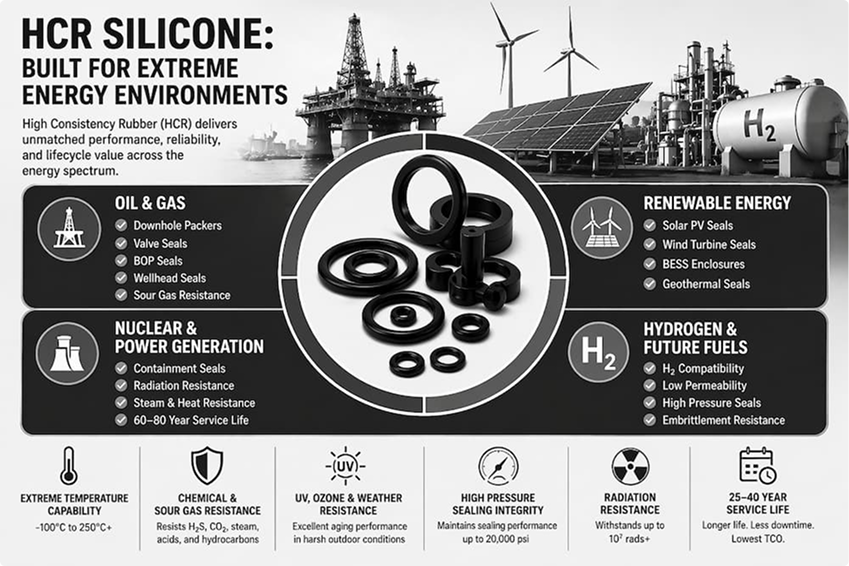
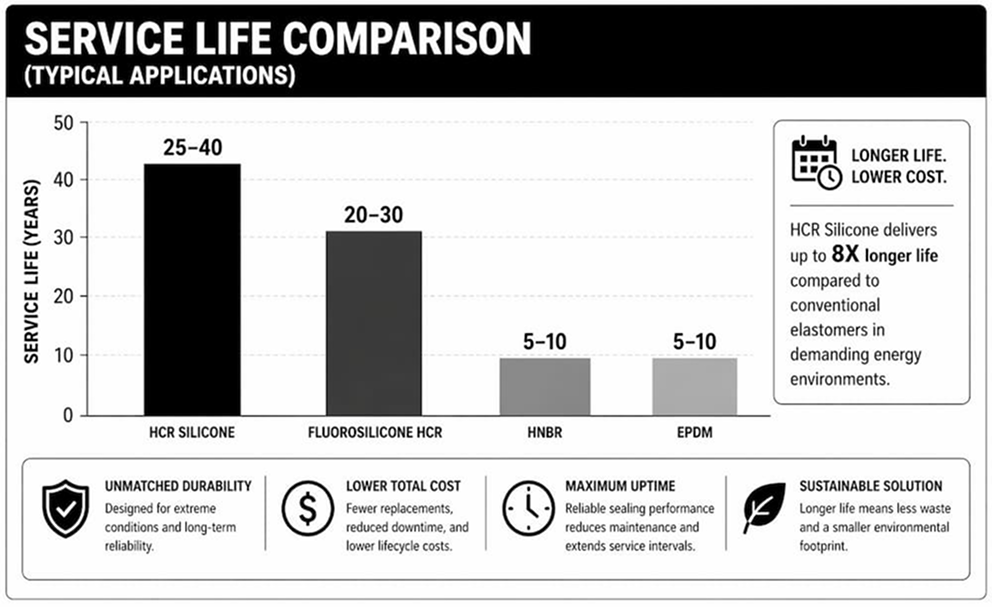
High Consistency Rubber (HCR) silicone is a heat-vulcanized, high-viscosity polydimethylsiloxane elastomer reinforced with fumed silica, heat stabilizers, and specialized fillers. It delivers continuous service from -100°C to +250°C (special grades to 300°C+), compression set below 15% at 200°C, and exceptional resistance to UV, ozone, steam, hydrocarbons, H₂S, and radiation. Unlike EPDM, NBR, or HNBR that often fail within 5–10 years under aggressive energy conditions, properly formulated HCR profiles, O-rings, packers, and gaskets routinely achieve 25–40 year service lives.

The energy transition amplifies the need for ultra-reliable sealing. Global solar and wind capacity is forecast to triple by 2030 (IEA 2025), grid-scale battery storage is growing at 27% CAGR, nuclear life extensions target 80 years, and hydrogen infrastructure requires low-permeability seals for high-pressure systems. Downtime in offshore oil can exceed $1 million per day. This guide provides mechanism-level analysis, 15 technical tables, quantified lifecycle models, failure case studies, regional regulatory variations, a supplier maturity framework, and a 22-question FAQ. Content is synthesized from Dow Oil & Gas, Parker Hannifin, Momentive, Wacker ELASTOSIL, Shin-Etsu, IEEE, API, ASME, and EPRI documentation.
CORE MATERIAL
SCIENCE AND
PERFORMANCE
MECHANISMS
HCR’s inorganic Si-O backbone (bond energy 452 kJ/mol) resists thermal chain scission and oxidative degradation far better than carbon-based elastomers. High-surface-area fumed silica (20–40 phr) creates a reinforcing network that provides tensile strength of 6–12 MPa while maintaining low modulus for dynamic applications. Platinum-catalyzed systems minimize volatiles; peroxide systems are used for ultra-high-temperature grades.
KEY MECHANISMS IN ENERGY SERVICE
- Thermal Stability: Cerium or iron oxide stabilizers suppress depolymerization up to 300°C. Low glass transition temperature (Tg ≈ -120°C) preserves elasticity in LNG service.
- Chemical Inertness: Hydrophobic surface and absence of unsaturation prevent swelling or cracking in sour gas (H₂S up to 30%), CO₂, steam, and completion fluids.
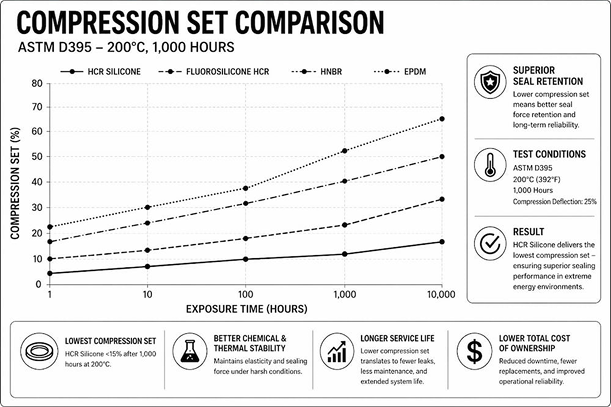
- Low Compression Set: Cross-link density stability yields <15% set after 1,000 hours at 200°C (ASTM D395), maintaining sealing force under pressure cycling.
- Radiation Resistance: Phenyl-modified grades tolerate >10^8 rads by limiting chain scission, critical for nuclear containment.
- UV/Ozone Stability: No carbon double bonds means zero surface cracking after 25+ years equivalent weathering (QUV/ASTM G154).
OIL & GAS: EXTREME DOWNHOLE AND
SURFACE SEALING
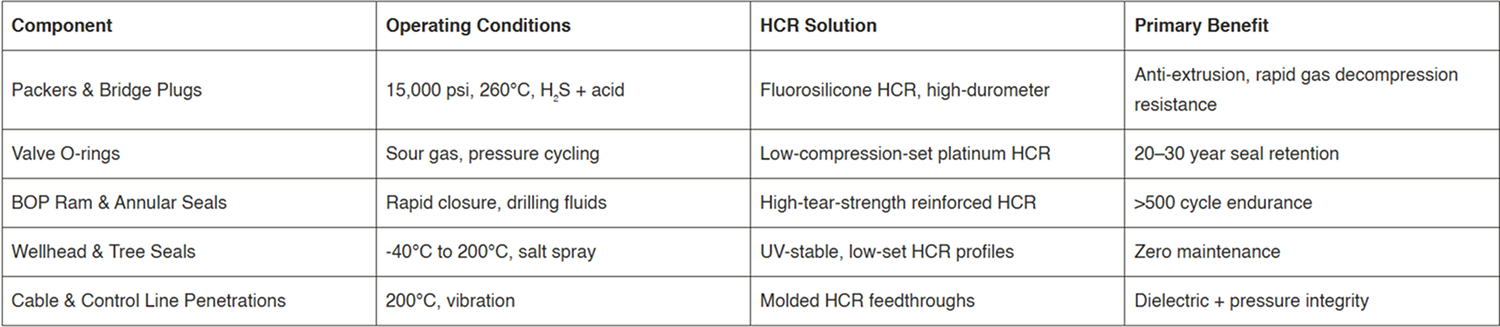
Downhole environments combine 10,000–20,000 psi, 250–300°C steam injection, H₂S partial pressures >1 psi, and mechanical shock. Standard elastomers harden, extrude, or swell rapidly. HCR and fluorosilicone HCR grades maintain integrity where alternatives fail within weeks.
DOWNHOLE APPLICATION MATRIX
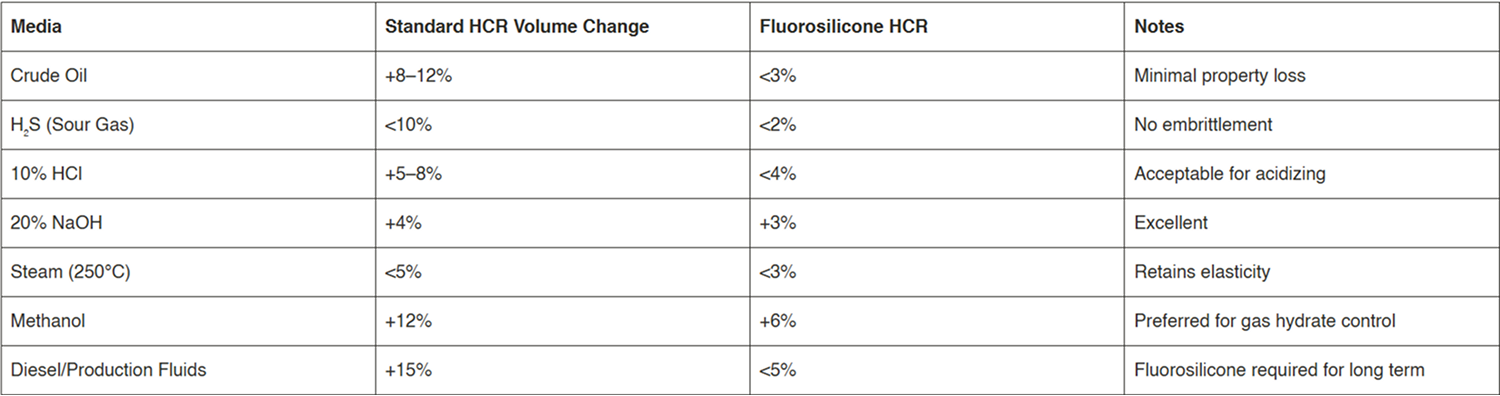
EXPANDED CHEMICAL RESISTANCE
(25°c, 30 DAYS IMMERSION)
RENEWABLE ENERGY: SOLAR, WIND, BESS, AND GEOTHERMAL
Solar installations demand 25–40 year warranties. HCR frame gaskets, junction box seals, and edge protectors resist UV, thermal cycling (ΔT 80°C daily), and humidity without chalking or cracking. EPDM typically loses 50% elasticity within 12–15 years. HCR retains >85% after 25,000 hours of QUV testing.
WIND TURBINE SEALING PERFORMANCE

Battery Energy Storage Systems (BESS) use HCR for module-to-rack gaskets, fire-resistant enclosures (UL 94 V-0, low smoke), and thermal interface compatibility. Hermetic sealing prevents moisture-induced thermal runaway while allowing off-gassing management.
Geothermal wells (200–350°C, silica-laden brines, high salinity) represent one of the harshest applications. High-temperature HCR grades with proprietary stabilizers maintain sealing force where HNBR and Viton degrade within months.
TRADITIONAL POWER GENERATION, NUCLEAR, AND HYDRO
Fossil plants use HCR for boiler penetration seals, turbine casing gaskets, flue gas ducts, and expansion joints. The material’s steam resistance and low set minimize forced outages. In nuclear facilities, radiation-tolerant HCR compounds (phenyl-siloxane modifications) qualify under IEEE 323-2014 and ASME Section III for 60–80 year plant life extensions. Containment penetration seals, valve stem packing, and electrical cable transits must survive LOCA (Loss of Coolant Accident) testing at 150°C + radiation + chemical spray.
Hydroelectric wicket gates, turbine shaft seals, and spillway gates benefit from HCR’s abrasion resistance against silt-laden water, zero biofouling tendency, and 40-year maintenance-free performance.
EXTREME TEMPERATURE PERFORMANCE
FRAMEWORK
CRYOGENIC TO HYPER-THERMAL RANGE
- LNG/Cryogenic (-162°C): Specialized low-temperature HCR grades retain flexibility and sealing force. Used in LNG loading arms, tank penetrations, and valve stems.
- Arctic Service (-60°C to +80°C): Standard HCR remains elastic where many rubbers become brittle.
- Geothermal/Steam (250–300°C): Premium grades with heat stabilizers maintain >70% elongation after 1,000 hours.
- Concentrated Solar Power (CSP): Special formulations handle heat transfer fluids at 400°C intermittent exposure.
STANDARDS, TESTING, AND REGULATORY
COMPLIANCE
CORE ENERGY SECTOR
STANDARDS TABLE
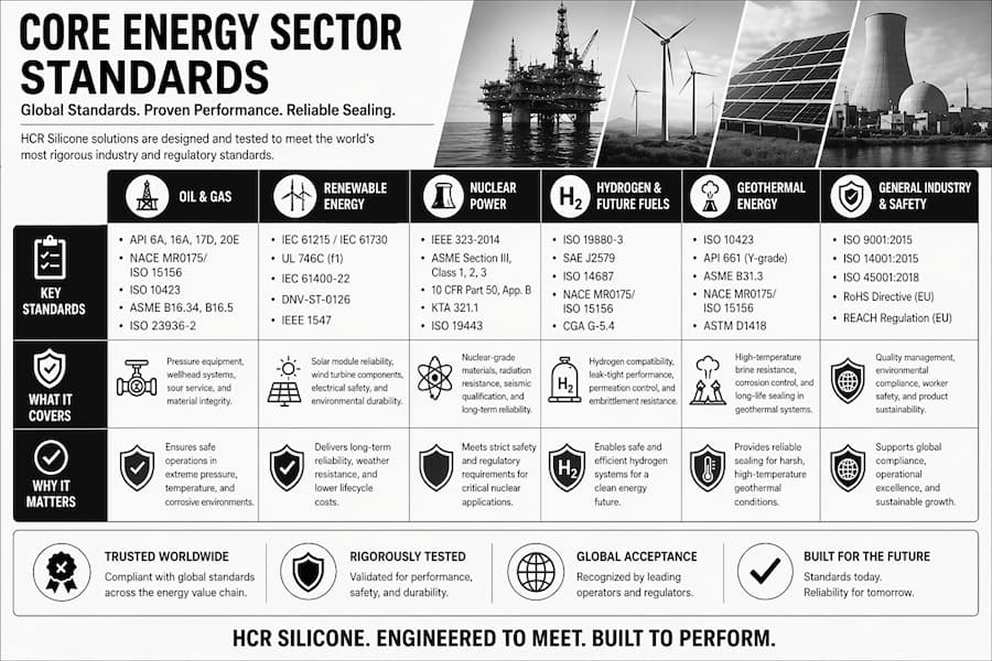
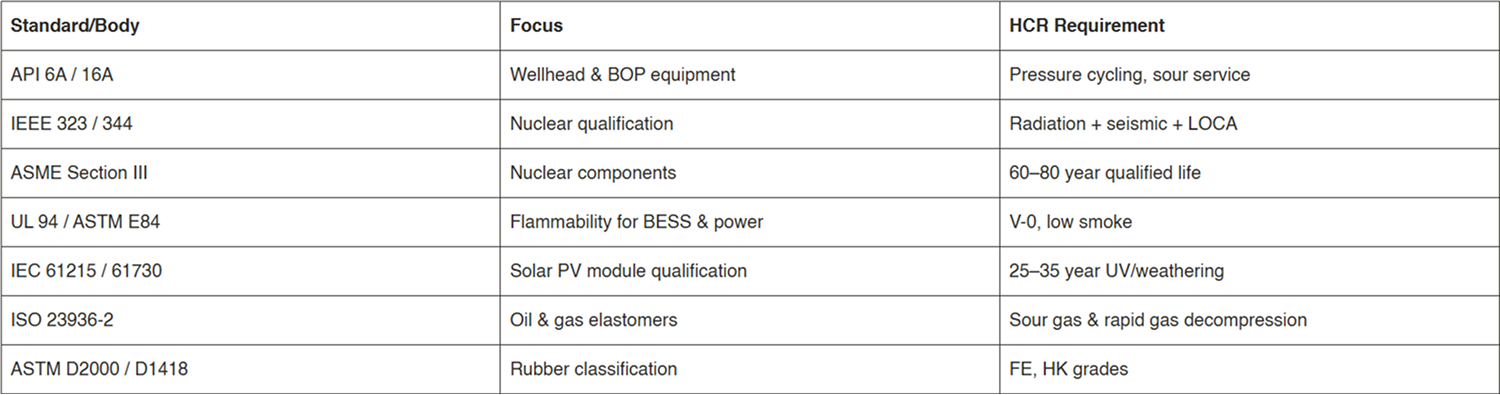
Third-party qualification, full traceability, and batch testing are mandatory for nuclear and offshore projects. Regional differences are significant: North Sea projects emphasize API/ISO with high H₂S focus; Middle East projects prioritize 300°C steam; US shale emphasizes rapid deployment and cost.
LIFECYCLE COST AND ROI MODELING
25-YEAR TCO EXAMPLE - OFFSHORE PLATFORM
WELLHEAD SEALS (200 UNITS)
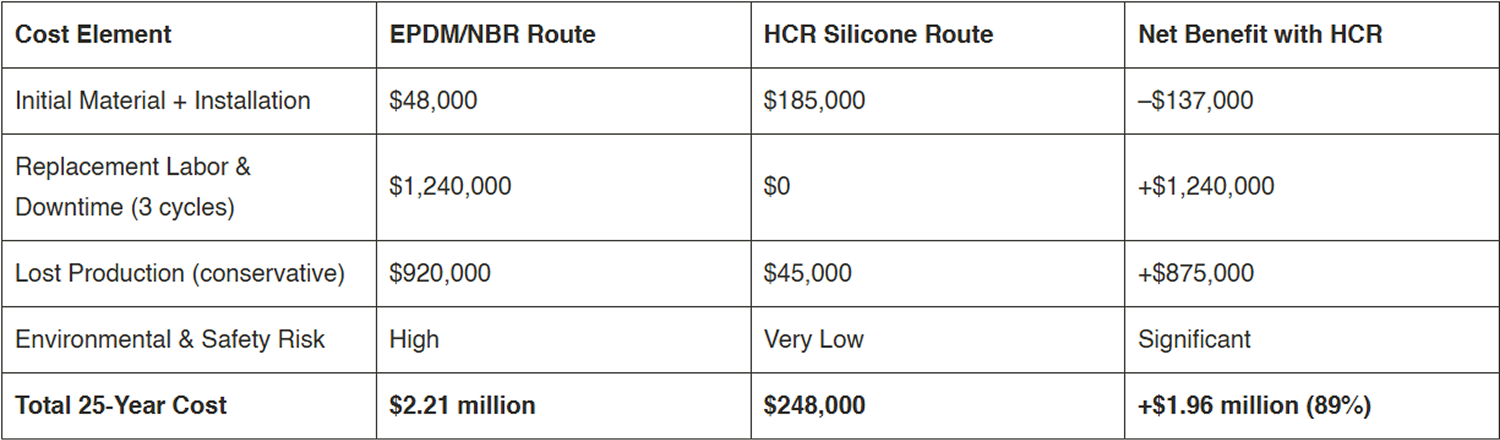
HCR breaks even within 18–36 months in critical service. Predictable aging (gradual hardening without sudden failure) enables condition-based maintenance using durometers and visual inspection rather than calendar-based replacement.
SUSTAINABILITY AND CIRCULAR ECONOMY
HCR’s longevity reduces material consumption by 60–75% over plant life. It contains no halogens or heavy metals in modern formulations. End-of-life options include mechanical grinding for reuse as filler, devulcanization, or clean energy recovery. Several suppliers now offer grades with 25–40% post-industrial recycled content qualified for energy applications. In solar farms, long-life seals support higher LCA scores for LEED, BREEAM, and Science Based Targets.
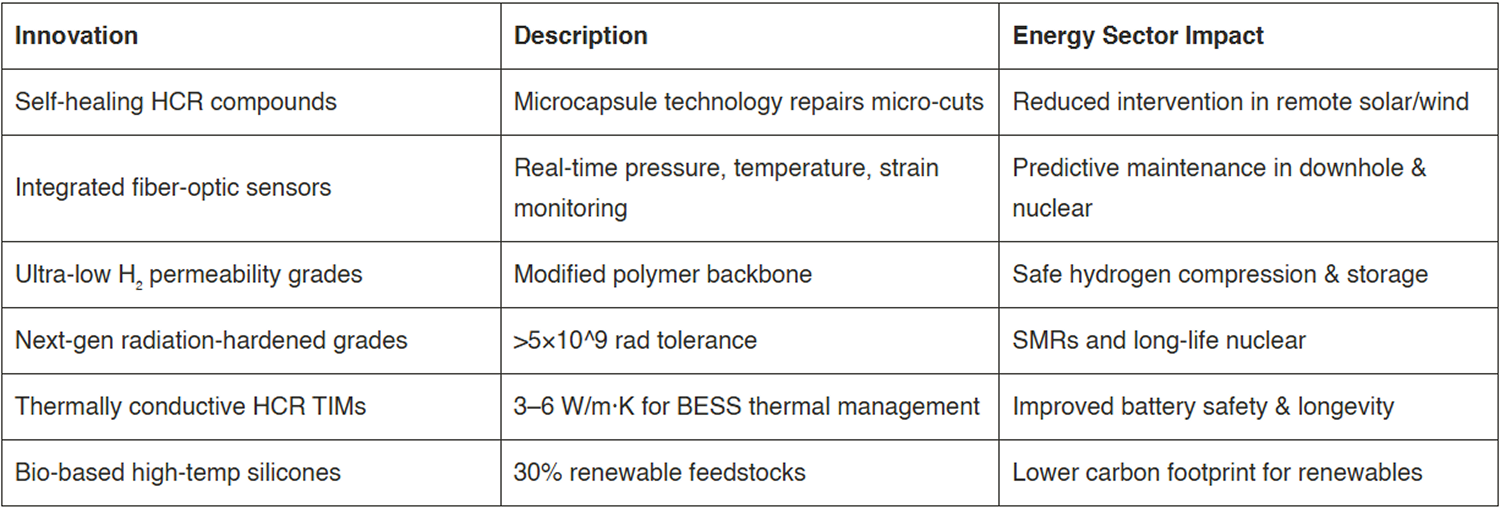
2026-2030 TECHNOLOGY TRENDS
STRATEGIC IMPLEMENTATION
ROADMAP
- Conduct full application audit (P, T, media, cycles, life target).
- Select base chemistry (standard HCR vs fluorosilicone HCR).
- Define qualification protocol (API, IEEE, IEC, or project-specific).
- Engage 2–3 qualified suppliers early (Dow, Parker, Momentive, Shin-Etsu).
- Prototype and conduct accelerated aging (pressure, temperature, chemical).
- Perform rapid gas decompression (RGD) testing where required.
- Qualify manufacturing process with full traceability (heat, batch, cure data).
- Execute third-party verification (e.g., Exova, Element Materials).
- Integrate into design standards and BIM/digital twin models.
- Train field personnel on handling and installation torque.
- Establish baseline inspection criteria and 5-year surveillance plan.
- Contract performance-based warranties tied to documented conditions.
- Plan recycling pathway at project inception.
- Capture field performance data to refine future specifications.
COMMON MISTAKES AND DECISION
FRAMEWORK
Avoid using standard consumer-grade HCR in energy service, under-specifying compression set for dynamic applications, or neglecting RGD resistance in gas wells. Use this maturity model:
- Level 1: Basic static seals in conventional power
- Level 2: Qualified HCR in solar/wind and conventional O&G
- Level 3: Radiation-hardened or 300°C geothermal with full qualification
- Level 4: Sensor-enabled, self-healing HCR in hydrogen and next-gen nuclear/SMRs
CONCLUSION
High-performance sealing in the energy sector increasingly depends on materials that can withstand extreme environments without compromising reliability. High Consistency Rubber continues to prove itself as a critical solution across oil & gas, renewable energy, nuclear, and hydrogen applications, offering unmatched durability, thermal stability, and lifecycle cost advantages. Its ability to maintain sealing integrity under high pressure, aggressive chemicals, and long service intervals makes it a strategic material choice for forward-looking infrastructure projects.
At Flexion, we specialise in engineering advanced silicone solutions tailored to demanding industrial applications, with a strong focus on High Consistency Rubber technologies. Our expertise lies in delivering custom-formulated compounds, precision-molded components, and application-specific sealing systems that meet stringent global standards across energy, aerospace, and advanced manufacturing sectors. By combining material science innovation with real-world engineering support, Flexion helps clients achieve long-term reliability, reduced maintenance, and optimised performance in even the harshest environments.
how we help you decide
We assess your operating fluids, temperature profile, sealing dynamics, and cost targets, then recommend fluorosilicone or alternatives where appropriate. If abrasion, dynamic motion, or strict cost caps are dominant constraints, we document why another elastomer may be better and outline the tradeoffs.
Request a Proposal or Book a Discovery Call to get a tailored materials recommendation.
book a
discovery call