
HCR SILICONE FOR AEROSPACE
APPLICATIONS 2026: COMPLETE TECHNICAL
GUIDE WITH FAA COMPLIANCE AND HIGH-
ALTITUDE SEALING SOLUTIONS

WHAT IS HCR AND HOW IS IT NORMALLY USED?
HCR, or High Consistency Rubber, is a solid-form silicone material known for its strength, durability, and ability to perform in both high and low temperatures. It is commonly used to make seals, gaskets, O-rings, insulation parts, tubing, and vibration-dampening components across industries such as aerospace, automotive, medical, electronics, and industrial manufacturing, especially where long-term reliability and resistance to heat, weather, and mechanical stress are important.
High Consistency Rubber (HCR) silicone has become an indispensable material in modern aerospace engineering, offering unmatched performance in extreme environments where failure is not an option. From commercial airliners cruising at 35,000 feet to spacecraft venturing beyond Earth’s atmosphere, HCR silicone components provide critical sealing, insulation, and vibration control functions that ensure passenger safety and mission success.
The aerospace industry demands materials that withstand temperature extremes from -50°C to +300°C (as noted by suppliers like Elkem and Dow), resist degradation from UV radiation and ozone at high altitudes, and maintain elastic properties under intense vibration and pressure differentials. HCR silicone meets these requirements while offering superior tear strength and durability compared to alternative elastomers, making it the material of choice for applications where long-term reliability is paramount.
This comprehensive guide examines HCR silicone’s role in aerospace applications, exploring specific use cases from engine seals to cabin pressure systems, comparing HCR with Liquid Silicone Rubber (LSR) for aviation use, and detailing regulatory compliance requirements including FAA standards and MIL-SPEC certifications.

WHY HCR SILICONE
EXCELS IN
AEROSPACE
ENVIRONMENTS
TEMPERATURE EXTREMES: FROM
ARCTIC COLD TO ENGINE HEAT
Aerospace applications subject materials to demanding thermal conditions. HCR silicone maintains elastic properties across -50°C to +300°C (Elkem and Momentive data sheets confirm this broad range, with some grades extending to -120°C low or +315°C short-term peaks), ensuring reliable performance in cabin door sealing at cruising altitude or engine insulation during takeoff.
At high altitudes, temperatures can drop to -56°C, causing conventional elastomers to become brittle. HCR silicone’s silicon-oxygen backbone provides inherent low-temperature flexibility, preventing seal failure (Dow SILASTIC grades highlight this advantage over carbon-based rubbers).
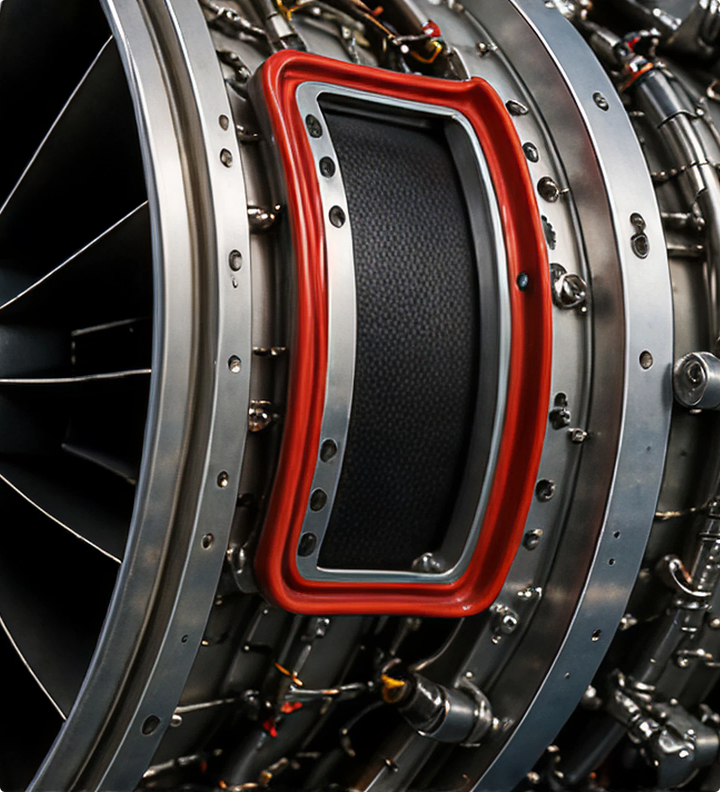
Engine compartments generate sustained temperatures over 200°C, with peaks to 300°C. HCR silicone’s thermal stability prevents hardening, cracking, and compression set common in nitrile or neoprene, extending service life significantly in hot zones.

UV AND RADIATION RESISTANCE FOR
HIGH-ALTITUDE PERFORMANCE
At 30,000–40,000 feet, components face elevated UV radiation, cosmic rays, and ozone. HCR silicone demonstrates exceptional resistance to UV degradation, ozone attack, and ionizing radiation (Wacker Chemie and Shin-Etsu emphasize superior photo-oxidative stability).
This resistance is critical for exterior seals, grommets, and insulation exposed to solar radiation. Unlike EPDM or natural rubber, which crack after prolonged exposure, HCR silicone maintains properties for decades, reducing maintenance (NASA reports confirm suitability for spacecraft external seals resisting atomic oxygen in low Earth orbit).
VIBRATION DAMPENING AND NOISE
REDUCTION
Aircraft generate significant vibration from engines, APUs, and aerodynamics, risking fatigue and passenger discomfort. HCR silicone’s viscoelastic properties excel in vibration isolation mounts, bushings, and dampeners (Parker Hannifin and Lord Corporation solutions highlight broad frequency absorption from 10 Hz to 10,000 Hz).
It protects avionics, reduces structural fatigue, and improves cabin comfort. Unlike rigid mounts, HCR silicone maintains performance across flight temperatures. Cabin noise reduction benefits from HCR gaskets and seals that block engine/airflow transmission (Airbus engineering notes contribute to quiet cabins).
KEY AEROSPACE
APPLICATIONS FOR
HCR SILICONE
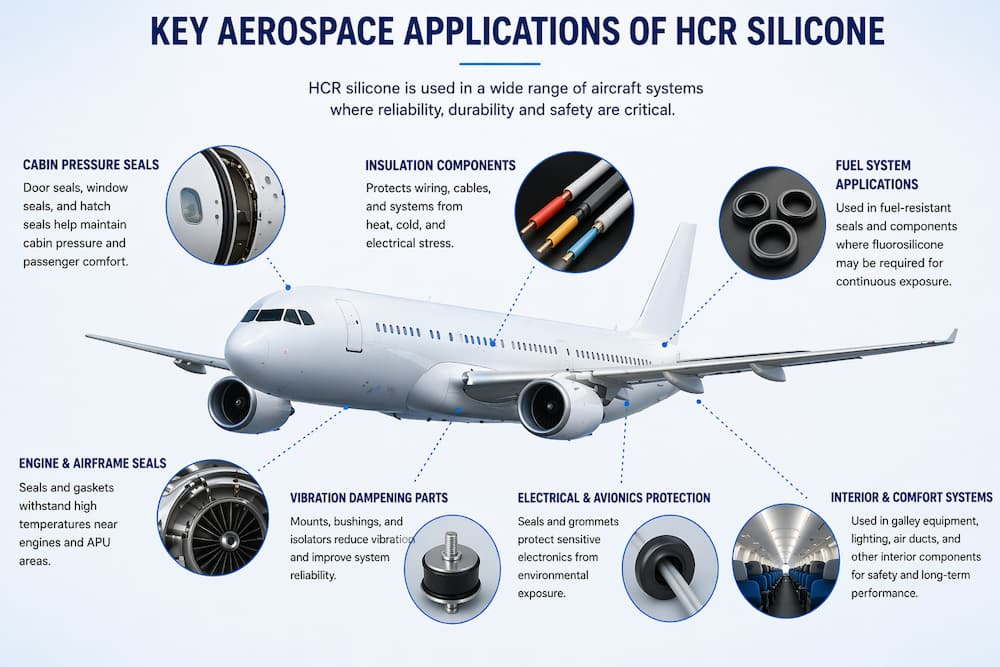
ENGIINE SEALS AND GASKETS
Aircraft engines combine extreme temperatures, chemicals, and stress. HCR silicone seals perform in turbine oil systems and combustion chambers (GE Aviation and Rolls-Royce materials highlight resistance to synthetic lubricants at >200°C).
Low compression sets maintain sealing force after thermal cycles, preventing leaks. Combustion gaskets accommodate expansion differentials between metals at 300°C peaks while retaining elasticity.
CABIN PRESSURE SEALS
Cabin pressure maintenance relies on reliable door, window, and bulkhead seals. HCR silicone provides elasticity across thousands of cycles (Boeing and Airbus designs note accommodation of deformation with minimal permanent set).
Window seals handle 80°C+ differentials between interior and exterior surfaces.
VIBRATION ISOLATION MOUNTS
Engine mounts, avionics racks, and equipment use HCR isolators to absorb vibrations (Hutchinson Aerospace and UTC systems emphasize consistent performance from ground to cruise).
ELECTRICAL INSULATION COMPONENTS
HCR silicone offers excellent dielectric properties for wire insulation, connector seals, and grommets (TE Connectivity notes resistance to fluids and self-extinguishing per FAA requirements).
Conductive grades provide EMI shielding while sealing against moisture.
FUEL SYSTEM COMPONENTS
While fluorosilicone dominates continuous fuel contact (per MIL-DTL-25988 for FVMQ), HCR silicone suits intermittent exposure in tank sealants, access panels, and vents (Safran and Eaton note enhanced formulations for vapor resistance).

HCR VS LSR: SELECTING THE RIGHT SILICONE
FOR AEROSPACE APPLICATIONS
HCR and LSR differ in processing and suitability (Stockwell Elastomerics and Simtec comparisons show HCR’s advantages in tear strength and compression set).
PROCESSING DIFFERENCES AND MANUFACTURING CONSIDERATIONS
HCR is high-viscosity, putty-like, processed via mills, extruders, and compression molding which is ideal for low-to-medium volumes and custom additives
(Trelleborg notes versatility).
LSR is low-viscosity, two-part, injection-molded for high-volume, precise parts.
APPLICATION SUITABILITY COMPARISON
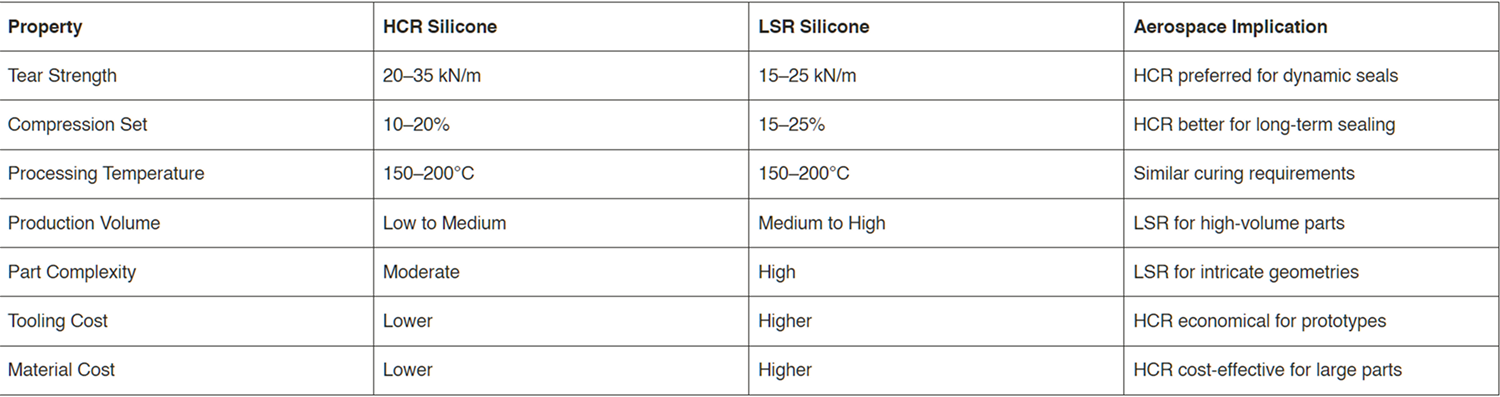
HCR suits larger components and lower volumes economically (Smithers Rapra market insights).
REGULATORY COMPLIANCE: FAA REQUIREMENTS AND MIL-SPEC STANDARDS
FAA CERTIFICATION REQUIREMENTS
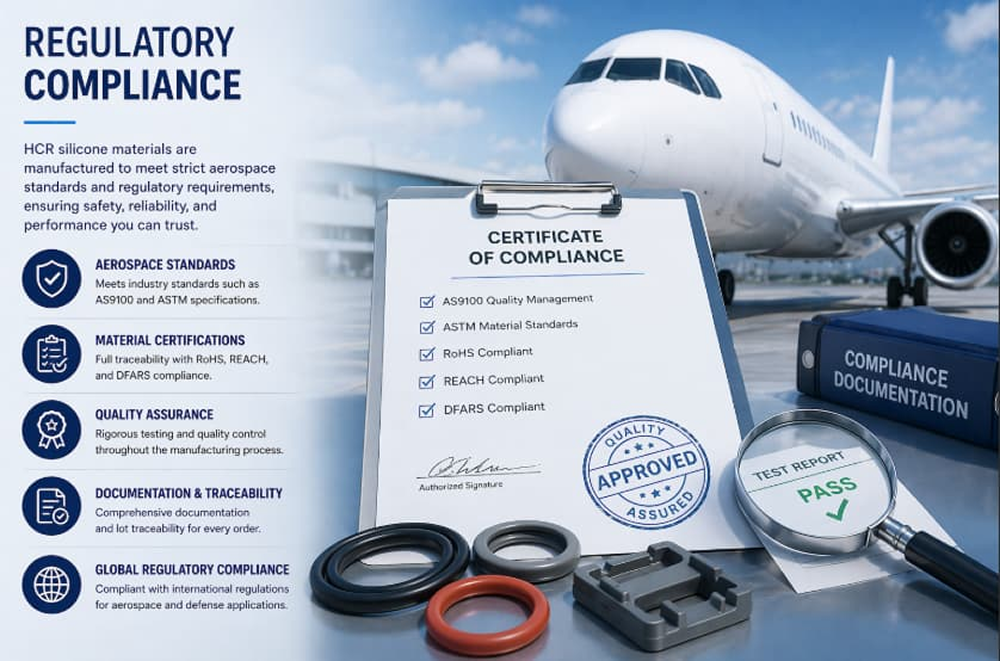
Components must meet FAA airworthiness standards. HCR silicone passes flammability per AC 25.853 (vertical burn, smoke, toxicity for interiors) and extensive qualification testing (FAA and EASA memoranda require aging, fluid compatibility, and mechanical validation).
MIL-SPEC STANDARDS FOR MILITARY
APPLICATIONS
Military use follows MIL-DTL-25988 for fluorosilicone (oil/fuel-resistant sheets, parts; not ideal for all lubricants) and MIL-PRF-83461 for O-rings (phosphate ester compatibility). HCR formulations meet these requirements for a defence aircraft.
CERTIFICATION PROCESSES AND
DOCUMENTATION
Qualification spans 12–24 months: material characterization, component testing, system integration (Boeing/Airbus processes emphasize traceability and Nadcap accreditation).
MATERIAL SELECTION
CRITERIA FOR
AEROSPACE
ENGINEERS
- Temperature/Environmental: Standard grades -50°C to +200°C; high-temp to +300°C; phenyl-modified for <-60°C (Momentive low-temp formulations).
- Mechanical: 40–60 Shore A hardness; 7–12 MPa tensile; 200–400% elongation; <15% compression set at 150°C (ASTM standards guide).
- Supplier: Require AS9100, Nadcap, lot traceability (SAE and PRI oversight).

CONCLUSION
HCR silicone continues to play a critical role in aerospace applications where temperature resistance, durability, sealing performance, and long-term reliability all matter. For projects that also require stronger fuel, oil, and chemical resistance, working with an experienced material partner becomes even more important.
At Flexion, we provide engineering-driven silicone manufacturing support across Thailand and Vietnam, helping customers develop custom parts for demanding industrial and technical applications with a strong focus on compliance, quality, and manufacturability. For companies evaluating advanced elastomers for aerospace, fuel-system, or harsh-environment sealing, Flexion is a trusted Fluorosilicone Manufacturer that can help turn material requirements into production-ready components.
how we help you decide
We assess your operating fluids, temperature profile, sealing dynamics, and cost targets, then recommend fluorosilicone or alternatives where appropriate. If abrasion, dynamic motion, or strict cost caps are dominant constraints, we document why another elastomer may be better and outline the tradeoffs.
Request a Proposal or Book a Discovery Call to get a tailored materials recommendation.
book a
discovery call